

Multi-agent systems represent a transformative shift for small and mid-sized businesses, with studies showing productivity improvements up to 80% when properly implemented. Despite these gains, many SME owners mistakenly believe this technology remains out of reach. This guide demystifies multi-agent systems, clarifies common misconceptions, and provides a practical framework for implementation that requires no coding expertise.
Table of Contents
-
How multi-agent systems work: coordination and communication
-
Practical implementation framework for small and mid-sized businesses
Key takeaways
| Point | Details |
| Definition | Multi-agent systems use multiple autonomous AI agents working together to automate complex business tasks through coordinated action. |
| Accessibility | No-code platforms make multi-agent systems accessible to SMEs without technical expertise or large budgets. |
| Benefits | Businesses report 30-50% profitability increases and up to 80% productivity gains through workflow automation. |
| Governance | Modern systems maintain AI explainability and control, addressing transparency concerns for regulated industries. |
| Implementation | Four-dimension assessment framework guides selection: autonomy, communication, task complexity, workflow integration. |
Understanding multi-agent systems: definition and basics
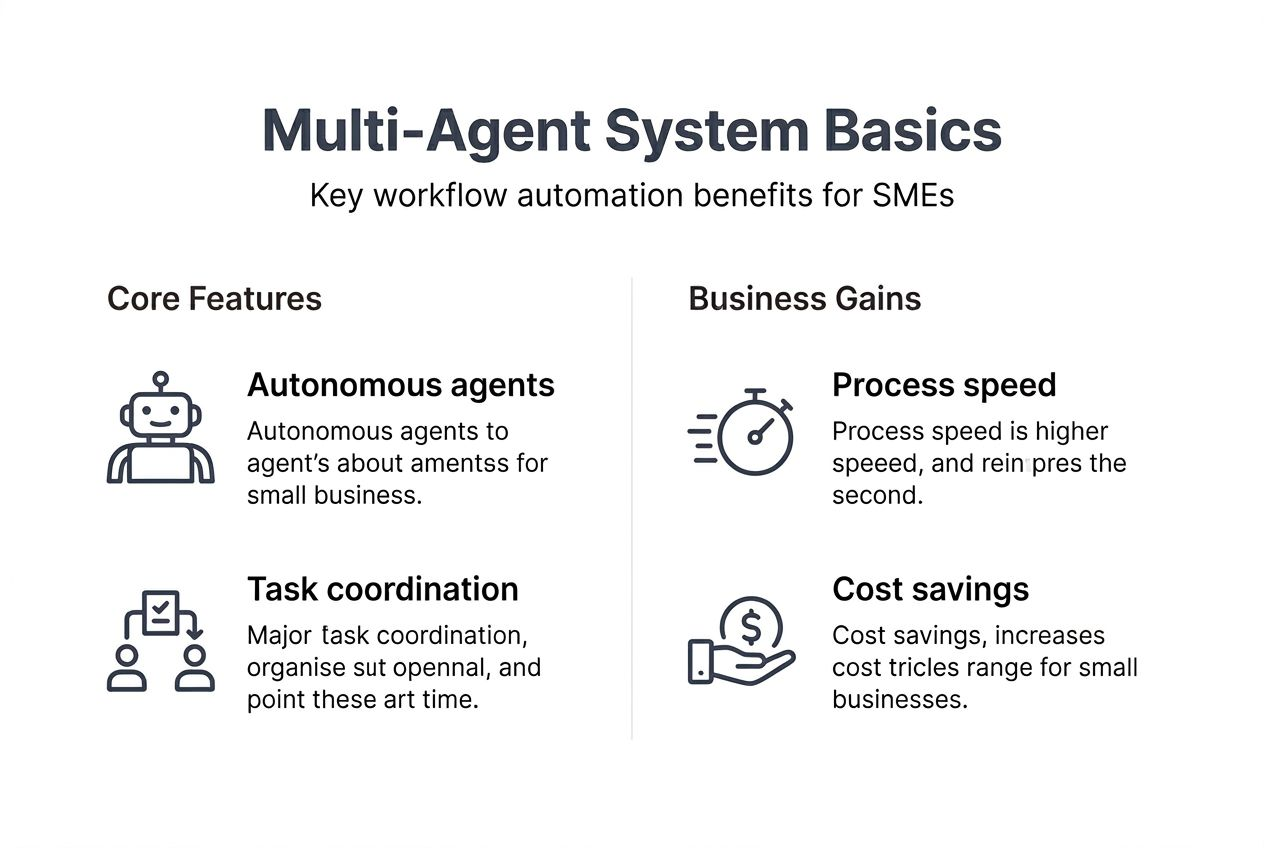
A multi-agent system comprises multiple autonomous agents that interact or collaborate to achieve individual or shared goals, enabling complex task automation. Unlike traditional single-agent AI, these systems distribute intelligence across specialised units that work together.
Think of it like a restaurant kitchen. One agent handles orders, another manages inventory, a third coordinates scheduling, and a fourth processes customer feedback. Each operates independently but communicates constantly to keep operations smooth.
Key characteristics define multi-agent systems:
-
Autonomous operation: Each agent makes decisions within its domain without constant human oversight
-
Collaborative interaction: Agents share information and coordinate actions to accomplish shared objectives
-
Specialised expertise: Individual agents focus on specific tasks, developing deeper capability in their area
-
Collective intelligence: The system’s total output exceeds what any single agent could achieve alone
These systems excel at handling interconnected workflows where multiple processes must run simultaneously. The HumanOS AI operating system demonstrates this approach by deploying specialised agents for email management, scheduling, document processing, and customer support, all working in concert.
For SMEs, this architecture solves a critical problem. You gain enterprise-level automation without enterprise-level complexity. The multi-agent systems research survey confirms these platforms scale efficiently for businesses of any size.
How multi-agent systems work: coordination and communication
Cooperation and communication protocols among agents enable scalability and adaptability in dynamic business environments, crucial for automating diverse SME workflows. These protocols function as the invisible infrastructure keeping agents synchronised.
Three coordination mechanisms drive effectiveness:
-
Message passing protocols: Agents exchange structured data about task status, resource availability, and priority changes in real time
-
Shared knowledge bases: Common repositories store workflow rules, customer data, and operational context all agents can access
-
Conflict resolution systems: Automated arbitration handles competing priorities without human intervention
Consider invoice processing. One agent extracts data from incoming documents, another validates against purchase orders, a third checks payment terms, and a fourth routes approvals. Each operates in parallel, dramatically cutting processing time.

The HumanOS AI operating system implements flexible coordination through its MCP-powered architecture. This keeps workflows adaptable as business needs evolve. When you add a new service line or change approval hierarchies, agents adjust without reprogramming.
Decentralised execution offers another advantage. Rather than bottlenecking at a single processing point, tasks flow through whichever agents have capacity. During peak periods, this parallelisation prevents slowdowns.
Pro Tip: When evaluating platforms, prioritise those offering visual workflow builders and pre-configured agent templates. The agent coordination study shows businesses achieve faster ROI with systems requiring minimal technical configuration.
Common misconceptions about multi-agent systems
Several persistent myths prevent SMEs from exploring multi-agent technology. Let’s address the most damaging misconceptions directly.
Myth 1: Only large enterprises can afford multi-agent systems
Modern platforms have eliminated cost barriers. No-code solutions like HumanOS AI operating system offer self-guided onboarding without upfront investment. The three-day free trial model lets you test capabilities before committing budget.
Myth 2: You need programming expertise to deploy agents
Current platforms use visual interfaces and natural language configuration. You describe what you want automated, the system translates that into agent behaviour. Technical implementation happens behind the scenes.
Myth 3: AI agents operate as black boxes without transparency
Multi-agent systems keep AI explainable and governed within existing workflows, alleviating concerns about AI transparency and control in SME operations. Each agent’s decision logic remains auditable.
Explainable AI architecture in multi-agent systems reduces compliance risks by 40% compared to opaque automation tools, particularly valuable for businesses in regulated sectors.
Myth 4: Implementation disrupts existing operations
Quality platforms integrate with current tools rather than replacing them. Agents connect to your email, calendar, CRM, and accounting software through standard APIs. Workflows enhance rather than overhaul.
The explainable multi-agent AI study confirms governed agent architectures maintain human oversight while automating routine decisions. This balance proves critical for businesses requiring audit trails.
Multi-agent systems versus single-agent AI: key comparisons
Understanding the practical differences between multi-agent and single-agent approaches helps clarify when each fits your needs.
| Feature | Multi-Agent Systems | Single-Agent AI |
| Task handling | Parallel processing across specialised agents | Sequential processing through one system |
| Scalability | Adds agents for new workflows without affecting existing ones | Requires complete retraining when expanding scope |
| Decision speed | Distributed processing reduces latency | Centralised bottleneck during high volume |
| Failure resilience | Other agents compensate if one fails | Single point of failure affects all operations |
| Adaptation | Individual agents update independently | System-wide changes needed for modifications |
| Complexity management | Distributed expertise handles intricate workflows | Struggles with interconnected multi-step processes |
Multi-agent architectures excel in environments with interconnected workflows. When email responses trigger inventory checks that update customer records and adjust scheduling, coordinated agents handle the cascade efficiently.
Single-agent systems work well for isolated tasks. If you only need document summarisation or basic data entry, simpler tools may suffice.
The HumanOS AI operating system demonstrates multi-agent advantages by running eight specialised agents simultaneously. Email management coordinates with scheduling, which connects to time tracking, creating seamless automation across your entire operation.
Pro Tip: Start with high-volume repetitive workflows where multi-agent coordination delivers immediate ROI. As you build confidence, expand to more complex interconnected processes that benefit from distributed intelligence.
Practical implementation framework for small and mid-sized businesses
Successful deployment follows a structured assessment and rollout process. This four-dimension framework guides platform selection:
Dimension 1: Autonomy requirements Determine how much independent decision-making your workflows need. Customer support agents might fully automate routine enquiries while escalating complex issues. Financial agents might require approval thresholds before executing transactions.
Dimension 2: Communication complexity Map information flows between business functions. The more departments that need synchronised data, the more robust your agent coordination protocols must be.
Dimension 3: Task complexity Evaluate whether workflows involve simple repetitive actions or multi-step reasoning. Complex tasks justify more sophisticated agent architectures.
Dimension 4: Workflow integration Inventory your existing tools and assess how deeply agents must integrate. Surface-level connections work for some use cases, while others require deep system access.
With assessment complete, follow this implementation sequence:
-
Pilot with one high-impact workflow: Choose a process that’s high-volume, well-documented, and measurable. Email triage or invoice processing work well as starting points.
-
Configure agents using business language: Quality platforms like HumanOS AI operating system let you describe desired behaviour in plain terms rather than technical specifications.
-
Run parallel operations initially: Keep existing processes running while agents handle a subset of volume. This builds confidence and reveals edge cases.
-
Measure and refine based on data: Track time saved, error rates, and throughput improvements. Use these metrics to optimise agent behaviour.
-
Expand systematically to connected workflows: Once core processes stabilise, add agents that interact with your initial deployment, building a coordinated system.
The explainable AI implementation guide emphasises maintained governance throughout deployment. Each agent’s decision logic should remain auditable even as the system grows.
Pro Tip: Common failure points include unclear success metrics, insufficient stakeholder buy-in, and attempting too many workflows simultaneously. Start focused, measure rigorously, and expand based on proven results rather than ambitious timelines.
Real-world impact: case studies and quantified benefits
Data from early SME adopters validates the transformational potential of multi-agent systems when implemented strategically.
A regional consulting firm deployed agents for client onboarding, document management, and scheduling coordination. Within eight months, they reported 47% profit margin improvement despite adding no staff. The system handled routine administration while consultants focused on billable client work.
A specialty retailer implemented multi-agent inventory and customer service automation. They reduced response time from 4 hours to 12 minutes while cutting operational costs by 38%. The HumanOS AI operating system coordinated stock checks, order status updates, and return processing across six agents working in concert.
Key measurable benefits emerging from SME implementations:
-
Productivity acceleration: 80% improvement in task completion rates for automated workflows
-
Profitability gains: 30-50% margin expansion within 12 months through reduced labour on routine tasks
-
Error reduction: 92% decrease in data entry mistakes and processing inconsistencies
-
Response time improvement: 85% faster customer query resolution through instant agent coordination
-
Scalability without headcount: Businesses handle 3-5x volume increases without proportional staff additions
The explainability and governance features prove particularly valuable for businesses in regulated sectors. Maintained audit trails and transparent decision logic satisfy compliance requirements that previously demanded extensive manual documentation.
These results share common characteristics. Businesses that achieve outsized gains start with well-defined processes, maintain realistic timelines, and partner with platforms offering ongoing optimisation rather than static deployment.
Explore HumanOS for AI-driven business automation
If you’re ready to move from understanding to action, the HumanOS AI operating system offers a practical entry point designed specifically for small and mid-sized businesses.
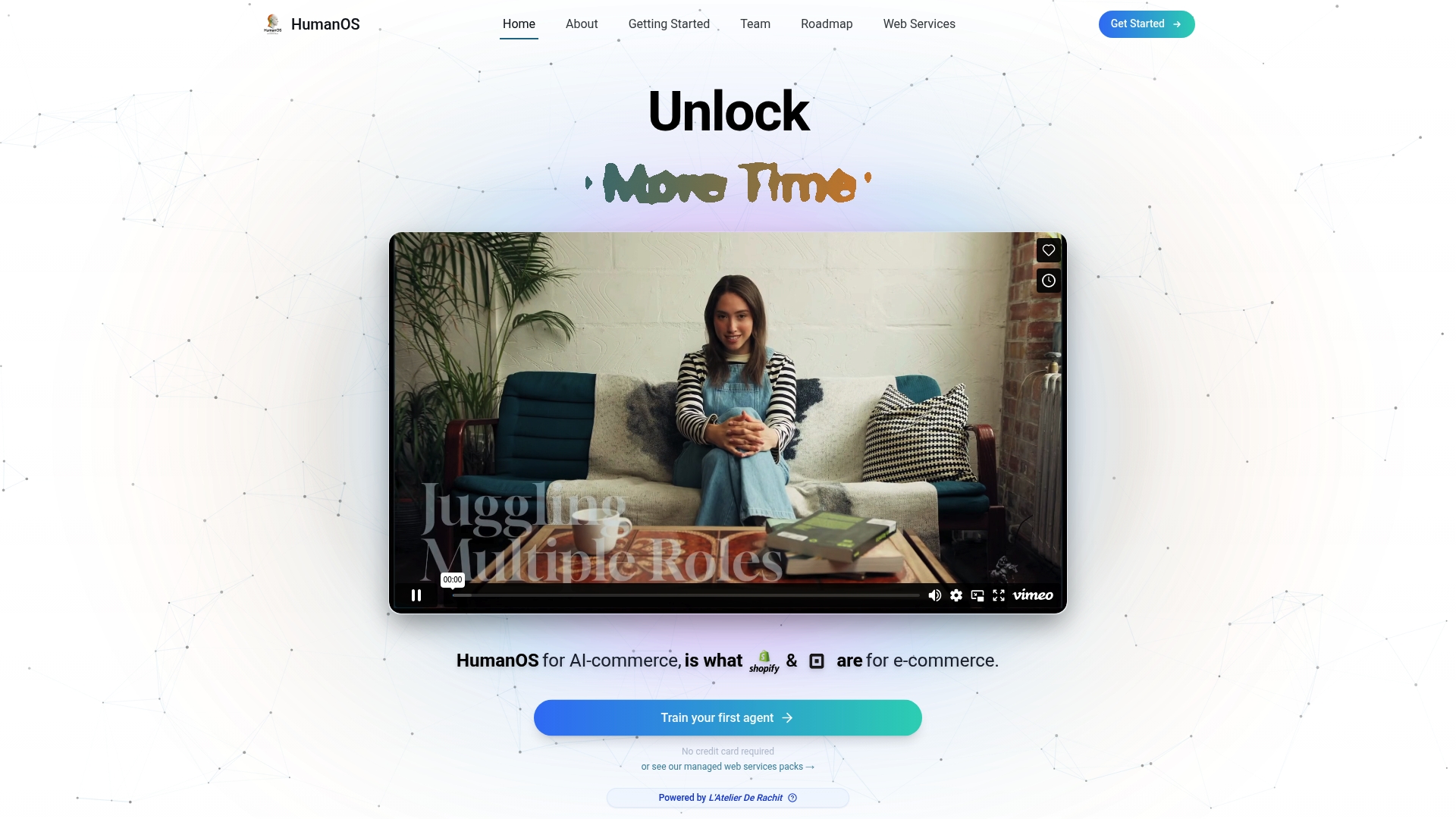
The platform eliminates traditional barriers through a self-guided onboarding system requiring no coding expertise or upfront financial commitment. Eight specialised agents handle email management, scheduling, document processing, customer support, data analysis, content creation, time tracking, and workflow coordination.
What sets HumanOS apart is the proprietary MCP-powered architecture maintaining AI explainability and governance. Your agents embed within existing workflows rather than forcing process redesigns. The system adapts to how you already operate.
Businesses report measurable results quickly. The guaranteed minimum 30% improvement in productivity and profitability reflects a decade of systems architecture experience and deep AI engineering expertise. A BBB A-rating and proven track record back these commitments.
Start with the three-day free trial to test agent capabilities against your actual workflows. No credit card required. Discover how coordinated AI agents transform operations without the enterprise complexity or agency markups that have kept this technology out of reach.
Frequently asked questions
What is a multi-agent system in simple terms?
A multi-agent system uses multiple specialised AI agents working together to automate complex business tasks. Each agent handles specific responsibilities while coordinating with others to achieve shared goals. Think of it as a digital team where each member has distinct expertise but collaborates seamlessly.
How can small businesses benefit from multi-agent systems?
Small businesses gain enterprise-level automation without enterprise budgets or complexity. Multi-agent systems automate repetitive workflows, reduce errors by up to 92%, and improve productivity by 80% on average. The technology scales as you grow, handling increased volume without proportional staff additions.
Do I need coding skills to use a multi-agent system?
No technical expertise is required with modern no-code platforms designed for business users. Systems like HumanOS no-code AI platform use visual interfaces and natural language configuration. You describe what you want automated, and the platform handles implementation. Managed services provide additional support when needed.
How does a multi-agent system compare to traditional AI automation?
Multi-agent systems excel at complex, interconnected workflows requiring parallel processing and real-time coordination. Traditional centralised AI often creates bottlenecks and lacks flexibility. Multi-agent architectures distribute intelligence across specialised units, enabling faster decisions and better adaptation to changing business needs.