

Many business owners believe AI can completely replace human support agents, but this misconception overlooks the nuanced reality of customer service automation. AI excels at specific tasks while struggling with others, and implementation quality matters more than the technology itself. Understanding where AI adds value and where human oversight remains essential helps you deploy automation that genuinely improves efficiency without sacrificing service quality or customer trust.
Table of Contents
- Understanding AI's Role In Customer Support
- Common Challenges And Misconceptions With AI Customer Support
- Hybrid AI Architectures For Effective Customer Support
- Best Practices To Successfully Implement AI In Customer Support
- Enhance Your Customer Support With HumanOS
- FAQ
Key takeaways
| Point | Details | |-------|---------|| | AI chatbots reduce workload | AI-powered chatbots significantly cut staff workload and improve response speed in small businesses. | | Implementation drives ROI | Only 25% of AI projects meet ROI expectations due to implementation issues, not technology limits. | | Hybrid systems outperform | Combining rule engines with AI agents balances speed, compliance, and adaptability efficiently. | | Human oversight remains critical | Prioritising efficiency over quality in AI customer service leads to negative outcomes and lost trust. | | Gradual deployment succeeds | Starting with repetitive tasks and maintaining human escalation paths ensures quality outcomes. |
Understanding AI's role in customer support
AI chatbots handle repetitive queries rapidly, freeing your staff to focus on complex issues that require empathy and judgment. This shift transforms customer service from a reactive cost centre into a strategic advantage. When AI-powered chatbots significantly reduce staff workload and improve response speed, micro-enterprises see measurable gains in customer satisfaction without hiring additional agents.
The reduction in workload translates directly to faster response times. Customers receive instant answers to common questions about order status, return policies, or account access. Your team handles fewer routine enquiries, allowing them to invest energy in high-value interactions that build loyalty and drive repeat business.
AI learns from interaction data to improve over time, adapting to shifts in user intent and query patterns. Machine learning models identify emerging question types and refine response accuracy continuously. Small to mid-sized businesses achieve operational improvements by deploying AI that evolves alongside their customer base, capturing institutional knowledge that might otherwise disappear when employees leave.
Regular system updates and human oversight amplify these outcomes. Your team reviews flagged interactions, corrects misunderstandings, and feeds corrections back into training data. This feedback loop prevents AI from drifting into unhelpful patterns and ensures responses stay aligned with your brand voice and service standards.
Pro Tip: Start by automating your three most frequent customer queries. Monitor AI performance daily for the first month, adjusting response templates based on customer feedback and escalation patterns.
Small businesses often lack dedicated IT teams, making automation guide for SMBs essential reading. Cloud-based AI platforms eliminate infrastructure headaches, letting you deploy chatbots without managing servers or hiring data scientists. Focus on defining clear success metrics like first-contact resolution rate and average handling time, then track improvements monthly.
Common challenges and misconceptions with AI customer support
Implementation quality determines outcomes more than technology choice. Many AI initiatives fail to deliver expected ROI because businesses rush deployment without proper planning, training data preparation, or integration with existing systems. Choosing sophisticated AI models means nothing if your team lacks processes to monitor performance and iterate based on real customer interactions.
Replacing humans entirely risks losing the empathy and contextual understanding that complex queries demand. Customers facing billing disputes, service outages, or sensitive account issues need agents who can interpret emotion, navigate ambiguity, and exercise judgment. AI struggles with these scenarios because training data rarely captures the full spectrum of human communication nuances.
Klarna's experience illustrates this tension. The fintech company initially replaced agents with AI chatbots to cut costs, only to rehire human staff when service quality declined and customer complaints spiked. Efficiency metrics improved, but satisfaction scores dropped because the AI mishandled edge cases and failed to recognise when escalation was appropriate. The case highlights how prioritising cost over quality backfires when customer trust erodes.
"One mishandled regulatory complaint can cost more than a year of agent labour, making human oversight essential for high-risk interactions."
AI may mishandle regulatory complaints, exposing your business to fines and reputational damage. Financial services, healthcare, and telecommunications face strict compliance requirements that demand documented human decision-making. Delegating these interactions to AI without robust guardrails creates liability risks that far exceed any operational savings.
Effective AI requires balancing efficiency with service quality through deliberate design choices. Define escalation triggers clearly, ensuring AI routes complex or emotional queries to human agents automatically. Monitor customer satisfaction scores alongside efficiency metrics, treating declines as warning signals that implementation needs adjustment. Consider AI a tool that augments your team rather than a replacement that eliminates headcount.
Businesses deploying HumanOS AI operating system benefit from built-in escalation logic and compliance safeguards that prevent common pitfalls. The platform routes queries based on complexity scores, ensuring sensitive issues reach human agents while routine requests resolve instantly through automation.
Hybrid AI architectures for effective customer support
Rule engines handle well-defined compliance and routing tasks reliably, executing deterministic logic without the unpredictability of machine learning models. These systems excel at enforcing business rules like regional compliance requirements, hours-based routing, or tiered support structures. When a query matches predefined criteria, the rule engine executes the appropriate action instantly, ensuring consistency across thousands of interactions.
AI agents process ambiguous queries by interpreting natural language, inferring intent, and generating contextually appropriate responses. Unlike rule engines that require exact matches, AI agents handle variations in phrasing, spelling errors, and incomplete information. This flexibility proves essential for customer service scenarios where users rarely express needs in standardised formats.

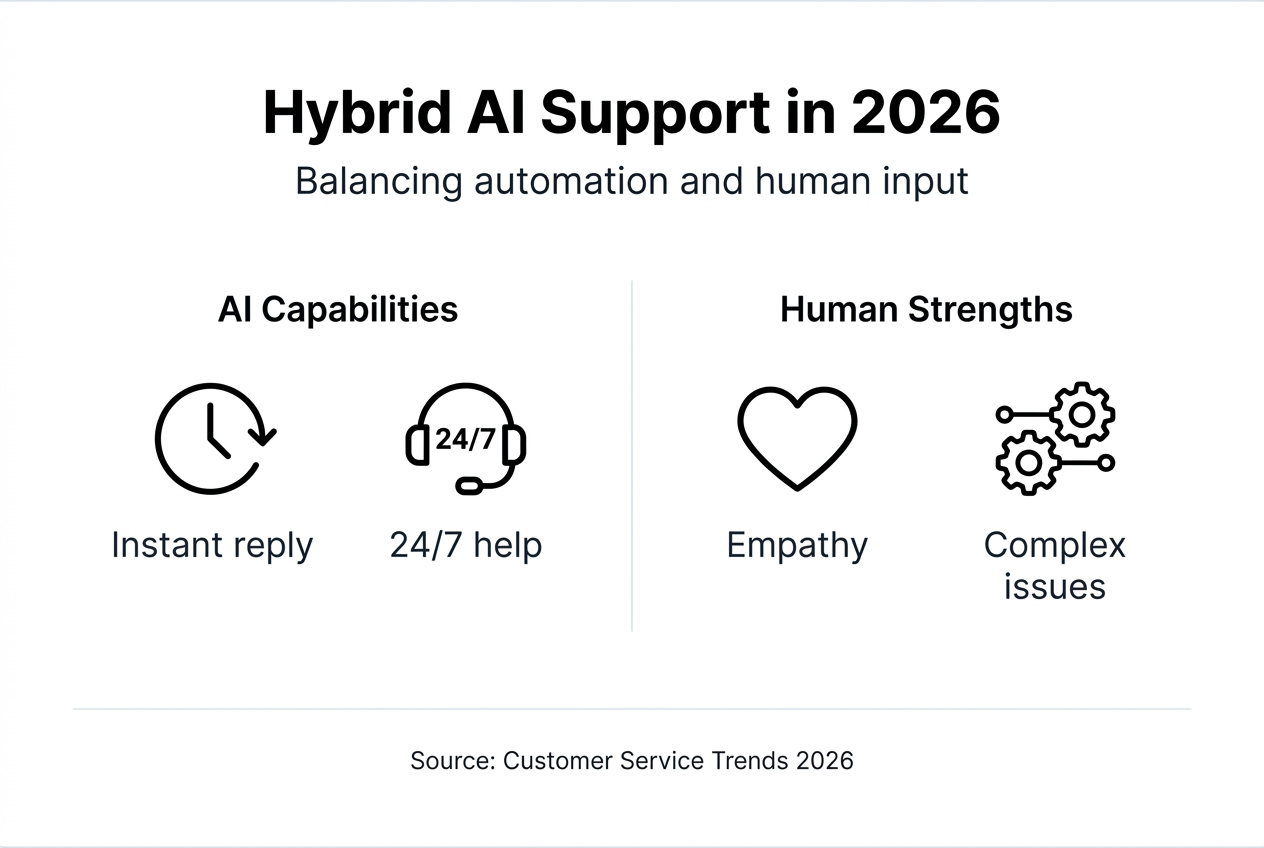
Hybrid decision-making systems combine rule engines and AI agents, enabling efficient handling of both structured and unstructured tasks. The rule engine acts as a first-pass filter, routing simple queries to templated responses while directing complex cases to AI agents or human staff. This architecture maximises throughput for routine enquiries while preserving quality for nuanced interactions.
| System Component | Best Use Cases | Performance Characteristics |
|---|---|---|
| Rule Engine | Compliance checks, routing logic, hours-based responses | 100% consistency, sub-100ms latency, zero learning required |
| AI Agent | Natural language queries, intent classification, personalised recommendations | 85-95% accuracy, 200-500ms latency, improves with training data |
| Human Agent | Complex disputes, emotional issues, regulatory complaints | Variable quality, 2-5 minute handling time, requires training |
Achieving 70% sub-500ms response time through appropriate routing remains challenging but delivers measurable customer satisfaction gains. The hybrid architecture routes approximately 70% of queries to rule engines and simple AI responses that resolve in under half a second, while directing the remaining 30% to AI agents or humans. This split optimises both speed and quality, meeting customer expectations for instant answers while preserving thoughtful handling of complex issues.
Cloud-based managed services support scalable hybrid AI implementations without requiring internal infrastructure expertise. Platforms handle model updates, infrastructure scaling, and security patches automatically, letting your team focus on refining routing logic and response quality. This managed approach reduces deployment time from months to weeks and eliminates the need for specialised AI engineering talent.
Pro Tip: Map your current support queue by complexity and volume. Route the top 60% of simple queries to rule engines, the next 25% to AI agents, and escalate the remaining 15% to human staff. Adjust these percentages monthly based on resolution rates and satisfaction scores.
Businesses exploring multi-agent system guide discover how specialised AI agents collaborate to handle complex workflows. Each agent focuses on a specific domain like billing, technical support, or account management, routing queries to the appropriate specialist automatically. This distributed architecture scales more effectively than monolithic AI systems attempting to master every support scenario simultaneously.
Best practices to successfully implement AI in customer support
-
Start with clear goals aligned to customer and business needs. Define specific metrics like first-contact resolution rate, average handling time, and customer satisfaction score before deployment. Vague objectives like "improve efficiency" lack the specificity needed to evaluate success or guide iteration.
-
Prioritise AI to handle repetitive, rule-based tasks first. Focus initial deployment on password resets, order tracking, FAQ responses, and other high-volume queries with straightforward answers. These use cases deliver quick wins that build organisational confidence while minimising risk from AI errors.
-
Maintain human oversight especially for complex or sensitive issues. Establish clear escalation triggers based on query sentiment, regulatory keywords, and customer value. Configure your AI to route edge cases to human agents automatically rather than attempting to handle every scenario autonomously.
-
Invest in quality training data and continuous model retraining. Allocate time weekly for your team to review flagged interactions, correct AI mistakes, and update response templates. Poor training data produces poor AI performance, regardless of model sophistication.
-
Monitor performance regularly and adapt system parameters as needed. Review resolution rates, escalation patterns, and customer feedback monthly. Treat declining satisfaction scores as signals to adjust routing logic, refine response templates, or increase human involvement in specific query types.
-
Plan for hybrid AI architectures to optimise costs and responsiveness. Combine rule engines for structured tasks with AI agents for ambiguous queries, ensuring each component handles workloads suited to its strengths. This approach reduces operational costs by 20-30% while maintaining service quality.
Pro Tip: Create a monthly AI performance dashboard tracking resolution rate, escalation percentage, average response time, and customer satisfaction score. Share this dashboard with your entire team to build transparency and encourage continuous improvement suggestions.
Implementing AI operating system automation streamlines deployment by providing pre-built integrations with common support platforms. These systems reduce setup time from weeks to days, letting you focus on training and optimisation rather than technical configuration. Managed platforms handle infrastructure complexity, security updates, and model versioning automatically.
Successful implementations balance enthusiasm for automation with realistic expectations about AI capabilities. Resist pressure to eliminate all human agents immediately, instead viewing AI as a tool that amplifies your team's effectiveness. Gradual deployment with continuous monitoring produces better long-term outcomes than rushed implementations that prioritise cost savings over customer experience.
Enhance your customer support with HumanOS
Deploying AI effectively requires more than choosing the right technology. You need architecture that balances automation with human judgment, infrastructure that scales without technical headaches, and expertise to guide implementation.
HumanOS integrates hybrid AI architectures specifically designed for small and mid-sized businesses, combining rule engines with AI agents to handle both routine queries and complex customer interactions efficiently. The platform deploys through a self-guided onboarding system requiring no coding, letting you automate customer support in days rather than months. Cloud-based infrastructure scales automatically as your query volume grows, eliminating capacity planning and server management.
Explore how HumanOS AI operating system delivers measurable productivity improvements backed by 10+ years of systems architecture experience. The platform's MCP-powered agent architecture keeps AI explainable and governed, embedding automation inside your existing workflows rather than forcing you to adopt new tools. Start with a 3-day free trial to experience how AI operating system automation transforms customer support efficiency, or discover the broader potential to automate with AI agents across your entire operation.
FAQ
What types of customer support tasks are best suited for AI?
AI excels at handling repetitive, rule-based queries like FAQs, order tracking, password resets, and simple troubleshooting. These tasks follow predictable patterns that AI can learn and execute consistently. AI is less effective with complex emotional issues, regulatory complaints, or situations requiring human judgment and empathy.
How can small businesses balance AI automation with human support?
Small businesses should employ AI for routine tasks while retaining humans for complex and emotional support, ensuring quality customer experiences without excessive costs. Deploy AI to handle the 60-70% of queries that follow standard patterns, escalating the remainder to human agents automatically. Hybrid systems like HumanOS AI operating system facilitate this balance through intelligent routing logic that assesses query complexity before determining the appropriate handler.
What are the risks of relying solely on AI for customer service?
Relying only on AI risks mishandling sensitive complaints, creating regulatory violations, and losing customer trust through impersonal interactions. One mishandled regulatory complaint can cost more than a year of agent labour in fines and remediation efforts. Customers frustrated by unhelpful AI responses defect to competitors, making the short-term cost savings self-defeating. Maintain human oversight for high-stakes interactions to protect both customer relationships and business liability.
How long does it take to see ROI from AI customer support implementation?
Most businesses see measurable efficiency gains within 60-90 days of deployment, with full ROI typically achieved in 6-12 months. Initial improvements appear quickly as AI handles high-volume routine queries, freeing staff for complex issues. Deeper ROI emerges gradually as you refine routing logic, expand AI capabilities, and capture institutional knowledge in training data. Rushed implementations that skip proper planning often fail to deliver returns, making careful deployment more valuable than speed.
What metrics should businesses track when implementing AI customer support?
Track first-contact resolution rate, average handling time, escalation percentage, customer satisfaction score, and cost per interaction. These metrics reveal whether AI improves efficiency without degrading service quality. Monitor escalation patterns to identify query types where AI struggles, guiding training data improvements. Compare satisfaction scores before and after AI deployment, treating declines as signals to adjust implementation rather than accepting them as inevitable trade-offs for efficiency gains.