

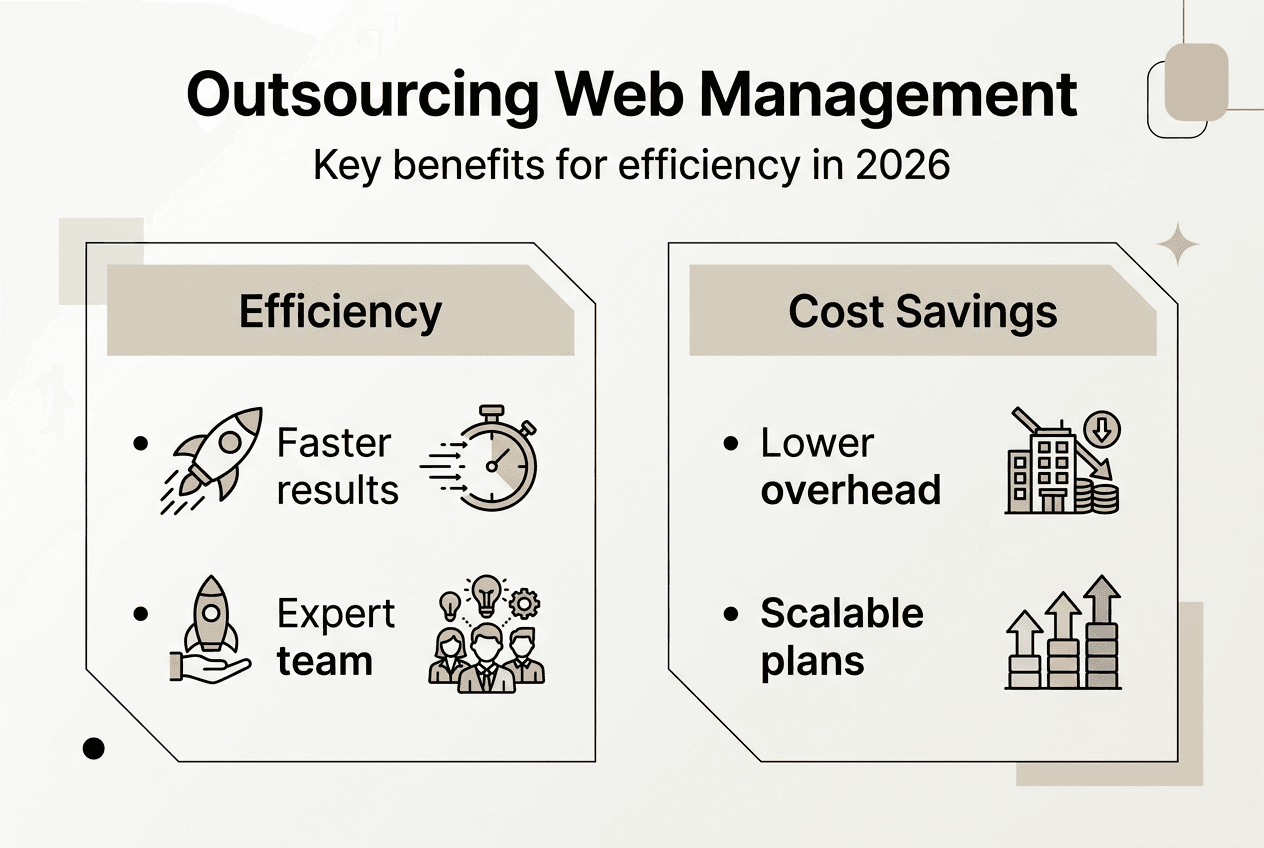
Managing your website internally might seem like the safest path, but it often drains resources and distracts from core business growth. Many business owners fear outsourcing means losing control, yet the opposite proves true when done strategically. Professional web management partners deliver up to 30% cost reductions while improving site performance, security, and conversions. This guide explores why outsourcing web management has become a strategic imperative for small and mid-sized businesses in 2026, offering flexibility, expertise, and measurable efficiency gains that in-house teams struggle to match.
Table of Contents
- The Cost And Efficiency Advantages Of Outsourcing Web Management
- Access To Expert Skills And Up-To-Date Web Technologies
- Flexibility And Scalability Through Outsourcing
- Dispelling Myths And Practical Tips For Outsourcing Success
- Explore Expert Solutions For Outsourced Web Management
- Frequently Asked Questions About Outsourcing Web Management
Key takeaways
| Point | Details |
|---|---|
| Cost reduction | Outsourcing eliminates salaries, infrastructure, and licence expenses, reducing operational costs by up to 30%. |
| Expert capabilities | Professional teams maintain current expertise in evolving web technologies, SEO, and security practices. |
| Scalable flexibility | Engagement models adjust to business needs without fixed overhead, converting costs to variable expenses. |
| Performance gains | Specialist management improves uptime, site speed, and organic traffic through proactive optimisation. |
| Risk mitigation | Clear service level agreements maintain control whilst professional security reduces breach risks. |
The cost and efficiency advantages of outsourcing web management
Running an in-house web team creates fixed costs that persist regardless of workload fluctuations. Salaries, benefits, software licences, hosting infrastructure, and training expenses compound quickly. For most small and mid-sized businesses, these costs exceed the actual value delivered, especially when technical staff spend time on routine maintenance rather than strategic initiatives.
Outsourcing reduces operational costs by up to 30% by eliminating these fixed expenses. You pay only for services consumed, converting predictable overhead into flexible variable costs. This model proves particularly valuable during seasonal fluctuations or growth phases when website needs change rapidly.
Specialist providers deliver faster, higher-quality results than newly hired in-house staff. Their teams handle dozens of client sites, encountering and solving diverse technical challenges daily. This accumulated experience translates to efficient problem-solving and proactive maintenance that prevents costly downtime. Where an in-house developer might spend hours researching a plugin conflict, experienced outsourced teams recognise patterns instantly and implement tested solutions.

The efficiency gains extend beyond technical execution. Professional capabilities include project management, quality assurance, and strategic planning that would require multiple full-time positions internally. Outsourced teams coordinate these functions seamlessly, ensuring consistent website performance without management overhead on your end.
Consider the hidden costs of DIY management:
- Emergency fixes during off-hours pulling you away from family time
- Security breaches from outdated plugins causing customer data exposure
- Lost revenue from performance issues driving visitors away
- Opportunity costs when you focus on technical tasks instead of business growth
- Knowledge gaps leading to suboptimal decisions about hosting, architecture, and optimisation
Case studies across industries demonstrate measurable returns. E-commerce businesses report conversion rate improvements of 15 to 25% after professional optimisation. Service companies see organic traffic increases of 40 to 60% within six months of implementing expert SEO strategies. These gains far exceed the cost of outsourcing, creating positive return on investment that compounds over time.
Pro Tip: Calculate your true in-house web management costs by tracking time spent on website tasks, including opportunity costs of what else you could accomplish. Compare this total against outsourcing quotes to reveal actual savings potential. Most business owners underestimate their real costs by 50% or more.
The HumanOS AI operating system exemplifies this efficiency model, combining automated operations with expert web services to deliver measurable productivity improvements. By eliminating routine technical burdens, you reclaim time for strategic activities that actually grow your business.
Access to expert skills and up-to-date web technologies
Web technology evolves at a pace that makes continuous learning essential. Content management systems release major updates quarterly. Search engine algorithms change hundreds of times annually. Security vulnerabilities emerge constantly, requiring immediate patches. Plugin compatibility issues multiply as ecosystems expand. Keeping pace with these changes whilst running a business proves nearly impossible for in-house generalists.
Outsourced teams stay current on web technologies, CMS frameworks, and search engine algorithms through dedicated professional development. They attend industry conferences, maintain vendor certifications, and participate in technical communities where emerging best practices surface first. This knowledge transfers directly to your website without requiring you to become an expert yourself.
The practical impact shows in measurable performance improvements. Professional management addresses five critical areas simultaneously:
- Security hardening through regular audits, patch management, and threat monitoring
- Performance optimisation including caching strategies, database tuning, and content delivery networks
- SEO implementation covering technical structure, content optimisation, and backlink strategies
- Content delivery ensuring fast load times across devices and geographic regions
- Platform updates maintaining compatibility whilst minimising disruption
These technical capabilities translate to business outcomes. Efficient web management leads to increased organic traffic and conversions through improved site performance, uptime, and search visibility. One regional service provider saw organic leads increase 127% within eight months after outsourcing to specialists who implemented structured data, improved site speed, and fixed technical SEO issues the internal team hadn't recognised.
Plugin management alone justifies professional oversight. The average WordPress site runs 20 to 30 plugins, each requiring updates, compatibility testing, and security monitoring. A single outdated plugin can create vulnerabilities exploited by automated attacks. Professional teams test updates in staging environments before deployment, preventing conflicts that crash live sites. They maintain fallback plans and backups that enable rapid recovery when issues occur.
Security expertise proves equally critical. DIY security typically means installing a basic plugin and hoping for the best. Professional teams implement layered security including:
- Web application firewalls blocking malicious traffic
- Intrusion detection systems monitoring for suspicious activity
- Regular malware scanning and removal
- Secure hosting configurations limiting attack surfaces
- Automated backup systems enabling rapid restoration
These measures prevent breaches that cost thousands in remediation, lost revenue, and damaged reputation. The average small business breach costs $25,000 to $50,000 when accounting for downtime, data recovery, legal fees, and customer notification requirements.
Pro Tip: Avoid common DIY pitfalls by auditing your current site for outdated plugins, slow load times, and security vulnerabilities. Tools like GTmetrix and Sucuri SiteCheck provide free baseline assessments revealing issues professional managers would address immediately.
The automation guide for SMBs 2026 explores how combining expert web management with operational automation creates compounding efficiency gains. When your website runs smoothly without constant attention, you focus energy on activities that generate revenue rather than fixing technical problems.
Flexibility and scalability through outsourcing
Business needs fluctuate throughout the year and across growth stages. Holiday traffic spikes, product launches, seasonal campaigns, and expansion into new markets create varying demands on web infrastructure. Fixed in-house teams struggle to accommodate these fluctuations efficiently, either sitting idle during slow periods or becoming overwhelmed during peaks.
Outsourcing partners offer flexible engagement models that scale operations up or down without overhead. You might need basic maintenance during steady-state operations, then ramp up for a major site redesign or e-commerce integration. Professional providers adjust resources to match requirements, ensuring you pay only for value delivered.
This flexibility extends to technical capabilities. Early-stage businesses need foundational services like reliable hosting, basic SEO, and security. As revenue grows, requirements expand to include conversion optimisation, advanced analytics, marketing automation integration, and multi-location support. Outsourced providers scale services alongside your business, eliminating the need to hire specialists for each new capability.
The financial advantages prove substantial. Outsourcing converts fixed costs into variable costs, improving cash flow management and reducing financial risk. Compare the models:
| Factor | In-house team | Outsourced services | | --- | --- | | Initial investment | High (recruitment, training, infrastructure) | Low (contract initiation) | | Monthly costs | Fixed regardless of workload | Variable based on needs | | Scaling timeline | Weeks to months (hiring, onboarding) | Days to weeks (contract adjustment) | | Capability breadth | Limited by team skills | Full-service across specialisations | | Risk exposure | High (employee turnover, knowledge loss) | Low (provider continuity, documentation) |
Scalability benefits include:
- Handling traffic spikes without infrastructure investment or performance degradation
- Launching new features quickly by accessing specialist developers on demand
- Testing new channels or markets with minimal upfront commitment
- Adjusting service levels during seasonal fluctuations to control costs
- Reducing risk by avoiding long-term commitments to technologies or platforms
Consider a retail business preparing for holiday season. Traffic might increase 300% during November and December, requiring enhanced hosting, performance optimisation, and support availability. An outsourced provider scales infrastructure automatically, monitors performance proactively, and provides extended support coverage. After the season ends, services scale back down, eliminating wasted capacity.
This agility proves equally valuable during rapid growth. A service business expanding from one location to five needs multi-location SEO, separate landing pages, and local schema markup. Outsourced teams implement these capabilities within weeks, whereas building internal expertise would take months and distract from core business operations.
Pro Tip: Evaluate your seasonal patterns and growth projections to choose the right outsourcing engagement model. If traffic or feature needs fluctuate significantly, prioritise providers offering month-to-month flexibility rather than rigid annual contracts.
The AI automation web services platform demonstrates this scalability in practice, offering tiered service levels that match business stages. Foundation services support early-stage operators, Growth tier accommodates expanding businesses, and Scale tier handles complex multi-location or e-commerce requirements. Each tier provides continuous optimisation rather than static deliverables that decay over time.
Dispelling myths and practical tips for outsourcing success
Misconceptions about outsourcing prevent many business owners from accessing valuable efficiency gains. The most common myth suggests outsourcing means losing control over digital assets. In reality, reputable agencies operate under clearly defined Service Level Agreements specifying update schedules, response times, and ownership rights. You maintain full ownership of domains, content, and data whilst delegating execution to specialists.
Proper SLAs include:
- Response time guarantees for support requests (typically 2 to 24 hours based on severity)
- Uptime commitments (usually 99.9% or higher with compensation for breaches)
- Update schedules for security patches, plugin updates, and content changes
- Performance benchmarks for site speed, mobile responsiveness, and conversion metrics
- Reporting cadence providing transparency into activities and outcomes
- Termination clauses ensuring smooth transitions if relationships end
Another misconception involves security. DIY security often means installing a basic plugin and hoping for the best, leaving vulnerabilities unaddressed. Professional providers implement comprehensive security programmes including regular audits, penetration testing, incident response protocols, and compliance monitoring. They maintain cyber insurance covering breaches and provide legal expertise navigating data protection regulations.
Plugin management represents another area where DIY approaches fail. Managing compatibility across 20 to 30 plugins requires systematic testing and rollback procedures. A single bad update can crash your site during peak business hours, costing thousands in lost revenue. Professional teams test updates in staging environments, maintain current backups, and implement changes during low-traffic windows with monitoring to catch issues immediately.
Successful outsourcing requires selecting the right partner and establishing clear communication:
- Define clear SLAs covering all critical services, performance metrics, and communication protocols
- Choose reputable partners with verifiable references, industry certifications, and transparent processes
- Track key performance indicators including uptime, load times, organic traffic, and conversion rates
- Schedule regular communication through monthly reviews, quarterly strategy sessions, and immediate incident notifications
- Maintain documentation of all changes, configurations, and access credentials
- Establish escalation procedures for urgent issues requiring immediate attention
Pro Tip: Demand transparency around security measures and incident response protocols before signing contracts. Ask providers to walk through their security stack, backup procedures, and past incident resolutions. Vague answers indicate insufficient preparation.
The AI operating system overview demonstrates how modern platforms combine transparency with automation. Clear dashboards show exactly what activities occur, when they happen, and what outcomes result. This visibility maintains control whilst delegating execution, combining the best aspects of in-house oversight with outsourced efficiency.
Verify provider credentials through independent sources. Check Better Business Bureau ratings, read detailed reviews on platforms like Clutch or Google, and request references from businesses similar to yours. Quality providers eagerly share success stories and connect prospects with satisfied clients.
Explore expert solutions for outsourced web management
Implementing the strategies outlined above requires finding partners who combine technical expertise with business understanding. Our AI-driven HumanOS platform streamlines web management tasks through intelligent automation, letting you focus on growth rather than technical maintenance. We eliminate the weekend troubleshooting and emergency fixes that drain energy from strategic initiatives.
Our web services combine expert automation with flexible scaling tailored to your business stage. Whether you need foundational hosting and maintenance or advanced conversion optimisation and multi-location SEO, our tiered approach matches capabilities to requirements without paying for unused services. Discover how the AI operating system platform simplifies website operations whilst reducing overhead costs through measurable efficiency gains. Our AI web automation services deliver continuous optimisation, not static deliverables that decay the day they launch.
Frequently asked questions about outsourcing web management
What is outsourced web management and how does it work?
Outsourced web management means hiring external specialists to handle website hosting, maintenance, updates, security, and optimisation instead of managing these tasks internally. Providers work under service level agreements defining responsibilities, timelines, and performance standards. You maintain ownership of all digital assets whilst delegating technical execution to experts who handle routine tasks proactively.
How quickly can I scale outsourced services up or down?
Most professional providers adjust service levels within days to weeks depending on the scope of changes required. Simple scaling like increased hosting capacity or additional support hours happens immediately. More complex changes like adding e-commerce functionality or implementing advanced SEO strategies require planning but still complete faster than building internal capabilities. Quality providers offer month-to-month flexibility rather than rigid annual contracts.
How do SLAs help maintain control over my website when outsourcing?
Service level agreements specify exactly what services providers deliver, when they deliver them, and what performance standards apply. SLAs include response time guarantees, uptime commitments, update schedules, and reporting requirements that create accountability. They also define ownership rights, ensuring you maintain full control over domains, content, and data. Clear SLAs prevent misunderstandings and provide recourse if providers fail to meet commitments.
What security measures do professional web managers provide compared to DIY?
Professional managers implement layered security including web application firewalls, intrusion detection systems, regular malware scanning, secure hosting configurations, and automated backup systems. They conduct regular security audits, apply patches immediately, and maintain incident response protocols. This comprehensive approach far exceeds typical DIY security that relies on basic plugins. Professional providers also carry cyber insurance and offer legal expertise navigating data protection regulations.
Can outsourcing improve my website's search engine ranking and traffic?
Yes, professional web management significantly improves search performance through technical SEO optimisation, site speed improvements, mobile responsiveness, and structured data implementation. Specialist teams stay current on algorithm changes and best practices, proactively implementing strategies that boost organic visibility. Businesses typically see 40 to 60% organic traffic increases within six months of engaging professional SEO services. The HumanOS AI operating system combines these technical optimisations with operational automation for compounding efficiency gains.