
TL;DR:
- The term "global hum" refers to two unrelated phenomena: measurable Earth's seismic vibrations and subjective auditory experiences. Confusing these distinctions can lead to costly errors in technology development, data sourcing, and automation design. Precise language and clear definitions are essential for effective business decisions and successful AI implementations.
Business and technology leaders routinely make costly decisions based on ambiguous terminology. The phrase "global hum" is a striking example. Depending on who you ask, it refers either to a measurable seismic phenomenon studied by geophysicists worldwide, or to a deeply mysterious auditory experience that a small percentage of people report hearing for years without explanation. These are two entirely different things. Conflating them, even casually, creates real confusion in technical scoping, data sourcing, and automation logic. This article separates the science from the anecdote, and explains why the distinction matters for businesses adopting AI and automation tools.
Table of Contents
- Understanding the dual meanings of global hum
- The science of Earth's hum: What we actually know
- The Hum: An unresolved global phenomenon
- Why "global hum" confusion matters for business, automation, and AI
- What most discussions about "global hum" miss
- Driving business clarity with automated AI solutions
- Frequently asked questions
Key Takeaways
| Point | Details |
|---|---|
| Dual definitions | ‘Global hum’ covers both a scientific seismic phenomenon and a mysterious human auditory experience. |
| Measurement matters | Earth’s hum is a continuous vibration, not a sound, and can only be measured with specialized equipment. |
| Prevalence is low | Only a small percentage of people actually report perceiving the audible Hum. |
| Business clarity | Clear definitions are essential to avoid costly missteps in AI and automation projects. |
Understanding the dual meanings of global hum
Precise language is the foundation of good decision-making. When a term carries two distinct meanings in two completely different domains, confusion is almost guaranteed, especially in fast-moving business and technology contexts.
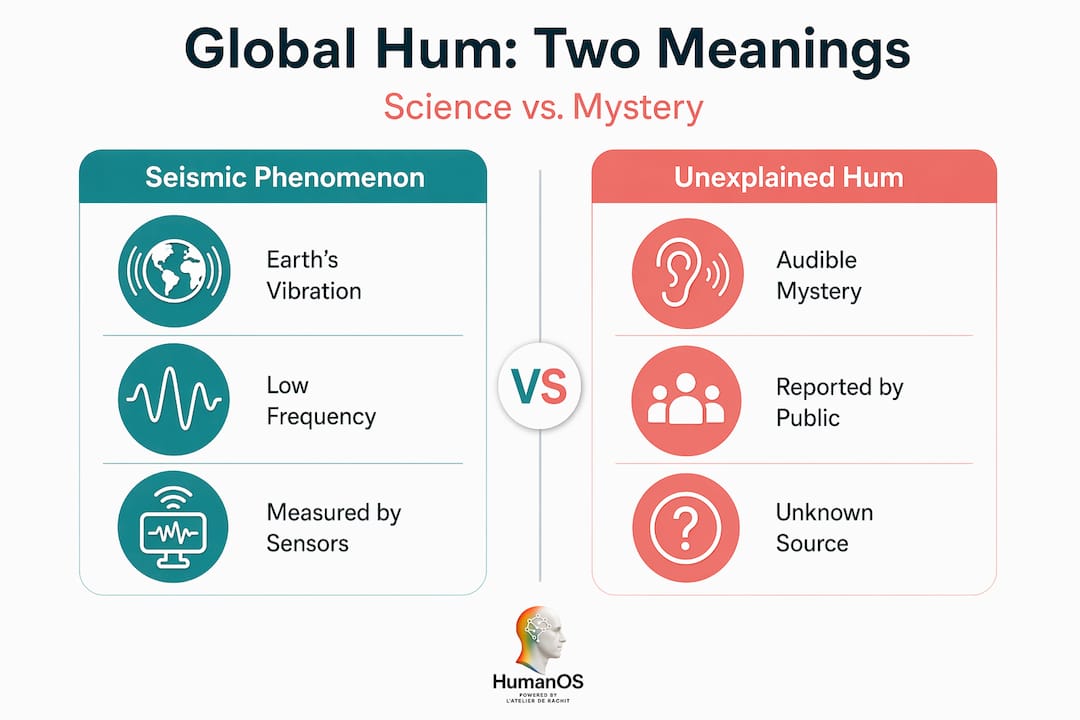
The phrase "global hum" is one of those terms. Global hum refers to two distinct phenomena: Earth's ultra-low-frequency seismic oscillations, which are measurable and scientifically documented, and a colloquial phenomenon often called "The Hum," which describes subjective reports of an unexplained, audible low-frequency noise experienced by people in certain regions. Both are real in the sense that scientists study both. But they are not the same thing, and treating them as equivalent leads to muddled thinking.
Here is a clear side-by-side comparison:
| Feature | Earth's seismic hum | "The Hum" (auditory) |
|---|---|---|
| Type | Seismic oscillation | Auditory experience |
| Measurable? | Yes, with seismometers | Inconsistently, at best |
| Frequency range | 2 to 20 mHz | Typically 30 to 80 Hz (audible) |
| Human-audible? | No | Reported as yes by sufferers |
| Cause | Ocean wave interactions | Unknown or multi-cause |
| Scientific status | Well-established | Unresolved |
Key distinctions to keep in mind:
- Earth's seismic hum is continuous, global, and instrument-detected.
- "The Hum" is localised, intermittent, and perceptual.
- The two phenomena occupy completely different frequency ranges.
- Conflating the two leads to fundamental errors in reasoning and project requirements.
- Only 2 to 4% of people in affected areas report hearing "The Hum," making it statistically rare even among those who live in known hotspots.
This ambiguity is not just an academic nuisance. For businesses trying to build data pipelines, deploy sensors, or automate environmental monitoring, using the wrong definition at the outset can derail an entire project before it starts.
The science of Earth's hum: What we actually know
With definitions established, we can now look at the hard data backing the scientific global hum. This is not speculation. It is well-documented geophysics backed by decades of seismographic data.
Earth's hum is continuous, oscillating in the 2 to 20 mHz band, and is entirely beyond the range of human hearing. To put that in perspective, the lowest note audible to humans sits around 20 Hz. Earth's seismic hum operates at frequencies thousands of times lower than that threshold. You cannot hear it. No standard audio recording equipment can capture it. Only precision seismometers designed for ultra-low-frequency detection can observe it.
Here is a summary of key scientific parameters:
| Parameter | Value |
|---|---|
| Frequency range | 2 to 20 millihertz (mHz) |
| Detectable by humans? | No |
| Primary cause | Ocean wave and coastal slope interaction |
| Presence | Continuous, even without earthquakes |
| Detection method | Broadband seismometers |
How the science breaks down:
- Ocean wave interactions. The primary driver is the collision between ocean waves and continental shelves. These interactions generate pressure pulses that couple into the solid Earth and propagate as seismic waves.
- Atmospheric contributions. Infragravity waves in the ocean, partly driven by wind and atmospheric pressure, also contribute to the signal.
- Continuous background. Unlike earthquakes, which are discrete events, Earth's hum is always present. Seismologists working in the 1990s first confirmed it clearly after advances in sensor sensitivity.
- Global distribution. The signal is not localised. Seismometers on every continent detect it consistently, which is what makes it genuinely "global."
- Research utility. Scientists use variations in Earth's hum to study the internal structure of the planet, similar to how a doctor uses sound waves during an ultrasound.
The science here is solid, well-funded, and internationally peer-reviewed. It has nothing to do with the mysterious reports of people hearing a persistent drone in places like Bristol, England, or Taos, New Mexico.
The Hum: An unresolved global phenomenon
Having examined the scientific perspective, we now turn to the equally important but more enigmatic reports of "The Hum." This is where things get genuinely strange, and where the temptation to reach for simple explanations must be resisted.
"The Hum" is not a single, unified phenomenon. Researchers increasingly treat it as a family of related experiences rather than one thing with one cause. The Hum remains reported by about 2 to 4% of people in affected areas, and despite decades of investigation, no single explanation has achieved scientific consensus.
"The Hum is one of those phenomena that refuses to fit neatly into a single category. It sits at the intersection of environmental acoustics, neuroscience, psychology, and infrastructure noise. That is precisely why it is so difficult to resolve."
What makes "The Hum" so puzzling? Several factors:
- It is selective. Most people in a given area hear nothing at all. A small minority report a low, persistent, diesel-engine-like rumble, often worse indoors or at night.
- It resists recording. Most attempts to capture "The Hum" with standard audio equipment produce no usable results, even when sufferers report it is present and loud.
- Proposed causes are many. Industrial machinery, military submarine communications (very low frequency or VLF transmissions), natural geological activity, and tinnitus-like neurological effects have all been proposed. None has been proven universally.
- Geographic clusters exist. Certain towns and regions around the world have disproportionate concentrations of reports, suggesting localised environmental factors in at least some cases.
- It causes real distress. For those who hear it constantly, The Hum is not an intellectual curiosity. It disrupts sleep, concentration, and quality of life in ways that are well-documented in self-report literature.
Pro Tip: If your business is involved in environmental monitoring, acoustic engineering, or community noise assessment, treat reports of "The Hum" as anecdotal data requiring further validation before acting on them. Never assume they correlate with any instrumentally measured signal without a specific, verified causal link.
The lesson here is that a phenomenon can be real in its effects, persistently reported, and still lack a definitive explanation. That is not a failure of science. It is science acknowledging its current limits honestly. For business owners, the parallel is clear: just because something is frequently reported does not mean the underlying cause is what people assume it to be.

Why "global hum" confusion matters for business, automation, and AI
With a clear picture of what the global hum is and is not, we can address its practical consequences for businesses building automation systems and deploying AI. This is where the distinction stops being academic and starts costing real money.
It is critical not to conflate Earth's seismic hum and anecdotal reports of The Hum when scoping requirements, selecting data sources, or designing automation logic. Here is why this matters in a business context:
- Project scoping errors. If a development team receives a brief that mentions "global hum monitoring" without a precise definition, they may design for entirely the wrong measurement domain. A sensor array built for acoustic frequencies will not detect seismic oscillations, and vice versa.
- Data source mismatches. AI systems are only as reliable as the data they are trained on. Feeding a model subjective community reports alongside instrument-grade seismic data creates a polluted dataset that produces unreliable outputs.
- Automation logic failures. Automated alerting systems designed around ambiguous inputs will trigger on the wrong signals, either missing genuine events or generating excessive false positives that erode team trust in the system.
- Vendor selection mistakes. Businesses that do not clarify their terminology before engaging technology partners may purchase solutions built for the wrong application entirely.
- Regulatory and compliance risk. In sectors like mining, construction, or environmental management, using the wrong measurement framework for noise and vibration monitoring can create legal exposure.
Claims that humans can directly perceive the seismic global hum are category errors. Measurement separation between seismic and auditory domains is not optional. It is essential for building trustworthy automation.
Pro Tip: Before any AI or automation project involving environmental data, sound, or vibration, create a shared glossary of terms that your entire team, your vendors, and your clients all agree on in writing. This single step eliminates a surprising number of downstream technical failures.
The broader business truth here is this: ambiguous language at the requirements stage is one of the most common and most expensive sources of failed technology implementations. Businesses that invest in definitional clarity before they invest in technology consistently outperform those that rush to deployment.
What most discussions about "global hum" miss
Most coverage of the global hum either sensationalises the mystery of The Hum or gets lost in geophysics jargon. Both approaches miss the more useful lesson for people running businesses in a technology-driven world.
What strikes us most about the global hum debate is how perfectly it mirrors the confusion we see in digital transformation projects every day. A term gets used loosely. Different stakeholders attach different meanings to it. Nobody pauses to align on definitions. And then months later, everyone is frustrated because the outcome does not match expectations, even though everyone thought they were working toward the same goal.
We have seen this play out in AI adoption projects repeatedly. A business owner hears "AI automation" and imagines one thing. A developer hears the same phrase and begins building something entirely different. The gap between those two mental models is where budget gets burned and timelines collapse.
The global hum is almost a perfect metaphor for this. Earth's actual hum is measurable, verifiable, and grounded in physical law. The Hum that some people report hearing is subjective, inconsistent, and resistant to conventional measurement. Both get called by the same name. The confusion is predictable. And yet most discussions never stop to separate the two clearly.
In our experience building operational systems for small and mid-sized businesses, the single most undervalued skill in technology adoption is definitional rigour. Not coding. Not AI architecture. Not even budget management. It is the ability to ask: "What exactly do we mean by that?" before committing resources to an answer.
Businesses that build this habit into their culture, their project intake processes, and their vendor relationships consistently deploy technology more successfully and with fewer painful course corrections.
Driving business clarity with automated AI solutions
Clarity is not just an intellectual virtue. It is a competitive advantage. When you understand exactly what a problem is, you can match it to exactly the right solution, and deploy that solution efficiently.

That is the operational philosophy behind HumanOS. We built our platform specifically for small and mid-sized businesses that are tired of ambiguous results from technology they do not fully understand. Our AI agent suite and managed web services are designed to remove the guesswork entirely, deploying with clear definitions, measurable outcomes, and guaranteed performance benchmarks. Whether you need AI agents handling scheduling, document processing, and customer support, or a professionally managed WordPress site built for conversion, every solution we deliver starts with clarity about what you actually need. No jargon fog. No scope creep. No surprises. Start with a three-day free trial and experience what operational clarity actually feels like in practice.
Frequently asked questions
Is the Earth's hum the same as the Hum people sometimes report hearing?
No. These are two distinct phenomena: Earth's hum is a seismic vibration far below human hearing range, while "The Hum" is an unresolved auditory experience reported by a small number of people in certain areas.
How common is it for people to hear "The Hum"?
It is rare. Only 2 to 4% of people in affected areas report hearing it, meaning the vast majority of residents in known hotspots experience nothing unusual.
Can "global hum" data help with automation or AI projects?
Only with careful distinction between data types. Measurement separation is essential because mixing seismic instrument data with subjective perceptual reports will corrupt any AI model trained on that dataset.
Is it possible to record Earth's hum with standard audio gear?
No. Earth's hum at 2 to 20 mHz sits far below the range of any conventional audio equipment or human hearing, and can only be captured using specialised broadband seismometers.