

TL;DR:
- Business productivity measures output relative to inputs like time, money, and technology.
- Tracking key metrics helps SMBs identify waste, boost profitability, and gain a competitive edge.
- AI tools automate data collection and trend analysis, making productivity measurement easier and more reliable.
Most small and mid-sized business owners believe they are productive because they are busy. The calendar is full, emails are flying, and the team looks occupied. But busyness and productivity are not the same thing, and confusing the two is one of the most expensive mistakes an SMB can make. Measuring business productivity provides objective insights into resource utilisation, replacing assumptions with data to identify inefficiencies and boost profitability. This guide will walk you through what productivity really means for your business, why measuring it matters, which metrics to track, and how AI-driven tools are making the whole process faster and more reliable than ever before.
Table of Contents
- What is business productivity and why does it matter?
- The key benefits of measuring productivity
- Essential metrics and how to track them
- Common challenges and nuanced realities of measurement
- Our perspective: Productivity measurement isn't everything — here's what matters most
- How HumanOS can help you measure and optimise productivity
- Frequently asked questions
Key Takeaways
| Point | Details |
|---|---|
| Measure for clarity | Tracking productivity reveals hidden inefficiencies and growth opportunities in SMBs. |
| AI simplifies tracking | AI-driven tools make it easy and affordable for smaller teams to automate measurement and analysis. |
| Balance metrics and people | The best results come from combining data with leadership, culture, and ongoing team development. |
| Avoid common pitfalls | Don't over-focus on activity numbers or overlook innovation and staff wellbeing. |
What is business productivity and why does it matter?
At its core, business productivity measures how much output you generate relative to the inputs you invest. Inputs include time, money, people, and technology. Output is what you actually deliver: revenue, completed projects, satisfied clients, or units sold. When inputs are high and outputs are low, you have an efficiency problem. When both are rising together, you are growing sustainably.
For SMBs, this definition matters more than it does for large corporations. You do not have the luxury of absorbing waste across dozens of departments. Every hour spent on low-value tasks, every duplicated process, and every missed deadline has a direct impact on your bottom line. That is why SMB productivity insights consistently show that leaders who track performance objectively outpace those who rely on gut feel.
"Productivity measurement provides the clarity that replaces guesswork. Without it, SMB owners are navigating growth with their eyes closed."
Here is where many business owners go wrong. They equate activity with results. A team member who sends 200 emails a day may be less productive than one who sends 20 and closes twice as many deals. Hours logged are not the same as value created. Recognising this distinction is the first step toward building a business that scales.
The good news is that AI-driven tools are closing the measurement gap faster than most owners realise. Platforms built around intelligent automation can surface productivity data in real time, without requiring a dedicated analyst or a complex reporting infrastructure. Exploring AI productivity tips is a practical starting point for any SMB owner who wants to move from assumptions to evidence.
Key reasons why productivity measurement is foundational for SMBs:
- It reveals where time and money are actually going, not where you think they are going.
- It creates accountability across teams without micromanaging individuals.
- It gives you a baseline to measure the impact of any change you make.
- It helps you identify your highest-value activities and double down on them.
- It supports smarter hiring decisions by showing where capacity is genuinely needed.
The key benefits of measuring productivity
Once you start measuring productivity objectively, the benefits compound quickly. The most immediate payoff is identifying waste. Every business has processes that consume resources without generating proportional value. Measurement makes these visible so you can eliminate or streamline them.
The financial impact is significant. SMB CEOs report that productivity investments link to profitability for 63% of respondents, revenue growth for 72%, and improved staff retention. Yet only 37% of SMBs actually see those gains, which points directly to a measurement gap. The businesses that measure are the ones that improve.
Here is a practical comparison of what measurement unlocks:
| Area | SMBs that measure | SMBs that don't measure |
|---|---|---|
| Profitability | Identify and cut waste systematically | Absorb hidden costs unknowingly |
| Revenue growth | Optimise high-performing activities | Repeat low-value work patterns |
| Staff retention | Spot burnout and workload imbalance early | React to turnover after it happens |
| Decision making | Use data to validate strategic choices | Rely on instinct and anecdotal evidence |
| Competitive edge | Adapt faster based on real performance data | Fall behind without knowing why |
Beyond profitability, measurement gives SMBs a competitive advantage that used to be reserved for large enterprises. OECD SME productivity data confirms that smaller firms with structured performance tracking close the productivity gap with larger competitors far more effectively than those operating without metrics.
Measurement also improves decision making in a very practical way. When you are considering whether to hire, invest in a new tool, or restructure a workflow, data gives you a defensible rationale. You stop making expensive decisions based on how things feel and start making them based on what the numbers show.
Here is a simple sequence to get started:
- Identify the two or three outputs that matter most to your business right now.
- Establish a baseline by tracking those outputs consistently for four weeks.
- Introduce one change and measure the impact against your baseline.
- Use that data to decide whether to scale, adjust, or abandon the change.
- Gradually layer in automated tracking tools as your measurement practice matures.
Pro Tip: Do not try to measure everything at once. Start with the outputs most directly tied to revenue, then expand your tracking as you build confidence and systems. Exploring AI productivity tools can help you automate this process once your baseline is established, and improving productivity with AI offers a step-by-step framework for doing exactly that.
Essential metrics and how to track them
Knowing you should measure productivity is one thing. Knowing what to measure is another. The most useful metrics for SMBs focus on outputs relative to inputs, not activity for its own sake.
Output per employee measures how much value each team member generates in a given period. This could be revenue, units completed, or client deliverables. It gives you a clear picture of team capacity and highlights where performance gaps exist.

Revenue per hour connects time directly to financial return. If your team is logging long hours but revenue is flat, this metric will tell you immediately. It is one of the most honest indicators of operational efficiency available to a small business.
Quality indicators include customer satisfaction scores, defect rates, and rework frequency. These matter because high output with poor quality is not productivity. It is waste in disguise. Tracking rework rates, for example, often reveals process problems that are costing you far more than you realise.
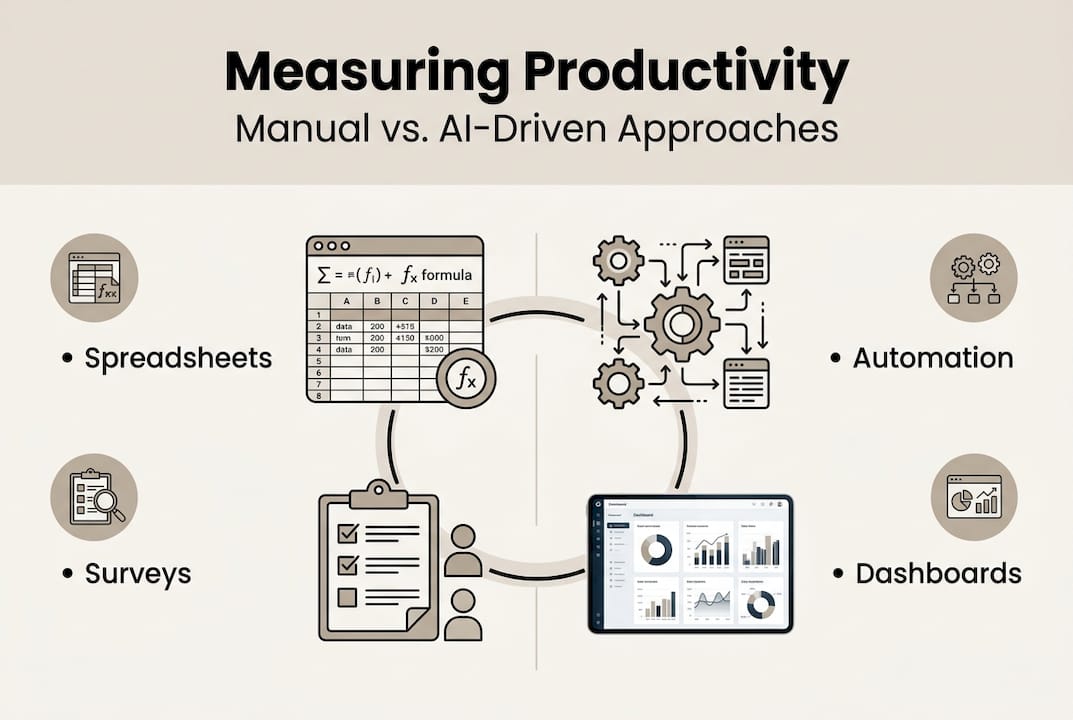
Here is how manual and AI-driven tracking compare:
| Tracking approach | Manual | AI-driven |
|---|---|---|
| Data collection | Spreadsheets, time logs, surveys | Automated, real-time dashboards |
| Trend identification | Weekly or monthly review | Continuous, flagged automatically |
| Error rate | High due to human input | Low with validated data sources |
| Time investment | Several hours per week | Minimal once configured |
| Scalability | Difficult as team grows | Scales with business automatically |
As productivity measurement guides emphasise, you should track trends rather than snapshots. A single week of low output might reflect a holiday or a one-off project delay. A consistent downward trend over six weeks is a signal that demands action.
Common pitfalls to avoid when setting up your tracking:
- Measuring activity instead of outcomes (calls made vs. deals closed)
- Using one-off data points to draw conclusions about performance
- Ignoring qualitative factors like client satisfaction and team morale
- Setting metrics that reward speed at the expense of quality
- Failing to communicate what is being measured and why to your team
Pro Tip: Use AI dashboards to identify trends across weeks and months, not just to check today's numbers. Effective time tracking strategies and AI automation for productivity can reduce the manual burden significantly. If scheduling is a bottleneck, AI scheduling tips offer practical ways to reclaim hours without adding headcount.
Common challenges and nuanced realities of measurement
Productivity measurement is powerful, but it is not a silver bullet. There are real limitations that every SMB owner should understand before building a metrics-heavy culture.
The first challenge is that some of the most valuable work is hard to quantify. A team member who mentors junior colleagues, builds strong client relationships, or contributes creative ideas to strategy sessions may not show up as a top performer on an output-per-hour report. Yet their contribution to the business could be enormous.
"Productivity is genuinely hard to measure in many contexts. Quality changes, public sector output, and intangible contributions are frequently undervalued when focus shifts too heavily toward numbers." Financial Post
Over-measuring also carries risk. When employees know they are being tracked on every metric, behaviour changes in ways that game the system rather than improve it. A customer service team measured purely on call volume will rush calls. A sales team measured only on new deals may neglect existing client relationships. The metric becomes the goal, and the actual goal gets lost.
There is also the question of employee wellbeing. AI automation for efficiency can help reduce workload, but if measurement is used to justify pushing teams harder rather than working smarter, you will see burnout, disengagement, and turnover. None of those outcomes show up immediately in your productivity dashboard, but they will eventually.
Common traps SMBs fall into with productivity measurement:
- Measuring inputs (hours, tasks) instead of meaningful outputs
- Using metrics as a surveillance tool rather than a growth tool
- Ignoring team culture and morale as performance drivers
- Treating measurement as a one-time exercise rather than an ongoing practice
- Applying the same metrics across roles that require very different types of work
The most effective approach balances quantitative tracking with qualitative check-ins. Regular conversations with your team about what is working, what is slowing them down, and where they feel underutilised will reveal insights that no dashboard can capture on its own.
Our perspective: Productivity measurement isn't everything — here's what matters most
Here is something most productivity guides will not tell you: chasing metrics alone will not build a great business. We have worked with SMBs across industries, and the ones that grow sustainably are not the ones obsessively tracking every output. They are the ones that measure what matters and then invest in the people and processes behind those numbers.
Many owners focus on lagging indicators: last month's revenue, hours billed, tasks completed. These tell you where you have been. The more powerful signals are leading indicators: team engagement, client relationship depth, and the speed at which your team learns and adapts. These predict where you are going.
The most resilient Canadian SMBs we have seen evolve by pairing measurement with a genuine investment in staff development and client relationships. They use data to ask better questions, not to replace human judgement. That balance is where real competitive advantage lives. Exploring AI-driven profitability strategies can help you build that foundation without losing sight of what makes your business worth growing in the first place.
How HumanOS can help you measure and optimise productivity
If this guide has made one thing clear, it is that measurement without the right tools is exhausting. That is exactly the problem HumanOS was built to solve.

The HumanOS AI automation platform deploys intelligent agents that automate time tracking, data analysis, scheduling, and reporting, so you get real-time productivity insights without the manual overhead. For SMBs with limited resources, this means data-driven decisions from day one, with no coding required and no credit card to start. Whether you need a smarter operational backbone or a professionally managed web presence, HumanOS solutions are built to deliver at least a 30% improvement in productivity and profitability. You can also explore our automation web services to see how we support the full picture of your digital operations.
Frequently asked questions
What are the best first steps for SMBs to start measuring productivity?
Begin by identifying one or two key outputs to track consistently, then gradually introduce automated tools as your approach matures. Measuring business productivity provides objective insights that replace assumptions with actionable data.
How can AI make productivity measurement easier for SMEs?
AI-powered tools automate data collection, surface trends in real time, and remove the manual burden of tracking, making measurement accessible even for resource-limited teams. AI-driven measurement enables optimisation without requiring large analytics teams.
What pitfalls should I avoid when measuring productivity?
Avoid focusing solely on activity metrics like hours worked and make sure you account for quality, innovation, and employee wellbeing alongside output numbers. Over-focus on metrics can miss what drives sustainable performance.
How does productivity measurement impact profitability and growth?
Businesses that measure productivity objectively are significantly more likely to grow revenue, improve profitability, and retain their best people. Productivity investments link to profitability for 63% and revenue growth for 72% of SMB CEOs surveyed.