

Profitability optimisation used to feel like a game reserved for corporations with dedicated finance teams and six-figure software budgets. That assumption is wrong, and the numbers prove it. SMB AI benchmarks show returns ranging from 200% to 1,893%, with a 42% productivity lift and 27% revenue growth reported across real businesses. This guide breaks down what profitability optimisation actually means, which frameworks work for small and mid-sized businesses, how to implement them without chaos, and where the real risks hide so you can protect every gain you make.
Table of Contents
- What is profitability optimisation?
- The business impact: What's possible with AI-enabled workflows
- Core frameworks and practical methods for profitability optimisation
- Risks and limitations: Knowing what not to automate
- Profit margin realities: How to sustain profitability with AI
- Start optimising your business profitability with AI today
- Frequently asked questions
Key Takeaways
| Point | Details |
|---|---|
| SMB profit boost with AI | Small businesses can realise remarkable profit gains with AI, seeing ROI as high as 1800%. |
| Phased, measurable approach | Start with audits and pilots, measure ROI, and gradually scale for lower risk and faster value. |
| Mind the risks | Set guardrails to avoid automating tasks with quality risks and hidden costs. |
| Margins need strategy | AI-driven workflows must be optimised for both efficiency and cost discipline to sustain profit margins. |
What is profitability optimisation?
Profitability optimisation is a systematic approach to increasing the financial return your business generates from every dollar of revenue and every hour of labour. It is not simply cutting costs. It is about finding the highest-value activities, eliminating waste, and continuously improving the ratio of output to input across your entire operation.
For SMBs, this means something different than it does for a Fortune 500 company. You do not have a team of analysts running Monte Carlo simulations. You need practical tools that fit your workflows and deliver measurable results fast. Modern AI-driven approaches make that possible by combining classical techniques with intelligent automation.
Profitability optimisation for SMBs draws on a range of methodologies, including Mixed-Integer Linear Programming (MILP), Nature-Inspired Algorithms (NIAs), and hybrid models designed to maximise Economic Value Added (EVA). In plain terms, these are structured ways to find the best possible outcome given your real constraints, whether that is budget, staff capacity, or time.
Here is what a modern SMB profitability optimisation approach typically targets:
- Revenue quality: Focusing on higher-margin products, services, or clients
- Operational waste: Identifying and eliminating repetitive, low-value tasks
- Workflow velocity: Speeding up processes that directly affect customer delivery
- Cost predictability: Replacing unpredictable manual effort with consistent automated systems
"Profitability optimisation is not a one-time project. It is an ongoing discipline that compounds over time, especially when AI is embedded into your daily workflows."
If you want a head start on applying this thinking, AI productivity tips offer a practical entry point for SMBs at any stage.
The business impact: What's possible with AI-enabled workflows
Understanding the definition is just the beginning. Actual business results paint an even clearer picture of what is at stake.

The data is striking. SMB AI adoption benchmarks consistently show that businesses implementing AI-driven workflows are not just saving time. They are transforming their financial position.
| Metric | Typical SMB result with AI |
|---|---|
| ROI range | 200% to 1,893% |
| Monthly cost savings | $5,000 or more |
| Productivity lift | Up to 42% |
| Revenue growth | Up to 27% |
| Profitability improvement | 30% to 50% |
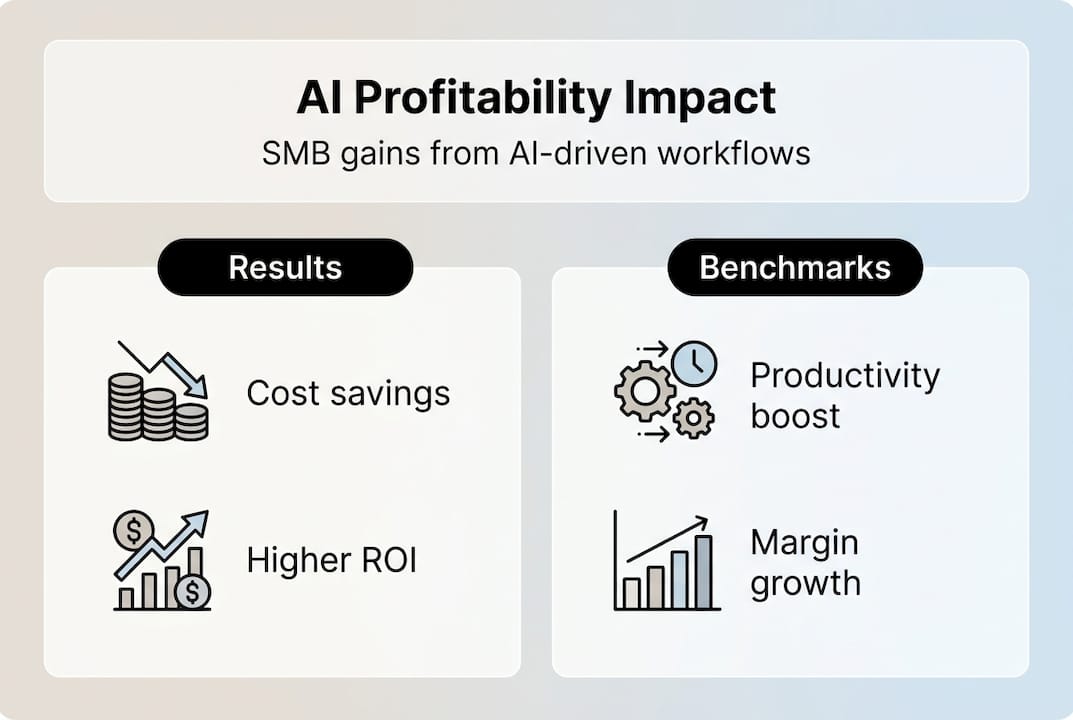
Consider two quick examples. A marketing firm that automated its reporting and client communication workflows cut 18 hours of weekly admin work and redirected that capacity toward billable strategy sessions, lifting monthly revenue by 22% within 90 days. A retail operator that deployed AI for inventory forecasting and customer support reduced overstock costs by 31% and improved customer satisfaction scores simultaneously.
These are not outliers. They reflect what happens when you apply top AI productivity tools to the right processes with clear measurement in place.
42% productivity lift. That is not a rounding error. That is nearly half again as much output from the same team.
Pro Tip: Start with your most measurable, repetitive processes first. Workflows with clear inputs and outputs, like invoice processing, appointment scheduling, or customer follow-up, deliver the fastest, most visible ROI and build internal confidence for broader SMB AI automation strategies.
Core frameworks and practical methods for profitability optimisation
Moving from results on paper to results in your business requires clear, practical frameworks built for SMB realities.
Here is a proven step-by-step approach:
- Audit your time sinks. Spend one week logging where your team's hours actually go. You will almost always find 20% to 30% of time absorbed by tasks that could be automated or eliminated entirely.
- Select one or two tools. Starting small with one or two AI tools reduces implementation risk and makes it easier to attribute results accurately.
- Run a focused pilot. Choose a single workflow, implement your chosen tool, and run it for 30 to 60 days without expanding scope. Discipline here pays off.
- Track ROI with NPV calculations. Net Present Value (NPV) analysis helps you compare the cost of your AI investment against the projected cash flow improvements over time. If the NPV is positive within six months, you scale. If not, you adjust.
- Optimise and expand. Once your pilot proves value, document what worked, refine the process, and roll it out to adjacent workflows.
When choosing your approach, it helps to understand the trade-offs between classical and AI-driven methods:
| Approach | Best for | Limitation |
|---|---|---|
| Classical (MILP, linear models) | Stable, well-defined processes | Rigid; struggles with variability |
| AI/ML models | Dynamic, data-rich environments | Requires clean data and oversight |
| Hybrid models | Most SMB scenarios | Needs initial setup investment |
Using an operational efficiency checklist before you begin ensures you are not skipping foundational steps. Pairing that with solid time tracking strategies gives you the baseline data your NPV calculations depend on.
Pro Tip: A pilot is not a soft commitment. Treat it like a real project with a defined owner, a success metric, and a hard deadline. That rigour is what separates businesses that prove ROI from those that are still "exploring AI" a year later. For more on execution, see improving team productivity with AI.
Risks and limitations: Knowing what not to automate
Knowing the risks is just as critical as knowing the action steps. Protecting your gains requires honest assessment of where AI falls short.
Not every task belongs in an automated workflow. Some processes require human judgement, contextual sensitivity, or creative problem-solving that current AI tools simply cannot replicate reliably. Automating these areas does not save money. It creates a "human cleanup tax," where staff spend more time fixing AI errors than they would have spent doing the task manually.
AI monetisation workflow failures consistently trace back to three root causes: quality volatility in AI outputs, unbounded inference costs that scale unexpectedly, and the hidden labour cost of correcting AI mistakes. These are not theoretical risks. They are budget line items that appear without warning if you do not build guardrails from the start.
Here is a practical checklist of what to watch for:
- High-stakes decisions: Client negotiations, hiring, legal judgements, and financial strategy require human accountability
- Emotionally sensitive interactions: Complaints, disputes, and relationship-critical communications need a human voice
- Highly variable inputs: Processes where the inputs change dramatically from case to case are poor candidates for rigid automation
- Unbounded cost processes: Any AI task billed per token or per API call needs a hard usage cap before deployment
- No fallback plan: Every automated workflow must have a manual override process documented and tested
"The businesses that get hurt by AI are not the ones that move too slowly. They are the ones that automate without guardrails and discover the cost of that decision in their next quarterly review."
For a deeper look at where automation adds genuine value versus where it creates friction, operational efficiency with AI and AI customer support efficiency are worth reviewing before you expand your stack.
Profit margin realities: How to sustain profitability with AI
Now that you know what to avoid, the focus shifts to keeping your profit margins strong as you scale automation.
Here is something most AI vendors will not tell you upfront: AI-powered businesses operate at structurally different margins than traditional SaaS businesses. AI profit margins typically run 25% to 50%, compared to 70% to 90% for conventional SaaS products. The reason is variable token costs. Every time an AI model processes a request, it consumes compute resources billed at a per-use rate. Those costs scale with usage in ways that fixed-cost software does not.
For SMBs, this means your AI investment strategy needs to account for operational cost variability, not just upfront licensing fees.
Here are the key strategies to protect and sustain your margins:
- Model distillation: Use smaller, task-specific AI models for routine operations instead of large general-purpose models. Smaller models cost significantly less to run and often perform better on narrow tasks.
- Workflow caching: Store the outputs of common AI queries so the same computation is not repeated unnecessarily. This alone can cut inference costs by 30% to 60% in high-volume workflows.
- Outcome-based pricing: When purchasing AI services, favour vendors who price on results rather than usage. This aligns their incentives with yours.
- Regular cost audits: Review your AI usage costs monthly, not quarterly. Token costs can compound quickly and quietly.
25% to 50% margins are still strong for an SMB, especially when the AI is replacing labour costs that were previously fixed. The key is going in with realistic expectations and a cost management discipline that matches your growth pace. Pairing these strategies with proven AI automation for sustained margins keeps your operation lean as you scale.
Start optimising your business profitability with AI today
With the frameworks, risks, and strategies clear, all that is left is putting them to work with the right tools and guidance.

HumanOS is built specifically for SMBs that are ready to move from manual chaos to measurable, AI-driven efficiency. The platform deploys a suite of AI agents across email management, scheduling, document processing, customer support, data analysis, and time tracking, all through a self-guided onboarding system that requires no coding and no credit card to start. On average, HumanOS clients see an 80% boost in productivity and a 30% to 50% improvement in profitability. You can automate with AI agents starting today, or explore the full range of tools and managed web services on the HumanOS platform. The first step is always the fastest one.
Frequently asked questions
How do you start profitability optimisation with AI in a small business?
Begin with a time audit of your workflows, identify your top one or two time sinks, and run a focused 30-day pilot with a single AI tool before expanding further.
What are the most common mistakes in automating profitability?
The most common mistakes are automating tasks that require human judgement, ignoring hidden inference costs and cleanup labour, and deploying automation without a documented fallback process.
How much ROI can SMBs expect from AI-driven profitability optimisation?
Real-world benchmarks show SMB AI ROI ranging from 200% to 1,893%, with 27% revenue growth and monthly cost savings exceeding $5,000 for businesses that implement strategically.
What is the main difference between AI and SaaS profitability models?
AI margins typically run 25% to 50% compared to 70% to 90% for SaaS, because AI operational costs vary with usage volume rather than remaining fixed.