

Most small business owners believe operational efficiency is about slashing budgets and doing more with less. That's only half the story. Real efficiency means optimising every resource to maximise output without burning out your team or compromising quality. In 2026, AI-driven automation is transforming how SMBs achieve this balance, yet many implementations fail because businesses chase technology instead of solving actual problems. This guide cuts through the noise to show you what operational efficiency truly means and how to harness AI automation to boost both productivity and profitability in your business.
Table of Contents
- Understanding Operational Efficiency And Its Importance For SMBs
- The Role Of AI Automation In Improving Operational Efficiency For SMBs
- Common Challenges In Achieving Operational Efficiency With AI And How To Overcome Them
- Measuring And Sustaining Operational Efficiency Gains With AI In Your SMB
- Explore AI Operating Systems To Supercharge Your SMB Efficiency
- Frequently Asked Questions
Key takeaways
| Point | Details |
|---|---|
| Operational efficiency optimises resources | It means maximising output whilst minimising wasted time, money, and labour across your business operations. |
| AI automation handles repetitive tasks | AI tools reduce human error and free up your team to focus on strategic work that drives growth. |
| Success requires clear business outcomes | SMBs that define specific problems before selecting AI tools achieve measurable results, whilst others waste money on unused software. |
| Poor data readiness kills AI projects | Inconsistent or scattered data prevents AI from delivering value, making data organisation a critical first step. |
| Continuous optimisation sustains gains | Regular reviews and workflow adjustments ensure AI tools remain aligned with evolving business goals. |
Understanding operational efficiency and its importance for SMBs
Operational efficiency is the art of maximising output with minimal wasted resources. For small and mid-sized businesses, this means getting the most value from every hour your team works, every dollar you spend, and every process you run. It's not about cutting corners or working your staff harder. It's about eliminating friction, reducing waste, and creating systems that deliver consistent results without constant firefighting.
Why does this matter so much in 2026? Competition is fiercer than ever. Customers expect faster responses, higher quality, and better experiences. SMBs that operate inefficiently burn cash on redundant tasks, lose talented employees to burnout, and struggle to scale when opportunities arise. Efficient operations give you the agility to pivot quickly, the margins to reinvest in growth, and the capacity to deliver exceptional customer experiences that build loyalty.
Core components of operational efficiency include:
- Streamlined workflows that eliminate unnecessary steps and handoffs
- Reduced waste in time, materials, and effort across all departments
- Effective resource allocation that matches skills and tools to the right tasks
- Data-driven decision making that replaces guesswork with measurable insights
- Continuous improvement processes that adapt to changing market conditions
Many business owners confuse efficiency with cost-cutting. Slashing budgets without examining processes often backfires, creating bottlenecks that cost more in lost productivity than you save. True efficiency sometimes requires upfront investment in better tools or training that pays dividends over time. Another misconception is that efficiency means standardising everything. The goal is to automate routine tasks so your team has more time for creative problem-solving and relationship building, the work that actually differentiates your business.
Operational efficiency directly impacts your bottom line and customer satisfaction. When your team spends less time on manual data entry or chasing approvals, they have more energy for serving customers and developing new offerings. Efficient businesses respond faster to market changes, recover quicker from setbacks, and build reputations for reliability that attract both customers and top talent. In practical terms, improving operational efficiency by even 20% can transform a struggling SMB into a profitable one, or turn a profitable one into a market leader.
The role of AI automation in improving operational efficiency for SMBs
AI automation enhances operational efficiency by taking over the repetitive and complex tasks that drain your team's time and introduce costly errors. For SMBs, AI means using software that handles work automatically, from sorting customer emails to analysing sales trends to scheduling appointments. These aren't futuristic concepts. They're practical tools solving real problems right now in businesses just like yours.
Typical SMB tasks ripe for AI automation include:
- Customer support through chatbots that handle common enquiries 24/7
- Marketing automation that personalises email campaigns based on customer behaviour
- Sales analysis that identifies patterns and forecasts revenue without spreadsheet gymnastics
- Scheduling that eliminates the back-and-forth of finding meeting times
- Invoice processing that extracts data, matches purchase orders, and flags discrepancies
- Document management that organises, tags, and retrieves files instantly
- Time tracking that captures billable hours without manual timesheets
Automation reduces time waste by handling tasks in seconds that would take humans minutes or hours. It eliminates human error in data entry, calculations, and routine decisions. The output quality improves because AI systems follow consistent rules and learn from patterns, whilst tired employees make mistakes. Your team shifts from doing the work to overseeing the work, focusing on exceptions and strategic decisions that require human judgement.

Here's the counterintuitive truth: businesses saving real money in 2026 are those who picked two or three AI tools that fit an actual problem and built from there. The SMBs that fail are the ones buying every shiny AI platform without clear use cases, then wondering why adoption stalls. Success comes from targeting specific pain points, not trying to automate everything at once.
Pro Tip: Start with the task costing you the most time or money. Calculate what it currently costs in labour hours or errors. Then evaluate AI solutions specifically designed to solve that problem. This focused approach delivers measurable ROI and builds internal confidence before expanding to other areas.
The critical insight is that AI must be integrated into your existing workflows, not bolted on as a separate tool nobody remembers to use. When automation feels invisible, handling tasks in the background whilst your team works normally, you've achieved true operational efficiency. When it requires constant manual intervention or exists as another dashboard to check, it becomes just another cost centre. The difference lies in thoughtful implementation that prioritises improving team productivity through seamless business operations automation.
Common challenges in achieving operational efficiency with AI and how to overcome them
Even with the best intentions, most SMBs hit predictable roadblocks when implementing AI for operational efficiency. Understanding these challenges upfront helps you avoid expensive mistakes and accelerate your path to results. The good news is that every obstacle has a practical solution if you approach it systematically.
Most AI implementations fail in SMBs because businesses invest in AI without a clear business outcome in mind. They buy technology first, then try to find problems it might solve. This backwards approach leads to unused software licences and frustrated teams. The second major challenge is poor data readiness. AI systems need clean, organised, consistent data to function effectively. When your customer information lives in three different spreadsheets, your invoices are PDFs in email attachments, and your inventory tracking is partially on paper, AI effectiveness gets hindered before it starts.
Other common challenges include:
- Limited technical resources and expertise to evaluate, implement, and maintain AI tools
- Unrealistic expectations about what AI can accomplish without human oversight
- Resistance from team members who fear automation will replace their roles
- Lack of continuous optimisation after initial deployment
- Integration difficulties with existing software and workflows
Here's how to overcome these challenges systematically. First, define measurable business outcomes before you even look at AI tools. What specific result do you want? Reduce invoice processing time by 50%? Cut customer response time from 24 hours to 2 hours? Increase sales team productivity by 30%? Write down the metric, the current baseline, and the target improvement. This clarity guides every subsequent decision.
Second, tackle data readiness as a separate project. Audit where your critical business data lives, how it's formatted, and who maintains it. Consolidate scattered information into centralised systems. Establish consistent naming conventions, required fields, and data entry standards. This groundwork might feel tedious, but it's the foundation that makes AI valuable. Think of it like preparing soil before planting. No amount of expensive seeds will grow in rocky, depleted ground.
Third, start small with pilot projects that deliver quick wins. Choose one process, one department, or one workflow. Implement AI there, measure results, learn from mistakes, and document what works. Use that success to build internal support before expanding. This approach also lets you develop expertise gradually rather than trying to become an AI expert overnight.
Pro Tip: Define measurable business outcomes before selecting AI tools to avoid costly failures. Write down exactly what success looks like in numbers, not vague improvements. This forces clarity and prevents technology purchases that sound impressive but deliver nothing.
Fourth, leverage strategic outsourcing for web management and other technical tasks where it makes sense. You don't need to build every capability in-house. Sometimes the most efficient path is partnering with specialists who handle complex implementations whilst your team focuses on core business activities. This is particularly true for integrating AI with your website, CRM, or other customer-facing systems where mistakes directly impact revenue.
Finally, build continuous optimisation into your process from day one. Schedule monthly reviews of AI system performance against your defined outcomes. Gather feedback from team members actually using the tools. Adjust configurations, add new use cases, and retire what isn't working. AI isn't a set-it-and-forget-it solution. It's a capability that grows more valuable as you refine how you use it.
Measuring and sustaining operational efficiency gains with AI in your SMB
Implementing AI automation is just the beginning. The real value comes from measuring what changes, understanding why, and continuously improving your approach. Without proper measurement, you're flying blind, unable to justify continued investment or identify where to focus next.
Key performance indicators for operational efficiency fall into several categories. Time savings measure how much faster tasks complete with automation versus manual processes. Cost reduction tracks decreased labour costs, error correction expenses, and resource waste. Error rates compare accuracy before and after AI implementation. Employee productivity assesses how much more output your team generates when freed from repetitive work. Customer satisfaction metrics like response time and resolution speed reveal whether efficiency improvements translate to better experiences.
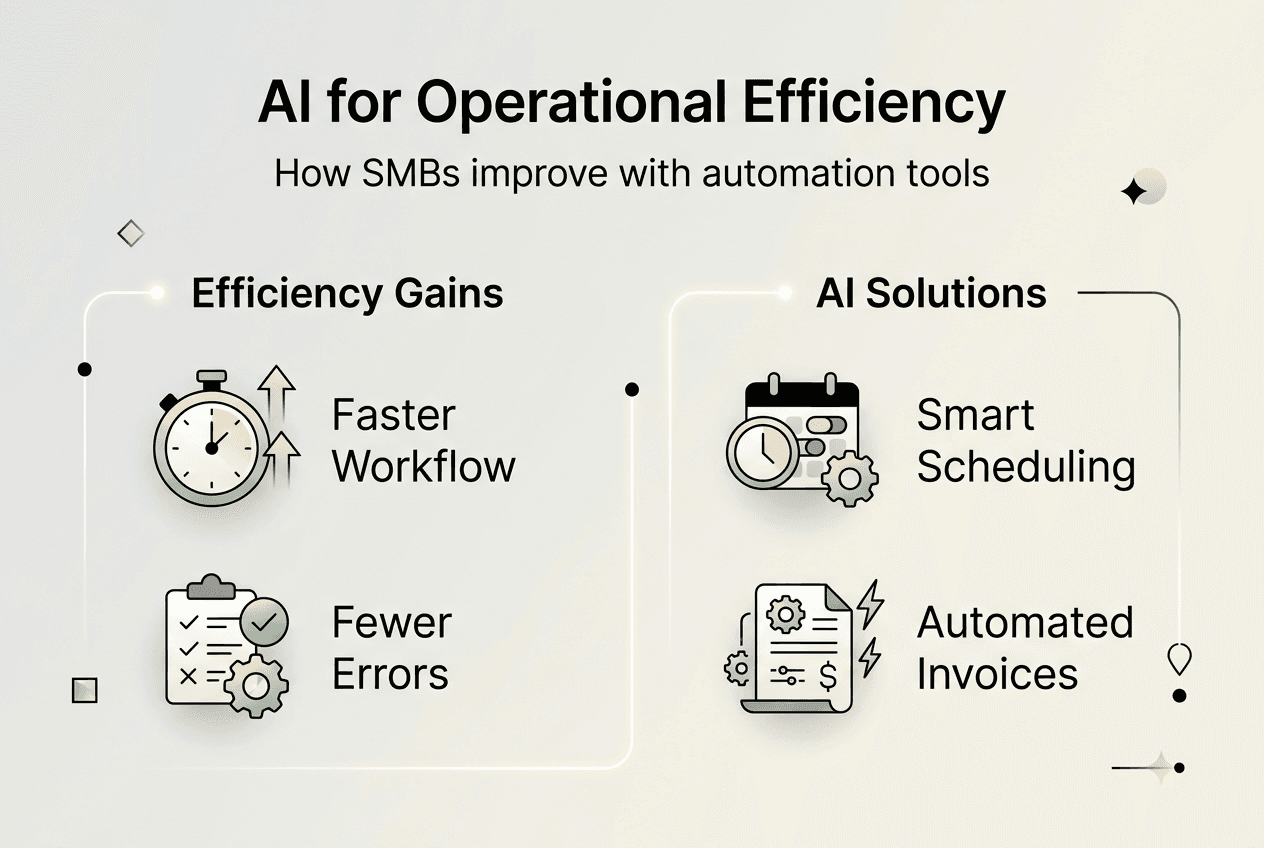
Here's what typical improvements look like:
| Metric | Before AI | After AI | Improvement |
|---|---|---|---|
| Invoice processing time | 45 minutes per invoice | 5 minutes per invoice | 89% reduction |
| Customer email response | 18 hours average | 2 hours average | 89% faster |
| Data entry error rate | 8% of records | 0.5% of records | 94% fewer errors |
| Sales report generation | 6 hours weekly | 15 minutes weekly | 96% time saved |
| Employee productivity | 100% baseline | 180% of baseline | 80% increase |
These aren't hypothetical numbers. They represent real outcomes from SMBs that implemented AI thoughtfully. Your results will vary based on your starting point, the processes you automate, and how well you integrate the technology. The point is that meaningful improvement is achievable and measurable.
Setting up continuous feedback loops ensures your AI systems stay effective as your business evolves. AI only delivers results when it's aligned with the correct data, integrated into existing workflows, and continuously optimised. This means regularly checking data quality, updating training datasets, and refining automation rules based on what you learn.
Best practices to sustain operational efficiency gains include:
- Train staff on new AI tools and workflows so adoption becomes habitual, not forced
- Review AI tool performance quarterly against your original success metrics
- Monitor integration points where AI hands off to human team members for friction
- Update automation rules as business processes change or new edge cases emerge
- Celebrate wins publicly to reinforce the value and build organisational support
- Retire or replace tools that aren't delivering promised results after fair trial periods
The final piece is aligning AI outputs with evolving business goals. What made sense six months ago might not match where you're headed now. Maybe you've expanded into new markets, launched different products, or shifted your customer focus. Your AI systems need to evolve with these changes. Regular strategy reviews that include your automation stack ensure technology serves your vision rather than constraining it.
Implementing effective time tracking strategies helps you measure exactly where AI delivers value and where manual processes still dominate. This visibility drives smarter decisions about where to invest in additional automation. For comprehensive operational efficiency, consider platforms like HumanOS that integrate multiple AI capabilities into a unified system rather than managing dozens of disconnected tools.
Explore AI operating systems to supercharge your SMB efficiency
You've seen how operational efficiency transforms SMB performance and why AI automation is the practical path to achieving it. The question now is how to move from understanding to implementation without the trial-and-error that wastes time and money.

AI operating systems provide integrated automation tailored specifically to SMB needs, handling everything from email management to customer support to document processing through a unified platform. These solutions embed AI directly into your existing workflows rather than requiring you to adopt entirely new processes. They're designed to overcome the common adoption challenges we discussed by focusing on measurable business outcomes from day one, not just technical features.
Explore HumanOS AI operating system to see how integrated AI automation tools can drive the 30-50% profitability improvements your business deserves. The platform combines operational AI agents with managed web services so your digital infrastructure works as hard as you do, without the duct tape.
Frequently asked questions
What is operational efficiency in a small business?
Operational efficiency in a small business means optimising your resources to achieve maximum output whilst minimising wasted time, money, and labour. It's about creating streamlined workflows that eliminate unnecessary steps, reduce errors, and free your team to focus on high-value work that drives growth. For SMBs, efficiency directly impacts profitability because every hour saved and every dollar preserved compounds over time into competitive advantage.
How can small businesses start improving operational efficiency with AI?
Identify the top time-consuming or cost-draining tasks in your business before evaluating any AI tools. Start with two to three AI applications that address real, measurable problems rather than trying to automate everything at once. Focus on integrating these tools into your existing workflows so they feel invisible to your team, handling work in the background rather than becoming another platform to manage. Measure results against clear benchmarks to build confidence before expanding.
What are the biggest challenges SMBs face when using AI to boost efficiency?
The biggest challenges include unclear goals, poor data readiness, limited technical resources, and unrealistic expectations about what AI can accomplish without human oversight. Many implementations fail because businesses buy technology first, then try to find problems it might solve. Solutions involve defining clear, measurable outcomes before selecting tools, organising your data into consistent formats, starting with focused pilot projects, and building continuous optimisation into your process from day one.
How do you measure operational efficiency improvements after AI implementation?
Track key performance indicators like time saved per task, cost reduction in labour and error correction, output quality improvements, and employee productivity increases. Use before-and-after comparisons with specific metrics such as invoice processing time, customer response speed, or data entry accuracy. Implement continuous monitoring through regular reviews that assess whether AI systems still align with your business goals as they evolve. The most successful SMBs treat measurement as an ongoing process, not a one-time evaluation.