

Small and mid-sized enterprises represent over 90% of global businesses, yet most still wrestle with manual workflows that drain time and resources. Business process automation offers a proven path to operational efficiency, allowing SMBs to compete with larger rivals by automating routine tasks and focusing human effort where it matters most. This guide explains what business process automation is, why it matters for your business in 2026, and how to implement it effectively to boost productivity and profitability.
Table of Contents
- Understanding Business Process Automation And Its Benefits For SMEs
- Core Technologies And Automation Types Powering Business Process Automation
- Real-World Automation Success Stories And Measurable Benefits For Small Businesses
- Implementing Business Process Automation In Your Small Or Mid-Sized Business: Practical Steps
- Discover HumanOS: AI Operating System For Seamless Business Automation
- Frequently Asked Questions About Business Process Automation
Key takeaways
| Point | Details |
|---|---|
| BPA transforms SME operations | Business process automation eliminates manual tasks, enabling small businesses to improve efficiency and build resilience against market disruptions. |
| No complex tech required | Modern automation tools are designed for SMBs, targeting specific bottlenecks without requiring enterprise-level infrastructure or technical expertise. |
| AI agents drive productivity | AI-powered automation handles repetitive workflows like email management, scheduling, and customer support, freeing teams to focus on strategic work. |
| Measurable ROI quickly | Companies implementing automation see dramatic results, with some tripling output whilst saving 40+ hours weekly within months of deployment. |
| Start small, scale strategically | Focus first on high-impact bottlenecks, then expand automation gradually to maximise return on investment and ensure smooth team adoption. |
Understanding business process automation and its benefits for SMEs
Business process automation (BPA) uses technology to handle routine tasks and workflows that previously required manual effort. Instead of employees spending hours on data entry, invoice processing, or email responses, automated systems execute these activities with minimal human intervention. For small and mid-sized businesses, this shift represents more than convenience. It's a strategic response to resource constraints and competitive pressure.
SMBs face unique operational challenges. Limited budgets mean every hour counts. Market volatility and supply chain disruptions hit smaller organisations harder because they lack the buffers larger enterprises maintain. SMEs exhibit heightened vulnerability to disruptions due to significant resource constraints, making operational efficiency not just desirable but essential for survival.
SMEs exhibit heightened vulnerability to disruptions due to significant resource constraints.
Many business owners assume automation suits only large corporations with dedicated IT departments. This myth costs SMBs thousands of hours annually. Modern BPA tools are built specifically for smaller operations, requiring no coding skills or complex infrastructure. A business operations automation guide shows how accessible these solutions have become.
Typical SME processes ripe for automation include:
- Marketing campaign execution and social media scheduling
- Customer relationship management and follow-up sequences
- Invoice generation and payment processing
- Inventory tracking and reorder alerts
- Employee onboarding and time tracking
- Document management and approval workflows
The benefits extend beyond time savings. BPA delivers measurable improvements across multiple dimensions:
- Cost reduction through eliminated manual labour and fewer errors
- Time efficiency allowing teams to focus on revenue-generating activities
- Error reduction by removing human inconsistency from repetitive tasks
- Scalability enabling growth without proportional staff increases
- Data accuracy providing reliable insights for strategic decisions
- Customer satisfaction through faster response times and consistent service
When you automate invoice processing, for example, the system captures data, matches purchase orders, flags discrepancies, and routes approvals automatically. What once took hours now completes in minutes, with an audit trail for compliance. This operational resilience becomes your competitive advantage.

Core technologies and automation types powering business process automation
Three primary technology categories drive modern BPA for SMBs: AI-agent automation, CRM integration, and agile marketing tools. Understanding how these work individually and together helps you build effective automated workflows.
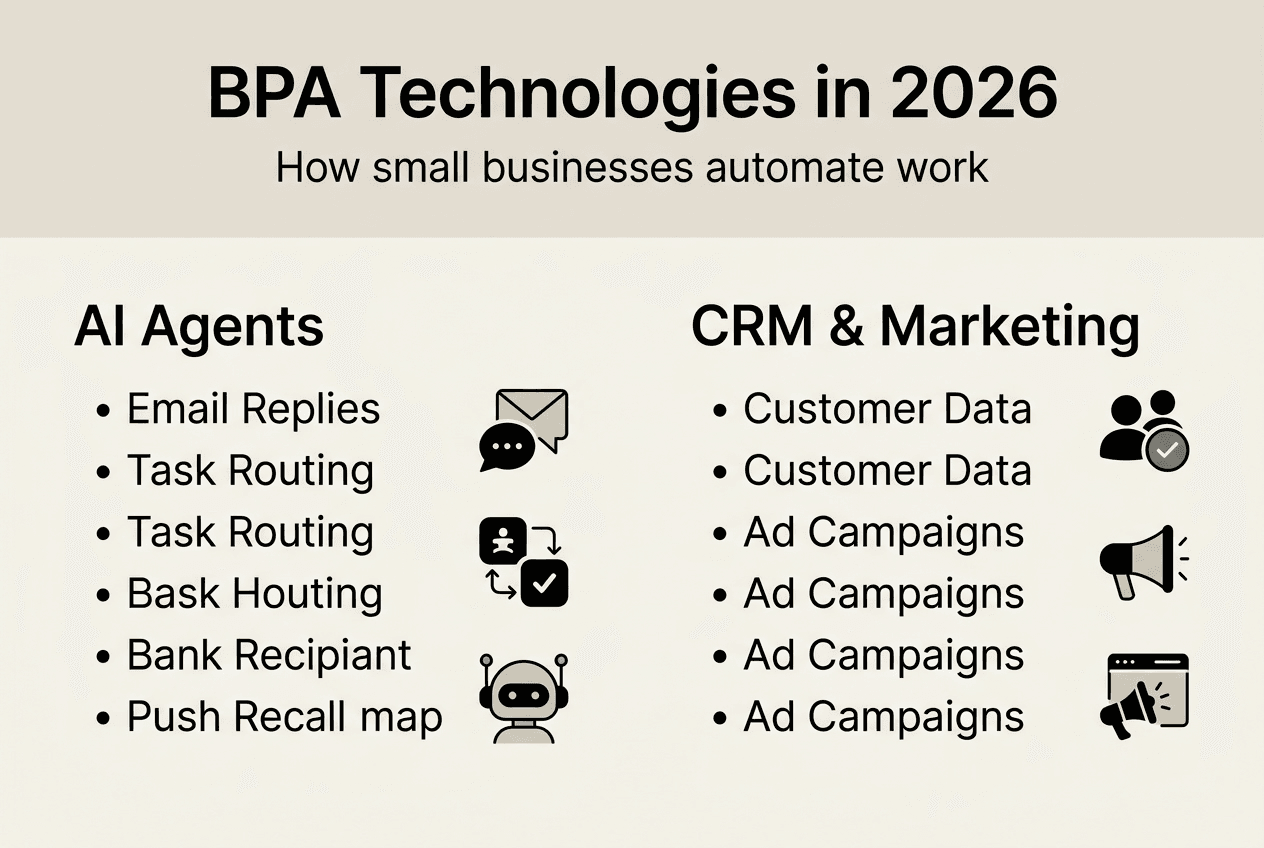
AI-agent automation deploys intelligent software agents that handle specific business functions. These agents process emails, schedule meetings, analyse data, and respond to customer enquiries using natural language processing and machine learning. Unlike rigid scripts, AI agents adapt to context and learn from interactions. A multi-agent system coordinates multiple specialised agents working in concert.
CRM automation connects customer data across touchpoints, triggering actions based on behaviour. When a prospect downloads a resource, the system adds them to a nurture sequence, assigns a sales rep, and schedules follow-up tasks automatically. This ensures no lead falls through cracks whilst maintaining personalised engagement at scale.
Agile marketing automation orchestrates campaigns across channels, adjusting tactics based on real-time performance data. Content gets published, emails deploy to segmented lists, social posts go live, and analytics feed back into strategy without manual intervention at each step.
The integrated model empowers SMEs to build dynamic resilience and achieve competitive parity through data-driven, automated workflows. When these technologies connect, they create a system greater than the sum of parts.
Key features of each automation type:
- AI-agent automation: Natural language processing, contextual decision making, continuous learning, task orchestration, exception handling
- CRM automation: Lead scoring, pipeline management, automated follow-ups, behaviour tracking, sales forecasting
- Agile marketing automation: Campaign scheduling, audience segmentation, A/B testing, performance analytics, cross-channel coordination
| Approach | Manual process | Single automation | Integrated BPA | | --- | --- | --- | | Workflow | Employee handles each step | One task automated | End-to-end automation | | Data flow | Siloed, requires manual transfer | Limited connection | Unified, real-time sync | | Adaptability | Slow, requires retraining | Fixed rules only | Dynamic, learns patterns | | Best for | Very small teams | Specific bottlenecks | Growth-focused SMBs | | Example | Manually sending follow-up emails | Email auto-responder | AI analyses enquiry, routes to right agent, schedules meeting, updates CRM, triggers nurture sequence |
Pro Tip: Start with your biggest bottleneck rather than trying to automate everything at once. Identify the single process consuming the most time or causing the most errors, implement automation there, measure results, then expand to the next priority. This approach maximises ROI whilst building team confidence in the technology.
The role of AI in customer support demonstrates how these technologies transform service delivery. AI agents handle routine enquiries instantly, escalate complex issues to humans with full context, and learn from every interaction to improve future responses. This hybrid model delivers both efficiency and quality.
For deeper technical understanding, the SME resilience through automation study provides comprehensive research on how integrated automation systems function in real business environments.
Real-world automation success stories and measurable benefits for small businesses
Theory matters less than results. Real SMBs implementing business process automation see dramatic, measurable improvements in productivity and profitability.
Consider a six-person marketing agency struggling with content production bottlenecks. Every client deliverable required manual research, writing, editing, formatting, and approval tracking. The team worked long hours yet struggled to scale beyond a handful of clients. After implementing automation, the results were striking. A 6-person marketing agency automated their content pipeline, eliminating 40 hours of weekly work and tripling client output. The same team now serves three times as many clients with better quality and faster turnaround.
This isn't an isolated case. Across industries, companies are saving thousands of work hours through AI-powered automation. The pattern repeats: businesses identify high-volume, repetitive tasks, deploy appropriate automation tools, and redirect human effort toward strategic activities that drive growth.
Types of efficiencies gained through BPA:
- Faster customer responses: AI agents handle routine enquiries instantly, reducing response time from hours to seconds
- Automated content creation: Systems generate reports, social posts, and email sequences based on templates and data inputs
- Workflow orchestration: Tasks route automatically to appropriate team members with all necessary context and deadlines
- Data processing: Information flows between systems without manual data entry, eliminating transcription errors
- Approval routing: Documents move through review cycles automatically, with reminders and escalations built in
40 hours saved weekly + 3x output increase = 300% productivity improvement without adding staff
The connection between automation and profitability is direct. When you eliminate 40 hours of manual work weekly, that's equivalent to hiring a full-time employee without salary, benefits, or management overhead. The marketing agency example translates to roughly $50,000 in annual labour savings, plus the revenue from serving additional clients.
Platforms like HumanOS demonstrate how accessible this technology has become for SMBs. Purpose-built automation systems designed for smaller businesses deliver enterprise-level capabilities without enterprise complexity or cost. The barrier to entry has dropped dramatically, making 2026 the ideal time for SMBs to adopt BPA.
These success stories share common elements. Businesses started with clear pain points, chose tools matching their technical capabilities, trained teams properly, and measured results consistently. They didn't try to automate everything overnight. They identified the highest-impact opportunities, implemented solutions methodically, and expanded based on proven results.
The marketing automation case study reveals another crucial insight: automation improves work quality alongside quantity. When humans stop spending time on repetitive tasks, they bring more creativity and strategic thinking to client work. This dual benefit of efficiency and quality elevates the entire business operation.
For comprehensive data on automation impact, Microsoft's collection of AI automation work hours savings stories provides hundreds of examples across industries and company sizes.
Implementing business process automation in your small or mid-sized business: practical steps
Moving from concept to implementation requires a structured approach. Follow these steps to deploy BPA effectively in your organisation:
-
Map your current workflows: Document how work actually flows through your business, not how you think it should flow. Identify every step, handoff, and decision point in key processes.
-
Identify automation candidates: Look for high-volume, rule-based tasks that consume significant time. Data entry, email responses, scheduling, and reporting typically top the list.
-
Prioritise by impact: Calculate potential time savings and error reduction for each process. Start with the highest-impact opportunity rather than the easiest automation.
-
Research appropriate tools: Small businesses don't need massive tech stacks; choose the right BPA tools to solve real bottlenecks without complexity. Match tool capabilities to your specific needs and technical comfort level.
-
Evaluate integration requirements: Ensure new automation tools connect with your existing systems. Data should flow seamlessly without manual exports and imports.
-
Start with a pilot: Implement automation for one process or department first. Measure results, gather feedback, and refine before expanding.
-
Train your team thoroughly: People make or break automation projects. Invest time explaining why automation helps them, how to use new tools, and what changes in their daily work.
-
Monitor and optimise: Track key metrics like time saved, error rates, and user satisfaction. Adjust automation rules based on real-world performance.
-
Scale gradually: Once the pilot succeeds, expand to additional processes using lessons learned. Build momentum through visible wins.
-
Maintain security and compliance: Ensure automated systems handle data according to privacy regulations. Regular audits prevent security gaps as automation expands.
Workforce training deserves special attention. Employees often fear automation will eliminate their jobs. Frame BPA as a tool that removes tedious work, allowing them to focus on interesting, valuable activities. Involve team members in identifying automation opportunities. Their frontline experience reveals bottlenecks management might miss.
Data security becomes more critical as automation touches more systems. Establish clear protocols for access control, data encryption, and audit trails. Automated systems should enhance security by reducing human error and maintaining consistent compliance.
Pro Tip: Begin automation projects with your simplest, highest-impact workflow rather than the most complex process. Quick wins build organisational confidence and provide proof of concept for larger initiatives. A successful email automation project makes it easier to gain buy-in for more sophisticated CRM integration later.
Align tool selection with your current business size and growth trajectory. A solopreneur needs different automation than a 50-person company. Choose solutions that scale with you rather than forcing you to switch platforms as you grow.
Common pitfalls to avoid:
- Overcomplexity: Implementing too many tools or automating too much at once overwhelms teams and increases failure risk
- Ignoring team adoption: Even perfect automation fails if people don't use it or work around it
- Poor data quality: Automation amplifies existing data problems; clean your data before automating processes that depend on it
- Neglecting maintenance: Automated systems require ongoing monitoring and adjustment as business needs evolve
- Skipping measurement: Without clear metrics, you can't prove ROI or identify areas for improvement
For comprehensive guidance on building an automation strategy, review this business operations automation guide tailored specifically for SMBs in 2026.
Implementation timelines vary based on process complexity and organisational readiness. Simple email automation might deploy in days. Comprehensive CRM integration could take months. Set realistic expectations and celebrate incremental progress rather than waiting for perfect, complete automation.
Discover HumanOS: AI operating system for seamless business automation
Transforming operational efficiency from concept to reality requires the right platform. HumanOS provides an AI-driven operations system built specifically for small and mid-sized businesses ready to stop duct-taping their digital infrastructure together. The platform combines AI agents that automate routine business operations with fully managed web services, delivering measurable productivity improvements without requiring technical expertise.
The AI operating system deploys through a self-guided onboarding process requiring no coding and no credit card to start. AI agents handle email management, scheduling, document processing, customer support, data analysis, and content creation whilst you maintain full control and visibility. On average, businesses using HumanOS see an 80% boost in productivity and 30-50% boost in profitability.
For businesses needing professional web presence alongside operational automation, AI automation web services eliminate both the agency markup and DIY guesswork. Three service tiers match different business stages, from solopreneurs to multi-location operations, with continuous optimisation ensuring your digital infrastructure grows with your business.
Frequently asked questions about business process automation
What types of small business processes are best for automation?
High-volume, rule-based tasks deliver the strongest automation ROI. Email responses, appointment scheduling, invoice processing, social media posting, data entry, and customer follow-ups are ideal starting points. Look for processes consuming significant time whilst following predictable patterns.
Is business process automation expensive for small businesses?
Modern BPA tools designed for SMBs cost far less than hiring additional staff to handle the same workload. Many platforms offer tiered pricing starting under $100 monthly, with free trials allowing you to prove ROI before committing. The typical payback period is under three months based on labour savings alone.
How long does it take to see ROI from BPA?
Most businesses notice time savings within the first month of implementing automation. Measurable ROI typically appears within 60-90 days as processes stabilise and teams adapt. The marketing agency example showed dramatic results within months, eliminating 40 weekly hours whilst tripling output. Your timeline depends on process complexity and implementation thoroughness.
Can BPA improve customer service for SMBs?
Absolutely. Automation enables faster response times, consistent service quality, and 24/7 availability without expanding staff. AI agents handle routine enquiries instantly whilst routing complex issues to human team members with full context. Customers receive better service whilst your team focuses on high-value interactions. Review this business operations automation guide for specific customer service automation strategies.
What are common pitfalls to avoid in BPA implementation?
The biggest mistakes are automating too much too quickly, choosing overly complex tools, neglecting team training, and failing to measure results. Start with one high-impact process, select user-friendly tools matching your technical capabilities, invest in proper training, and track specific metrics proving ROI. Build on success rather than attempting wholesale transformation overnight.