

Running a small business means juggling endless tasks while trying to stay profitable. You know the drill: manual data entry eats hours, emails pile up unanswered, and scheduling conflicts derail your day. These operational inefficiencies don't just waste time, they directly limit growth and profitability. AI automation offers a proven path forward, with studies showing efficiency gains of 5-33% for SMBs that implement it correctly. This guide walks you through the exact steps to prepare, deploy, and sustain AI-driven improvements that genuinely transform how your business operates.
Table of Contents
- Key Takeaways
- Understanding the operational challenges in SMBs
- Preparing your business for AI-driven efficiency improvements
- Implementing AI automation for operational efficiency
- Measuring and sustaining operational efficiency gains
- Explore HumanOS for AI-driven operational efficiency
- Frequently asked questions
Key Takeaways
| Point | Details |
|---|---|
| Up to 33 percent gains | AI adoption can improve SMB operational efficiency by up to 33 percent when prepared and deployed with proper governance and oversight. |
| Preparation matters | Start with documenting and mapping current workflows and cleaning data before selecting AI tools to ensure meaningful results. |
| Human in the loop | Maintain human oversight so AI handles routine tasks while people manage exceptions and strategic decisions. |
| Monitor for failures | Use monitoring tools to identify issues early and sustain efficiency gains over time. |
Understanding the operational challenges in SMBs
Most small businesses struggle with the same core inefficiencies. Manual repetitive tasks consume employee time that could drive revenue. Email management, scheduling, data entry, and customer follow-ups demand constant attention yet add little strategic value. Fragmented workflows force teams to toggle between disconnected tools, losing context and momentum with every switch. Poor data quality compounds these problems, with incomplete records, duplicate entries, and inconsistent formatting creating confusion and errors.
The temptation to automate immediately is strong, but rushing in causes more harm than good. Many SMBs try to automate their existing flawed processes, essentially hardcoding inefficiency into their operations. Studies confirm that AI adoption yields significant gains when done right, yet resistance and poor implementation sabotage results. Automating a broken workflow just makes the brokenness happen faster.
Resistance to AI stems from legitimate concerns. Business owners fear losing control over critical decisions, worry about job displacement, and struggle to understand what AI can and cannot do. These fears aren't irrational, they reflect real risks when AI is deployed without proper governance. Understanding your operational efficiency boost potential requires honest assessment of current processes before adding technology.
Human oversight remains essential even with sophisticated automation. AI excels at pattern recognition and repetitive tasks but struggles with edge cases, nuanced judgement, and contextual understanding. A hybrid approach combining AI efficiency with human expertise delivers the best outcomes. Think of AI as a highly capable assistant that needs clear direction and occasional course correction, not a replacement for human decision-making.
Pro Tip: Map your current workflows on paper before researching AI tools. Identify which tasks are truly repetitive versus those requiring judgement. This clarity prevents expensive mistakes and focuses automation where it delivers maximum value.
Preparing your business for AI-driven efficiency improvements
Successful AI implementation starts with preparation, not technology selection. Begin by assessing and mapping your current workflows in detail. Document every step of key processes: who does what, when, using which tools, and what triggers each action. This exercise reveals bottlenecks, redundancies, and dependencies you didn't realise existed. Most businesses discover their workflows are more chaotic than they thought.
Data quality determines AI success or failure. Clean and standardise your data before feeding it to any AI system. Remove duplicate entries, fill in missing information, establish consistent formatting rules, and verify accuracy. McKinsey research emphasises fixing data and processes first to enable effective AI agents. Garbage data produces garbage results, no matter how sophisticated your AI tools.
Redesign workflows with AI capabilities in mind rather than simply digitising existing processes. An "AI-first" approach means structuring tasks so AI handles routine elements while humans manage exceptions and strategic decisions. For example, instead of having staff manually sort and respond to every email, design a workflow where AI categorises messages, drafts responses for approval, and escalates complex issues to humans. This business operations automation approach maximises efficiency while maintaining quality.

Incorporate human-in-the-loop checkpoints for high-stakes decisions and edge cases. Define clear criteria for when AI should pause and request human input. Set up approval workflows for customer-facing communications, financial transactions, and strategic decisions. This governance structure prevents costly errors while building confidence in your AI systems.
| Preparation step | Time investment | Impact on success |
|---|---|---|
| Workflow mapping | 1-2 weeks | Critical foundation |
| Data cleaning | 2-4 weeks | Prevents AI failures |
| Process redesign | 2-3 weeks | Maximises efficiency gains |
| Governance setup | 1 week | Ensures quality control |
Pro Tip: Start with one high-volume, low-complexity process for your first AI automation project. Success builds momentum and teaches lessons applicable to more complex workflows. Onboarding automation often makes an ideal starting point because it's repetitive yet critical.
Implementing AI automation for operational efficiency
Deployment begins with selecting the right AI tools and agents for your specific needs. Platforms like LangChain and n8n enable workflow automation with clear task definitions and integration capabilities. Focus on tools that connect with your existing systems rather than requiring wholesale replacement. The goal is augmentation, not disruption.
Define precise task parameters for each AI agent. Specify inputs, expected outputs, decision criteria, and exception handling rules. Vague instructions produce inconsistent results. For instance, an AI email assistant needs clear guidelines about tone, response templates, escalation triggers, and approval requirements. Research demonstrates that AI boosts productivity especially on text-heavy tasks when properly configured.
Implement human-in-the-loop controls from day one. Configure your AI agents to flag uncertain situations, request approval for high-value decisions, and provide explanations for their recommendations. This oversight prevents runaway automation and builds trust with your team. Staff should feel like they're directing capable assistants, not fighting autonomous robots.
Monitor AI behaviour continuously using observability tools that track performance, errors, and decision patterns. Deploy kill switches that allow immediate shutdown if something goes wrong. Common AI agent failures include retrieval noise, inefficient loops, and hallucinations. Early detection prevents these issues from compounding.
Balance automation levels carefully to avoid homogenising your brand voice and losing flexibility. Over-automation makes your business feel robotic and strips away the human touch that differentiates you. Maintain manual override options and preserve space for creativity and judgement. The best implementations feel invisible, enhancing human capabilities rather than replacing them.
Stepwise deployment reduces risk and enables learning:
- Pilot with a single process and small user group
- Monitor results closely and gather feedback
- Adjust parameters and rules based on real-world performance
- Expand gradually to additional processes and users
- Iterate continuously based on outcomes and changing needs
| Deployment approach | Risk level | Learning opportunity | Time to value |
|---|---|---|---|
| Big bang (all at once) | High | Limited | Fast but risky |
| Stepwise (gradual rollout) | Low | Extensive | Steady and sustainable |
| Pilot program | Very low | Maximum | Slower but proven |
Pro Tip: Document every configuration decision and its rationale. When issues arise months later, this documentation saves hours of troubleshooting and prevents repeating past mistakes. Your team productivity improvements depend on institutional knowledge, not just technology. Effective business process automation requires both technical implementation and organisational learning.
Measuring and sustaining operational efficiency gains
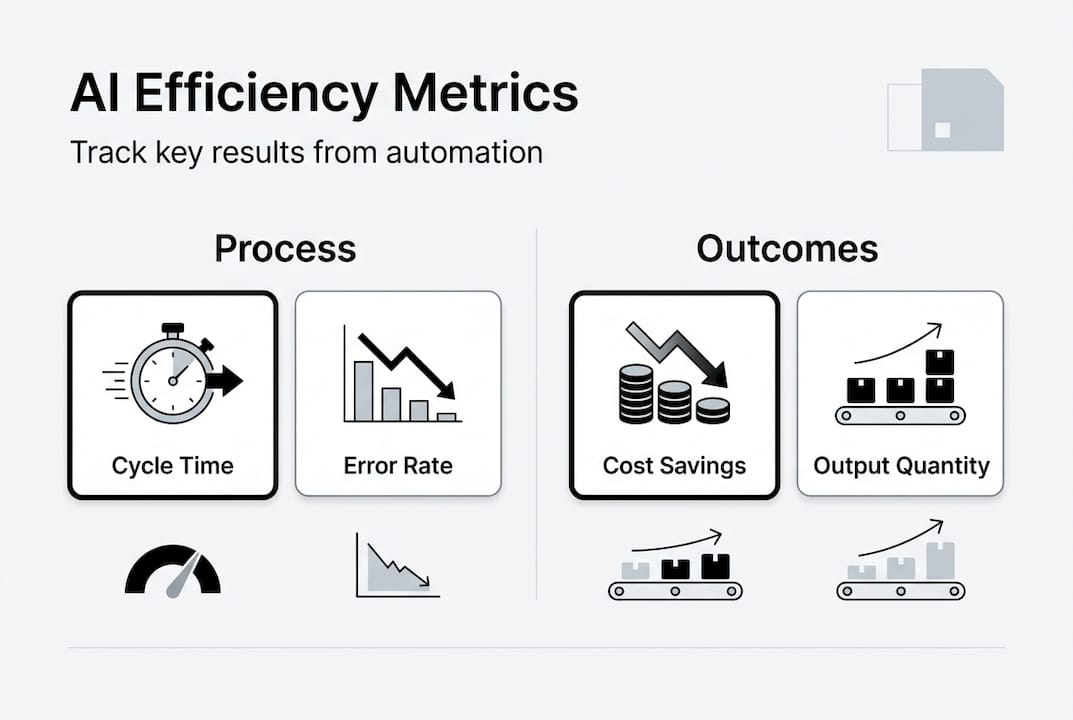
Measurement transforms AI from an experiment into a strategic asset. Establish clear KPIs before deployment so you can track actual impact. Task completion time reveals whether AI genuinely speeds up work or just shifts bottlenecks elsewhere. Error rates show if automation maintains quality standards or introduces new problems. Cost savings quantify ROI by comparing labour hours saved against implementation and maintenance expenses. Employee retention indicates whether AI reduces burnout or creates frustration.
Regularly audit AI outputs to detect issues early. Review a sample of automated decisions, communications, and data processing results each week. Look for hallucinations where AI invents information, inefficiencies where it takes unnecessarily complex paths, and drift where performance degrades over time. Catching these problems quickly prevents them from becoming systemic.
Maintain governance frameworks that define roles, responsibilities, and escalation procedures. Someone must own AI performance, respond to alerts, and make adjustment decisions. Without clear ownership, issues languish unresolved until they cause visible damage. Sustaining AI benefits requires active governance because 40% of projects fail without ongoing management.
Continuously update and retrain AI models based on real-world feedback. Business conditions change, customer preferences evolve, and new edge cases emerge. Static AI becomes obsolete quickly. Schedule regular reviews to assess whether your automation still serves current needs or requires adjustment. This iterative approach keeps AI relevant and valuable.
Foster user acceptance through clear communication and training. Explain what AI does, why it helps, and how humans remain essential. Address concerns directly and involve staff in improvement decisions. Resistance often stems from fear of the unknown rather than actual problems. Transparency builds confidence and encourages productive collaboration between humans and AI.
- Track both leading indicators (task completion rates, processing speed) and lagging indicators (customer satisfaction, revenue impact)
- Compare performance against pre-AI baselines, not just theoretical targets
- Celebrate wins publicly to build momentum and demonstrate value
- Address failures quickly and transparently to maintain trust
- Adjust expectations based on actual results rather than vendor promises
| Metric category | Example KPIs | Measurement frequency |
|---|---|---|
| Efficiency | Task completion time, throughput | Weekly |
| Quality | Error rates, rework frequency | Weekly |
| Financial | Cost per transaction, labour savings | Monthly |
| Employee | Satisfaction scores, retention rates | Quarterly |
| Customer | Response times, satisfaction ratings | Monthly |
Pro Tip: Implement effective time tracking before and after AI deployment to quantify actual productivity gains. Subjective impressions often mislead, hard data reveals truth. Understanding the role of AI in scheduling helps you identify where automation delivers maximum value versus where human judgement remains superior.
Explore HumanOS for AI-driven operational efficiency
Ready to transform your operations without the trial and error? HumanOS delivers AI agents purpose-built for small business workflows, from email management and scheduling to document processing and customer support. Our platform includes human-in-the-loop controls by design, preventing the common failures that plague DIY automation attempts.

Backed by 10+ years of systems architecture experience and a BBB A-rating, HumanOS guarantees at least 30% productivity and profitability improvements. Our MCP-powered architecture keeps AI explainable, governed, and embedded in your existing workflows rather than bolted on as another forgotten tab. Explore our AI operating system with no credit card required, or discover how our managed web services eliminate the $5K-$15K agency markup while continuously optimising your digital presence. Visit HumanOS to see how we handle the mundane so you can focus on what compounds: human connections, strategy, and growth.
Frequently asked questions
What are the biggest challenges when adopting AI to boost operational efficiency?
Data quality issues top the list, since AI trained on incomplete or inconsistent information produces unreliable results. Many businesses also make the mistake of automating existing broken processes, which just makes inefficiency happen faster. Resistance to change creates friction when employees fear job loss or loss of control. AI failure risks like hallucinations, inefficient loops, and model drift threaten ROI without proper monitoring and governance. Human oversight and proper workflow redesign before automation address these challenges effectively.
How can SMBs ensure AI automation does not disrupt existing workflows?
Start by mapping and fixing workflows before introducing AI, identifying bottlenecks and redundancies that need addressing first. Implement human-in-the-loop controls that allow staff to monitor AI decisions and handle exceptions requiring judgement. Deploy automation gradually through pilot programs that reveal issues before full rollout. Maintain kill switches and override capabilities so humans retain ultimate control. This measured approach prevents chaos while building confidence in AI capabilities.
What metrics should businesses track to measure the success of AI-driven efficiency improvements?
Track task completion times to verify AI genuinely speeds up work rather than just shifting bottlenecks. Monitor error rates to ensure automation maintains quality standards. Measure cost savings by comparing labour hours saved against implementation expenses. Employee retention rates indicate whether AI reduces burnout or creates frustration. Regular audits of AI outputs help identify issues like hallucinations or drift before they compound. Comparing these metrics against pre-AI baselines reveals actual impact versus theoretical promises.