

Eleven percent of new hires drop out before their first day, costing businesses thousands in recruitment expenses and operational delays. This dropout crisis stems from disconnected communication, paperwork overload, and a lack of engagement during the pre-boarding phase. Onboarding automation transforms this vulnerable period by creating seamless, personalised experiences that keep candidates engaged from offer acceptance to day one. For small and mid-sized businesses, automation isn't just about efficiency, it's about protecting your talent investment and building momentum before new hires even walk through the door. This article explains what onboarding automation is, how it works, and why it delivers measurable improvements in retention, productivity, and cost savings for growing organisations.
Table of Contents
- Understanding Onboarding Automation And Its Benefits
- How Onboarding Automation Improves Efficiency And Collaboration
- Customisation, Personalisation And Data Insights In Onboarding Automation
- Comparing Manual Vs Automated Onboarding Processes
- Enhance Your Onboarding With AI Automation Solutions
Key takeaways
| Point | Details |
|---|---|
| Reduces dropout rates | Automation cuts pre-day one dropouts by 11% through consistent engagement and personalised communication. |
| Saves administrative time | Automated workflows eliminate over 1,200 hours of manual tasks annually, freeing HR for strategic work. |
| Enables personalisation | Tailored onboarding journeys based on role, location, and preferences improve new hire engagement and retention. |
| Provides data insights | Learning and development teams track cohort performance and refine training programmes using onboarding analytics. |
| Delivers measurable ROI | Organisations report up to $1.5M in savings from reduced dropouts and improved efficiency. |
Understanding onboarding automation and its benefits
Onboarding automation uses technology to streamline and personalise the integration of new hires into your organisation. It replaces manual, repetitive tasks with intelligent workflows that handle everything from document signing to IT provisioning without constant human intervention. This approach ensures consistency, reduces errors, and creates a structured experience that scales with your business growth.
The benefits extend far beyond administrative convenience. Onboarding automation reduces pre-day one dropouts by 11% by maintaining regular touchpoints with candidates during the critical period between offer acceptance and start date. When new hires receive timely communication, clear next steps, and personalised content, they feel valued and connected to your organisation before day one arrives.
Automation transforms several key onboarding processes:
- Digital document collection and e-signature workflows eliminate printing, scanning, and manual follow-ups
- Automated IT provisioning triggers laptop orders, software access, and account creation based on role requirements
- Scheduled communication sequences deliver welcome messages, company information, and pre-boarding tasks at optimal intervals
- Task management systems assign and track completion of orientation activities across departments
- Integration with HRIS platforms ensures data flows seamlessly between recruitment, payroll, and employee records
These capabilities align perfectly with broader business process automation strategies that help SMBs compete with larger enterprises. When you automate onboarding, you're not just improving one process, you're establishing a foundation for operational excellence that compounds over time. New hires experience professionalism from day one, managers receive real-time visibility into onboarding progress, and HR teams gain capacity to focus on relationship building rather than paperwork chasing.
The impact shows up in retention metrics, time-to-productivity measurements, and employee satisfaction scores. Organisations that implement structured onboarding automation report higher engagement levels, faster ramp-up periods, and stronger cultural alignment among new team members. For businesses operating on tight margins, these improvements translate directly to bottom-line results.
How onboarding automation improves efficiency and collaboration
Time savings represent the most immediate and measurable benefit of onboarding automation. Organisations implementing automated workflows save over 1,200 hours annually in administrative work that previously consumed HR team capacity. These hours don't just disappear, they get redirected toward high-value activities like strategic workforce planning, employee development programmes, and culture building initiatives that actually move your business forward.

Cross-functional collaboration improves dramatically when automation coordinates activities across departments. Consider the typical manual onboarding scenario: HR emails IT about a new hire's laptop needs, IT responds when they see the message, facilities gets looped in separately for desk assignment, and the manager discovers gaps on day one. Automation eliminates this coordination chaos by triggering parallel workflows the moment a hire is confirmed. IT receives laptop specifications automatically, facilities gets workspace requirements, and the manager sees a dashboard showing exactly what's complete and what's pending.
The efficiency gains compound across your organisation:
- HR teams eliminate repetitive data entry and focus on personalised new hire conversations
- IT departments provision access and equipment proactively rather than reactively
- Managers receive automated reminders for check-ins and milestone reviews
- Finance processes payroll setup without manual form collection
- Compliance teams track required training completion through automated dashboards
These improvements directly support effective time tracking strategies by creating transparent workflows where every stakeholder knows their responsibilities and deadlines. When tasks flow automatically between systems, you eliminate the hidden time costs of status updates, follow-up emails, and coordination meetings.
Pro Tip: Schedule quarterly reviews of your automated onboarding workflows with representatives from HR, IT, operations, and management. Use these sessions to identify bottlenecks, update content, and ensure cross-functional coordination remains smooth as your business evolves.
The collaboration benefits extend beyond internal efficiency. New hires experience a coordinated, professional onboarding journey that reflects well on your organisational competence. When their laptop arrives on time, their accounts work on day one, and their manager has a structured plan ready, they perceive your business as organised and capable. This perception shapes their early engagement and willingness to invest energy in their new role.
Customisation, personalisation and data insights in onboarding automation
Personalisation transforms onboarding from a generic checklist into a meaningful journey tailored to each new hire's role, location, and experience level. Automated systems enable customised experiences by branching workflows based on employee attributes captured during recruitment. A remote software developer receives different content, tasks, and touchpoints than an on-site sales representative, ensuring relevance at every step.
This customisation happens automatically through conditional logic embedded in your onboarding platform. When you define role-based pathways, the system delivers appropriate training modules, introduces relevant team members, and assigns location-specific tasks without manual intervention. A new hire in your Toronto office gets information about local benefits and parking, while someone joining your Vancouver location receives content specific to their workplace and regional policies.
The personalisation extends to communication timing and content. Some new hires prefer detailed information packages, others want concise summaries with links to deeper resources. Automated surveys during pre-boarding capture these preferences and adjust content delivery accordingly. This responsiveness creates a sense of individual attention that manual processes struggle to match at scale.
Data insights represent the strategic advantage of onboarding automation. Learning and development teams track cohort performance across multiple dimensions:
- Task completion rates reveal which onboarding activities engage new hires and which get skipped
- Time-to-productivity metrics show how quickly different roles reach performance benchmarks
- Satisfaction scores identify pain points in the onboarding journey that need refinement
- Retention correlation analysis links specific onboarding experiences to long-term employee success
- Training effectiveness measurements demonstrate which learning modules drive actual skill development
These insights inform continuous improvement cycles that manual onboarding can't support. When you see that new hires in a particular department consistently struggle with a specific training module, you can revise content, add support resources, or adjust the timing. The AI-driven analytics available in modern platforms surface patterns that would remain invisible in spreadsheet-based tracking.
Pro Tip: Implement automated pulse surveys at days 7, 30, and 90 to capture new hire sentiment while experiences are fresh. Use this feedback to refine your onboarding workflows quarterly, ensuring your process evolves with your organisational needs and employee expectations.
The combination of personalisation and data creates a virtuous cycle. Better data leads to more refined personalisation, which improves engagement and generates richer data for further optimisation. Organisations that embrace this cycle see onboarding effectiveness improve year over year, even as they scale hiring volume.
Comparing manual vs automated onboarding processes
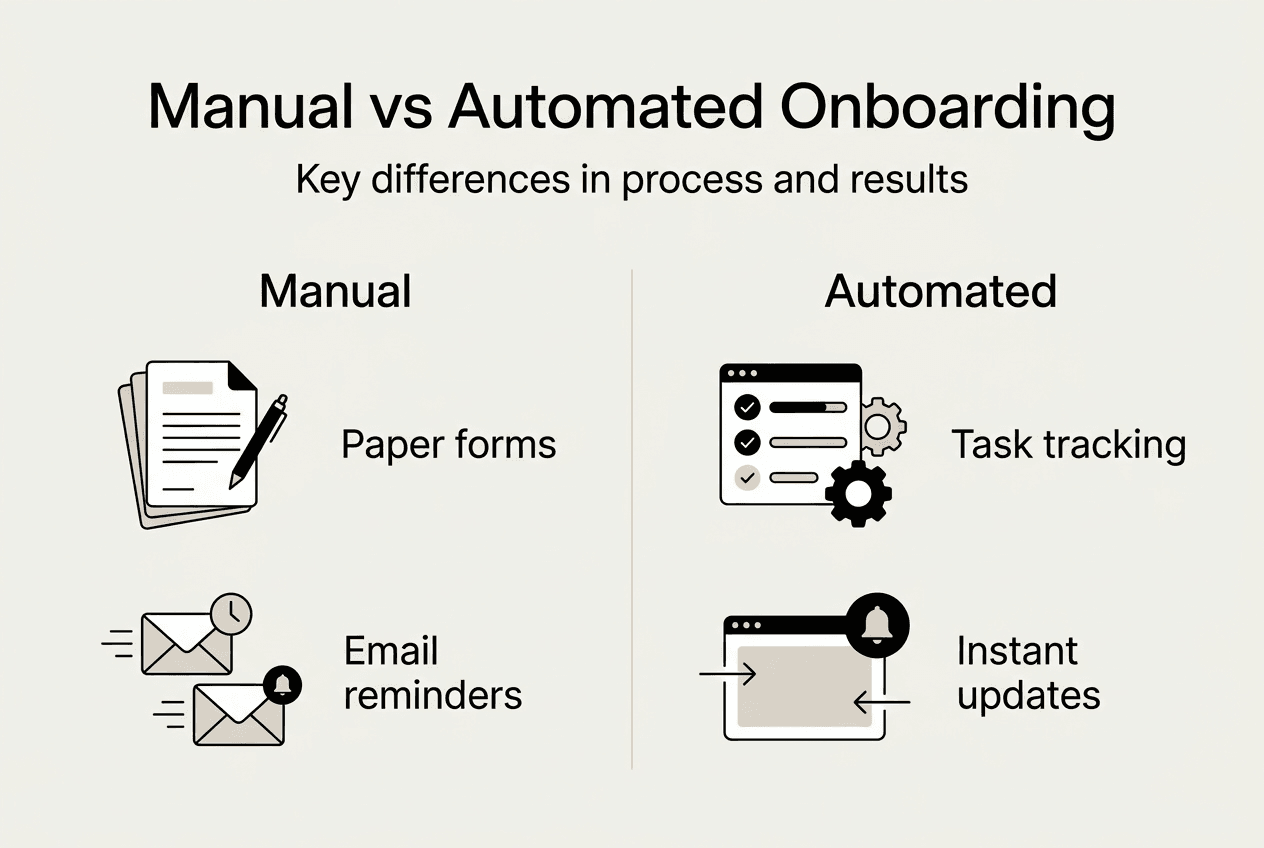
Understanding the practical differences between manual and automated onboarding helps you evaluate whether automation delivers sufficient value for your investment. The comparison reveals stark contrasts across operational dimensions that directly impact your business performance.
| Aspect | Manual onboarding | Automated onboarding |
|---|---|---|
| Time investment | 20-30 hours per hire across multiple departments | 5-8 hours per hire with automated workflows |
| Consistency | Varies by HR staff member and workload | Standardised experience for every new hire |
| Dropout rate | 15-20% before day one | 4-9% with engagement automation |
| Scalability | Requires proportional HR headcount growth | Handles volume increases without additional staff |
| Data tracking | Spreadsheets with incomplete information | Real-time dashboards with comprehensive analytics |
| Cost per hire | $3,000-$5,000 including hidden coordination costs | $800-$1,500 with platform subscription |
The efficiency advantages become more pronounced as hiring volume increases. A business onboarding five people monthly might manage manual processes adequately, though inefficiently. That same business scaling to 15 hires monthly faces a choice: triple HR headcount or implement automation that handles the volume with existing staff.
Manual onboarding creates several persistent challenges:
- Paperwork delays when documents sit in email inboxes or on desks awaiting signatures
- Inconsistent experiences when different HR team members follow slightly different processes
- Lack of visibility into completion status across departments and tasks
- Difficulty tracking which new hires need follow-up and for which specific items
- Limited ability to personalise experiences when every customisation requires manual effort
- No systematic way to capture feedback or measure onboarding effectiveness
Automation eliminates these friction points while introducing capabilities impossible with manual processes. The financial impact extends beyond direct time savings. Organisations implementing comprehensive onboarding automation report ROI exceeding $1.5M annually from reduced dropouts, faster productivity ramp-up, and improved retention rates. These gains compound over time as your onboarding process becomes a competitive advantage in talent acquisition.
The strategic value appears in your ability to scale operations without proportional cost increases. Business operations automation creates leverage, allowing your team to accomplish more with existing resources. When onboarding runs smoothly, you can focus growth investments on revenue-generating activities rather than administrative overhead.
Enhance your onboarding with AI automation solutions
Transforming your onboarding process from manual chaos to automated excellence requires the right technology foundation. HumanOS delivers AI-powered automation specifically designed for small and mid-sized businesses ready to eliminate operational friction. The platform handles onboarding workflows alongside broader business process automation, creating an integrated system where new hire integration connects seamlessly with your existing operations.
The AI agents manage document collection, task assignment, communication sequences, and progress tracking without requiring coding knowledge or technical expertise. You configure workflows through an intuitive interface, the system handles execution, and you gain visibility through real-time dashboards showing exactly where each new hire stands in their onboarding journey. Explore AI automation solutions that scale with your business, delivering the 30% productivity improvements that separate growing companies from stagnant ones. With managed web services handling your digital infrastructure and AI agents automating your operations, you build the foundation for sustainable growth without the weekend-consuming DIY approach that burns out operators.
FAQ
What is onboarding automation?
Onboarding automation uses technology platforms to handle the administrative and operational tasks required to integrate new hires into your organisation. It includes digital forms, automated task assignments, scheduled communication sequences, and progress tracking dashboards. The system coordinates activities across HR, IT, facilities, and management without manual intervention, ensuring consistent experiences and eliminating coordination delays.
How does onboarding automation reduce pre-day one dropouts?
Automated communication and engagement keep new hires connected to your organisation during the vulnerable period between offer acceptance and start date. Regular touchpoints, personalised content, and clear next steps make candidates feel valued and excited about joining. When new hires receive consistent attention and see your organisational competence through smooth pre-boarding, they're far less likely to accept competing offers or experience cold feet.
What are the main time savings with onboarding automation?
Automation eliminates over 1,200 hours annually in administrative work by handling document collection, IT provisioning, task tracking, and cross-functional coordination automatically. HR teams stop chasing signatures and status updates, allowing them to focus on relationship building and strategic initiatives. The time savings compound across all departments involved in onboarding, from IT to facilities to management. These efficiency gains align with broader time tracking strategies that help SMBs maximise team productivity.
How can SMBs customise onboarding automation?
Most onboarding platforms enable customisation through conditional workflows that branch based on role, location, department, and experience level. You define different pathways for various employee types, and the system automatically delivers appropriate content, tasks, and communication. SMBs can also integrate automated feedback collection to capture new hire preferences and adjust experiences accordingly. The customisation happens through configuration rather than coding, making it accessible even for businesses without technical resources. This personalisation capability mirrors the adaptive intelligence found in modern AI customer support systems that tailor interactions to individual needs.