

TL;DR:
- Most small business owners expect a plug-and-play AI button, but the gent model ecosystem offers a powerful, configurable automation platform that orchestrates AI agents, memory, and workflows without coding. It enables per-phase AI model assignment and persistent memory, improving accuracy, adaptability, and knowledge retention across processes. Implemented incrementally, this modular approach helps SMBs build smarter workflows, enhance operational resilience, and boost productivity sustainably.
Most small business owners searching for "gent model" expect to find a ready-to-deploy AI button they can click and walk away from. The reality is more interesting, and far more powerful. The Gentle AI ecosystem is a flexible configurator that orchestrates AI agents, memory, workflow logic, and model assignment together, giving SMBs a smarter, more adaptable automation foundation without requiring a software engineering degree to operate it.
Table of Contents
- What is the gent model and how does it work?
- How per-phase model assignment supercharges business workflows
- Unlocking persistent memory: Why 'Engram' matters for SMBs
- Practical steps for using gent model to improve your SMB process
- Gent model: What most SMB owners miss about AI automation
- Ready to simplify AI automation? Discover HumanOS solutions
- Frequently asked questions
Key Takeaways
| Point | Details |
|---|---|
| Not just another tool | The gent model refers to a flexible AI ecosystem, not a single plug-and-play app. |
| Smart, phase-based automation | Assigning different AI models to each workflow phase boosts small business productivity and reliability. |
| Persistent memory advantage | Gentle AI's 'Engram' feature keeps business knowledge accessible and reduces repeated work. |
| No-code friendly | You can benefit from the gent model's automation even with minimal technical skills. |
| Start small, scale wisely | Begin with a few targeted automations and grow as your business sees results. |
What is the gent model and how does it work?
The term "gent model" does not refer to a single packaged product sitting on a shelf waiting to be installed. It points to the Gentle AI stack, an ecosystem-level toolset designed to coordinate how AI agents think, remember, and act across different stages of a business workflow. Think of it less like a single power tool and more like an entire workshop, where each tool is selected and assigned based on the job at hand.
For SMBs, that distinction matters enormously. Most plug-and-play AI tools hand you one hammer and expect you to use it on everything. The gent model approach lets you configure which AI model handles which task, how memory is retained between sessions, and how workflows are structured so that automation actually fits your business rather than forcing your business to fit the automation. This flexibility is what allows operators to boost SMB productivity without overhauling their entire operation at once.
Here is what the gent model ecosystem actually manages for you:
- Memory configuration: Persistent recall of past decisions, bugs, and context so the AI does not start from scratch every session.
- Workflow orchestration: Structured sequences that guide AI agents through repeatable business processes step by step.
- Model assignment: Routing specific AI models to specific phases of work, so a creative task gets a creative model and a logic-heavy task gets a precision-focused one.
- Skills management: Defining what capabilities each agent is permitted to use within a given context.
Pro Tip: You do not need to configure everything at once. Start with workflow orchestration for your single most repetitive task, get comfortable with the outputs, and layer in memory and model assignment as confidence builds.
The key insight here is that the gent model is a configurator, not a replacement for your existing processes. It improves decision-making at the automation layer, reduces the technical friction of setting up AI agents, and makes it realistic for non-technical operators to run sophisticated workflows. That is a significant shift from what most SMBs assume AI automation requires.
How per-phase model assignment supercharges business workflows
One of the most practically valuable features inside the gent model ecosystem is per-phase model assignment. The concept is straightforward: different phases of any project or workflow call for different kinds of thinking. Gentle AI formalises this by letting you route AI models to different Spec-Driven Development phases, including design, implementation, and exploration, so the right intelligence is always applied at the right moment.
Consider a customer onboarding workflow. The exploration phase, where you are mapping out what the customer needs, benefits from a conversational, context-sensitive AI model that can handle ambiguity well. The implementation phase, where you are populating forms, assigning accounts, and triggering follow-up sequences, benefits from a model that is precise, rule-following, and fast. Using the same model for both phases is like asking your most creative copywriter to also proofread legal contracts. Technically possible. Rarely optimal.

Here is how per-phase assignment compares to a traditional single-model approach:
| Feature | Gent model (per-phase) | Traditional one-size-fits-all AI |
|---|---|---|
| Model selection | Best model per phase | Single model for all phases |
| Error rate | Lower, task-specific accuracy | Higher, generalised trade-offs |
| Workflow flexibility | Highly configurable | Rigid and limited |
| Setup complexity | Moderate initial config | Simple but limited |
| Scalability | Scales with business complexity | Hits ceiling quickly |
| Cost efficiency | Optimised per task type | Often over-powered for simple tasks |
To implement per-phase model assignment effectively in your own workflows, follow this sequence:
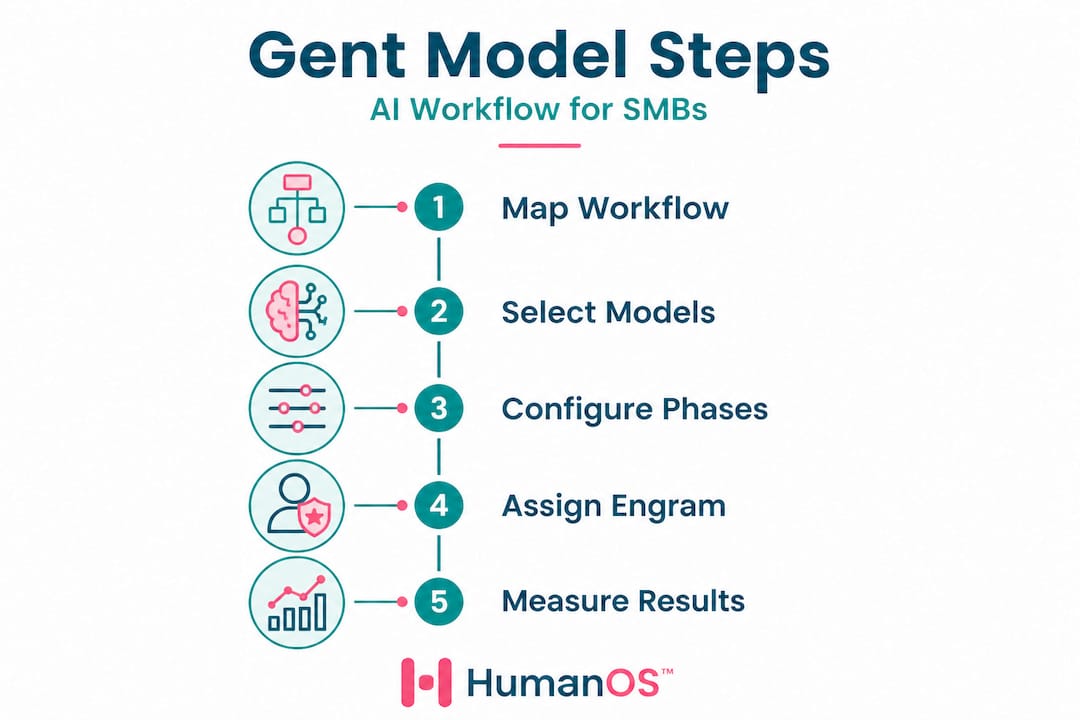
- Map your workflow phases. Write out the distinct stages of a recurring process, such as new client intake, monthly reporting, or support ticket resolution.
- Identify the nature of each phase. Is it creative, exploratory, analytical, or procedural? Each type has an AI model that excels at it.
- Assign models to phases. Configure the gent model ecosystem to route each phase to the appropriate model.
- Run a test cycle. Process a real workflow end to end and compare results against your manual baseline.
- Measure and adjust. Track error rates, time savings, and output quality, then refine assignments based on what you observe.
This structured approach is precisely how AI is driving SMB growth in a sustainable way rather than through hype-driven deployments that collapse under real operating conditions. The businesses seeing results are the ones treating AI assignment like a staffing decision, where the right person (or model) gets the right job.
Pro Tip: If you are not sure which model suits a particular phase, start with a reasoning-optimised model for analytical tasks and a generative model for communication or content tasks. Test both and let the results guide your configuration.
Improving AI operational efficiency through per-phase assignment is not just a technical win. It is a strategic one. When your AI infrastructure mirrors how thoughtful humans actually work, you get outputs that feel purposeful rather than mechanical.
Unlocking persistent memory: Why 'Engram' matters for SMBs
Here is a frustration nearly every SMB owner recognises. You spend 45 minutes walking a new team member through the context of an ongoing client project, covering what was tried, what failed, and where things stand now. Three weeks later, the same conversation happens again with someone else. Time gone. Energy wasted. Progress stalled.
Engram is the gent model ecosystem's answer to that problem. It is persistent AI memory that retains decisions, bug histories, and contextual information across sessions so that your AI agents do not suffer from the same amnesia that plagues disconnected tools. When a workflow resumes after a break, Engram brings the agent back up to speed instantly.
The business impact is more significant than it might initially seem. Consider these common scenarios:
- Support workflows: An agent that remembers a customer's previous issue and resolution does not ask them to repeat themselves. That alone changes the customer experience.
- Project documentation: Context about why certain decisions were made is retained automatically, reducing the time spent reconstructing logic weeks or months later.
- Process troubleshooting: If a workflow fails, Engram retains information about what went wrong, making repeat failures far less likely.
- Onboarding sequences: An agent guiding a new client through setup steps can recall where the previous session ended and pick up without interruption.
"Persistent memory is not a luxury feature for enterprise platforms. For small businesses running lean teams, it is the difference between an AI tool that saves time and one that silently doubles the effort."
Here is a practical overview of what Engram tracks and why it matters for your day-to-day operations:
| Memory type | What Engram retains | Business benefit |
|---|---|---|
| Decision history | Past choices and rationale | Avoids repeating resolved debates |
| Bug and error log | Past failures and fixes | Prevents recurring troubleshooting loops |
| Session context | Where a workflow left off | Eliminates onboarding time each session |
| Client-specific data | Preferences and prior interactions | Personalises automated responses |
Using AI productivity tools that retain context is not just about convenience. Research consistently shows that context-switching and repeated rework are among the largest hidden costs in small business operations. Engram directly attacks those inefficiencies by making your AI infrastructure behave like a knowledgeable, experienced team member rather than a tool with no short-term memory. The cumulative effect on SMB profitability is real and measurable, particularly for businesses that handle high-volume, repetitive workflows.
Practical steps for using gent model to improve your SMB process
The gent model ecosystem is designed to be configured without heavy development resources, which means the barrier to entry for most SMB owners is lower than expected. The critical shift is moving from "I'll try AI eventually" to "I'll automate one specific thing this week." That single step is where real operational improvement begins.
Here is a clear sequence for getting started without getting overwhelmed:
- Identify your top three recurring workflows. Look for tasks that happen weekly or daily, involve predictable steps, and currently eat up disproportionate time. Common candidates include customer support responses, new client onboarding, invoice processing, and meeting preparation.
- Choose your first automation target. Pick the one workflow where errors are most costly or where the time drain is most obvious. Start there. Do not try to automate everything at once.
- Map the workflow phases. Break the chosen process into distinct steps and note which steps require creativity, which require precision, and which are purely repetitive.
- Configure model and memory settings. Using the gent model ecosystem, assign appropriate AI models to each phase and activate Engram so context is retained between sessions.
- Run a parallel test. Process the workflow both manually and through your new automation simultaneously for a short period. Compare outputs, flag discrepancies, and refine your configuration.
- Track measurable improvements. Time savings per week, error rate reduction, and team hours recovered are all worth logging. These numbers matter when you are making the case for expanding automation further.
- Iterate and expand. Once your first workflow runs reliably, apply the same process to the next item on your list.
The most common use cases where SMBs see fast, tangible wins include:
- New employee onboarding: Automating document distribution, task sequencing, and follow-up reminders.
- Customer support routing: Using intelligent assignment to direct queries to the right resolution path without manual triage.
- Process documentation: Having AI agents capture workflow steps automatically as they are performed, building a living knowledge base with minimal extra effort.
Pro Tip: Before you configure anything, spend 20 minutes writing out one workflow in plain language, step by step, as if you were explaining it to a new hire. That document becomes your automation blueprint and dramatically speeds up the configuration process.
The journey from AI productivity improvement steps to measurable results does not require a six-month implementation project. With the gent model approach, most SMBs can have their first automated workflow running in under a week.
Gent model: What most SMB owners miss about AI automation
Here is the perspective most AI guides will not give you directly. The businesses that struggle most with AI adoption are not the ones that lack budget or technical talent. They are the ones paralysed by the belief that AI is an all-or-nothing commitment. Either you overhaul your entire operation and go "full AI," or you wait until the technology matures further. Both positions leave enormous value sitting on the table.
The gent model ecosystem challenges that binary thinking in a concrete way. Because it is modular, you can automate one workflow phase while keeping others manual. You can activate memory for one process without touching another. That granularity is not just a technical convenience. It is a strategic advantage that lets you experiment safely, build confidence incrementally, and compound your gains over time without betting the business on a single implementation.
There is also a deeply human dimension that most automation guides overlook. Engram and per-phase model assignment are not just efficiency tools. They are knowledge retention tools. For SMBs where critical operational knowledge often lives in the heads of two or three key people, building that knowledge into an AI-powered system creates resilience. When those people are unavailable, on holiday, or eventually move on, the institutional memory does not walk out the door with them.
The real edge of the gent model approach is that it encodes good business habits into your infrastructure. The way you onboard clients, handle escalations, and document decisions becomes embedded in a system that improves over time rather than degrading when your team changes. Exploring productivity tips for SMBs will consistently point back to this principle: systemise what you do well, so you can do it consistently at scale.
Small, strategic adoption beats all-or-nothing every time. The gent model gives you the tools to prove that in your own business, one workflow at a time.
Ready to simplify AI automation? Discover HumanOS solutions
The gent model approach shows exactly what smart AI automation looks like: modular, memory-driven, and matched to how your business actually works. If reading through these concepts has you thinking "this is what I need, but I want help getting there," that is precisely what HumanOS is built for.
HumanOS offers no-code AI agents and managed automation tools designed with the same principles at their core, flexible configuration, persistent context, and workflow logic that fits your operation rather than the other way around. You do not need to hire a developer or spend months on implementation. Our platform is built so SMB operators can start automating real workflows quickly, with guaranteed results and no credit card required to begin. Explore our full range of AI automation solutions or visit HumanOS to start your free trial today and see what measurable productivity looks like in your business.
Frequently asked questions
Is the gent model suitable if I don't have coding skills?
Yes, the gent model (Gentle AI) is designed as an ecosystem you can configure without heavy coding, with its ecosystem configurator handling memory, workflow, and model assignment in an accessible way that suits non-technical SMB owners.
What makes per-phase model assignment better than using just one AI for everything?
Assigning different AI models to specific project phases means each part of your workflow gets the most capable tool for that job, reducing errors and improving output quality compared to a single generalised model. Gentle AI's per-phase model assignment formalises this approach across design, implementation, and exploration stages.
How does Engram help my business processes?
Engram acts as persistent AI memory, storing decisions, past errors, and session context so your AI agents never start from zero, which directly reduces rework and speeds up every subsequent workflow run.
Can I automate only a few workflows to start?
Absolutely. The gent model's ecosystem configurator is modular by design, so you can automate one workflow at a time and expand gradually as your confidence and results build.