

TL;DR:
- Focus on mapping tasks by frequency, value, and risk before adopting AI tools.
- Test AI pilots on high-frequency, low-risk tasks for measurable productivity gains.
- Maintain a hybrid approach, combining automation with human judgment for optimal results.
Running a small or mid-sized business in 2026 means navigating a flood of AI tools, workflow promises, and competing priorities all at once. The pressure to modernise is real, but so is the risk of chasing shiny technology without a clear plan. The good news? AI can boost productivity significantly for SMB knowledge work, but only when you apply a strategic lens to which tasks get automated, augmented, or kept human. This article walks you through four evidence-backed, field-tested approaches so you can make confident decisions and start seeing measurable gains fast.
Table of Contents
- Map tasks for automation, augmentation, or human judgement
- Start small with AI pilots and measure for real impact
- Standardise team processes for reliable results
- Compare high-impact productivity upgrades for SMBs
- Why the right blend beats full automation every time
- Ready to boost your SMB productivity with AI solutions?
- Frequently asked questions
Key Takeaways
| Point | Details |
|---|---|
| Map tasks strategically | Organise each workflow by frequency, value, and risk to choose the right automation approach. |
| Pilot with AI and measure | Launch small-scale AI projects in text-heavy tasks, tracking outcome metrics like time saved. |
| Standardise teamwork | Set clear ownership and uninterrupted time blocks to boost results before adding more tech. |
| Balance automation with human judgement | Keep humans involved for critical decisions, leveraging automation where risks are lowest. |
Map tasks for automation, augmentation, or human judgement
Before you touch a single tool, you need a map. Not a vague list of "things AI can help with," but a structured view of your workflows built around three criteria: frequency, value, and risk. This workflow automation mapping approach is what separates businesses that see real productivity gains from those that simply add more software to their stack.
Here is how the three categories break down:
- Automate: High-frequency, low-value, low-risk tasks. Think invoice reminders, appointment confirmations, and data entry. These are perfect candidates because mistakes are easily caught and the time savings compound quickly.
- Augment: Tasks where AI assists but a human still decides. Examples include drafting client proposals, analysing sales data, or filtering support tickets. The AI does the heavy lifting; you apply judgement.
- Keep human: Low-frequency, high-value, high-risk decisions. Contract negotiations, hiring choices, and crisis communications belong here. Automating these too early creates liability and erodes trust.
To make this concrete, here is a sample mapping for common SMB tasks:
| Task | Category | Reason |
|---|---|---|
| Invoice reminders | Automate | Repetitive, low-risk, rule-based |
| Customer support triage | Augment | Needs context, AI filters first |
| Email follow-ups | Automate | High volume, templatable |
| Proposal writing | Augment | Creative, AI drafts, human refines |
| Hiring decisions | Keep human | High-risk, judgement-critical |
| Social media scheduling | Automate | Repetitive, low-stakes |
| Vendor contract review | Keep human | Legal risk, nuanced terms |
| Meeting notes and summaries | Augment | AI transcribes, human validates |
The table above is a starting point. Your version will reflect your own business processes, team size, and risk tolerance. The key insight is that targeting high-frequency, low-value tasks for automation creates the fastest time savings, while augmentation handles the middle ground where creativity and accuracy both matter.
Pro Tip: Build your task map before you evaluate any tool. If a tool does not serve a task you have already identified as a priority, skip it. Let your map drive your tech choices, not the other way around.
This criteria-driven method ensures that every investment, in time, money, or training, earns its place in your operations.
Start small with AI pilots and measure for real impact
With a clear map in hand, the next move is to test one change at a time in a controlled, low-risk setting. This is the pilot approach, and it is far more powerful than rolling out AI tools across your entire operation at once.
Here is a simple four-step process to get started:
- Choose one workflow. Pick a task from your automation or augmentation list. Prioritise something your team does daily and that has a measurable output, like response time or document turnaround.
- Define your success metrics. Before you start, agree on what success looks like. Time saved per task? Error rate? Team satisfaction score? Pick two or three numbers you can track.
- Run the pilot for two to four weeks. Keep the scope tight. One tool, one workflow, one team or one person. Avoid changing other variables during this period.
- Measure and decide. Compare your pre-pilot and post-pilot numbers. Did you hit your targets? If yes, scale. If not, adjust the approach or move to the next task on your map.
The evidence supports this method. Generative AI assistance has been shown to improve time-to-completion and satisfaction for text-heavy tasks, with meaningful time savings observed per writing or research session. That is the kind of concrete, measurable win that builds internal confidence and justifies further investment.
The mistake most SMBs make is measuring success by counting tools rather than tracking outcomes. Ten AI tools delivering vague "efficiency gains" is worth far less than one tool that saves your team two hours per day with documented proof. Explore AI productivity pilot strategies to go deeper on structuring experiments that produce reliable results.
Pro Tip: When selecting your first pilot, look for the process that causes the most friction and has the clearest output. These are the quick wins that build team buy-in and make your next pilot easier to justify. You can also review how boosting efficiency and profit with AI looks in practice across different SMB contexts.
Standardise team processes for reliable results
AI pilots gain traction faster when your team's underlying processes are already clean. Standardisation is not glamorous, but it is one of the highest-leverage moves an SMB can make, with or without any technology investment.
Here are four process upgrades that deliver immediate operational value:
- Assign a single owner to every task. When two people are responsible, nobody is. Clear ownership eliminates the follow-up emails, the dropped balls, and the wasted time spent figuring out who is handling what.
- Set one meaningful daily goal per team member. Prioritising everything means prioritising nothing. One clear goal per person per day keeps output focused and progress visible.
- Run brief, structured standups. A 10-minute daily check-in with a fixed agenda outperforms a 60-minute weekly meeting every time. Keep it short, keep it consistent.
- Protect deep-work blocks. Fragmented attention is the enemy of quality output. Operational productivity improvements in SMBs consistently point to protecting uninterrupted work time as a top-tier lever.
"Standardising work ownership and shielding focused work time from constant interruption are among the most reliable, research-backed ways to lift team output without adding a single new tool."
Process standardisation also multiplies the value of any AI you introduce. When your workflows are consistent and well-documented, AI agents have clear inputs to work with. When workflows are chaotic, AI simply automates the chaos faster. If you want to understand how structure and technology combine, see how AI for operational efficiency works in real SMB environments.

The businesses that see the strongest long-term gains from AI are rarely the ones that moved fastest. They are the ones that laid clean operational foundations first, then layered intelligent automation on top. SMB growth efficiency strategies confirm this pattern across industries.
Compare high-impact productivity upgrades for SMBs
Now that you have explored the individual strategies, it helps to see them side by side. Choosing where to focus first depends on your business goals, team capacity, and risk comfort level.
| Upgrade type | Value potential | Ease of implementation | Risk level | Best fit for |
|---|---|---|---|---|
| Full automation | High | Moderate | Low to medium | Repetitive, rule-based workflows |
| AI augmentation | Very high | Moderate | Medium | Creative or analytical tasks |
| Team process standardisation | High | Easy | Low | Any team size, any stage |
| Pilot programme | Medium to high | Easy | Low | Businesses new to AI |
| Combined hybrid approach | Highest | Complex | Medium | Scaling SMBs with clear ops |
A few scenario-based recommendations to guide your choice:
- If you are just starting out with AI, begin with a single pilot on a text-heavy task. Generative AI is most reliably effective for writing, research, and meeting-related work, so that is your lowest-risk entry point.
- If your team is already stretched thin, process standardisation delivers fast relief without requiring new tools or training investment.
- If you are scaling past $5K/month, the combined hybrid approach, clean processes plus targeted AI augmentation, delivers the strongest compound gains.
- If you want to explore the full range of options, reviewing top AI productivity tools gives you a clear picture of what is available at different investment levels.
The goal is not to implement every upgrade at once. It is to pick the one that matches your current bottleneck and move decisively. You can always expand from there. For a broader view of how to prioritise, business efficiency with AI tips offers a practical framework for sequencing your investments.
Why the right blend beats full automation every time
Here is something most productivity guides will not tell you: chasing full automation can quietly erode the very things that make your business worth running. When you remove human judgement from too many decisions, you lose the creative instincts, the relationship nuance, and the contextual awareness that your customers actually pay for.
We have seen this play out in businesses that automated aggressively and then wondered why their customer relationships felt transactional. The fix was not more automation. It was reintroducing human touchpoints in the right places.
The strongest results consistently come from a hybrid model, where proven routines anchor the operation and AI handles the volume work. For higher-risk decisions, best practice is clear: keep humans in the loop. That is not a limitation of AI. It is a feature of good systems design.
Pro Tip: Schedule monthly micro-reviews of your automated flows. Check that outputs still match your standards, adjust prompts or rules where needed, and look for new tasks to graduate into the automation tier. This keeps your systems sharp without constant hands-on management. See how SMB productivity with AI automation can stay sustainable over time.
Ready to boost your SMB productivity with AI solutions?
If these strategies have you thinking about what implementation actually looks like, you are asking the right question. Moving from framework to action is where most SMBs stall, and that is exactly the gap HumanOS is built to close.
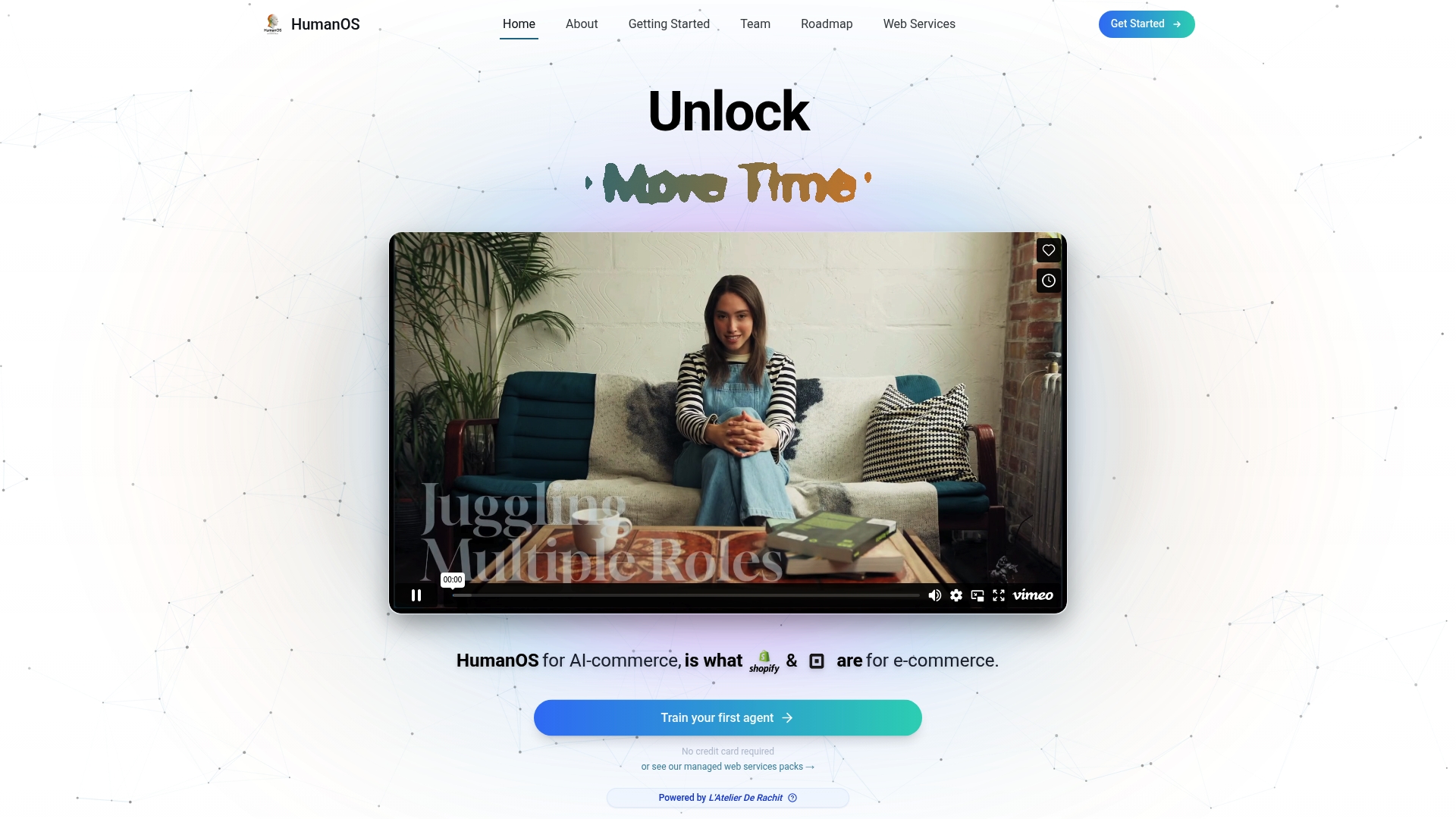
HumanOS combines an AI agent platform with fully managed web services so you can stop patching your operations together and start running them with intention. Whether you need AI automation web services that handle scheduling, email, and document workflows, or a professionally built website that converts, the platform is built around the same criteria-driven logic this article covers. No coding required, no credit card to start, and a guaranteed 30% productivity improvement backed by 10 years of systems experience. Visit HumanOS and start your free trial today.
Frequently asked questions
What is the most effective first step toward boosting SMB productivity?
Start by mapping your workflow's repetitive, low-value tasks, then pilot AI assistance in those areas. This targeted approach ensures your first investment delivers measurable productivity gains rather than added complexity.
How should SMBs measure the success of a productivity upgrade?
Focus on outcome metrics like time saved, error reduction, and team satisfaction rather than counting tools. Tracking business outcomes gives you a clear picture of real impact.
Which tasks benefit the most from AI in SMB operations?
Text-heavy tasks like research, writing, and meeting management see the most reliable improvements. Generative AI is most effective in these knowledge-work categories across SMB environments.
Is it better to automate everything in an SMB?
No. Keep humans involved for high-risk or high-value decisions and reserve automation for low-risk, repetitive work. Best practices recommend a hybrid approach that preserves human judgement where it matters most.