

TL;DR:
- AI is now affordable and accessible for small and mid-sized businesses, driving operational gains.
- Key AI applications include customer support, financial forecasting, workflow automation, and marketing.
- Successful AI adoption requires strategy, measurement, data quality, and disciplined implementation.
AI is no longer a privilege reserved for corporations with dedicated tech departments and seven-figure budgets. Over 90% of SMBs using AI report measurable operational gains, which means the competitive advantage you thought was out of reach is already in the hands of businesses just like yours. The question isn't whether AI works for small and mid-sized businesses. It's whether you're moving fast enough to benefit. This guide cuts through the noise to show you where AI delivers real results, what's holding most SMBs back, and how to build a strategy that actually sticks.
Table of Contents
- How AI is levelling the playing field for SMBs
- Key applications of AI powering SMB growth
- Barriers and edge cases: What slows SMB AI adoption?
- Best practices for sustainable SMB AI integration
- Why most SMBs get stuck: The overlooked role of strategy and measurement
- Powering your next leap: AI solutions for forward-thinking SMBs
- Frequently asked questions
Key Takeaways
| Point | Details |
|---|---|
| AI is accessible and impactful | Small businesses can now leverage powerful AI tools to compete and grow efficiently. |
| Practical applications drive value | Customer support, workflow automation, and financial management deliver the fastest returns. |
| Start small and measure | Begin with pilot projects, measure outcomes, and scale up as you understand what works. |
| Overcoming barriers is possible | Expertise gaps and costs can be managed through phased adoption, external support, and cloud solutions. |
How AI is levelling the playing field for SMBs
Not long ago, enterprise-grade automation required enterprise-grade budgets. That's no longer true. Cloud-based AI tools have collapsed the cost barrier, giving SMBs access to the same forecasting, customer support, and workflow automation capabilities that large corporations pay millions to build in-house. The gap between a 10-person team and a 1,000-person organisation has never been smaller.
Affordable cloud and generative AI are the primary drivers of this shift, with 90% of SMBs reporting gains after adoption. These aren't marginal improvements. Businesses are cutting response times, reducing manual errors, and making faster decisions with better data. That's a structural change, not a trend.
Here's what SMBs are gaining most from AI adoption:
- Operational efficiency: Routine tasks like scheduling, invoicing, and data entry get automated, freeing staff for higher-value work
- Better decision-making: AI surfaces patterns in sales, customer behaviour, and inventory that humans miss in spreadsheets
- Improved customer experience: Faster responses, personalised interactions, and 24/7 availability raise satisfaction without raising headcount
- Competitive positioning: SMBs using AI-driven productivity strategies are winning contracts and customers that used to default to larger competitors
"The businesses that will define the next decade aren't the ones with the most employees. They're the ones with the most intelligent systems."
Despite this momentum, adoption still lags. The OECD average for SMB AI adoption sits at just 14%, compared to significantly higher rates among large enterprises. That gap represents both a warning and an opportunity. SMBs that move now are capturing ground while competitors hesitate. Those that wait are falling further behind every quarter.
The good news is that AI automation in SMBs doesn't require a complete overhaul of your operations. Most platforms today are designed for non-technical users, with guided setup and no coding required. The barrier to entry is lower than most business owners realise.
Key applications of AI powering SMB growth
Knowing AI works is one thing. Knowing where to apply it is what separates results from regret. The most effective SMBs aren't trying to automate everything at once. They're targeting specific, high-impact areas and building momentum from there.
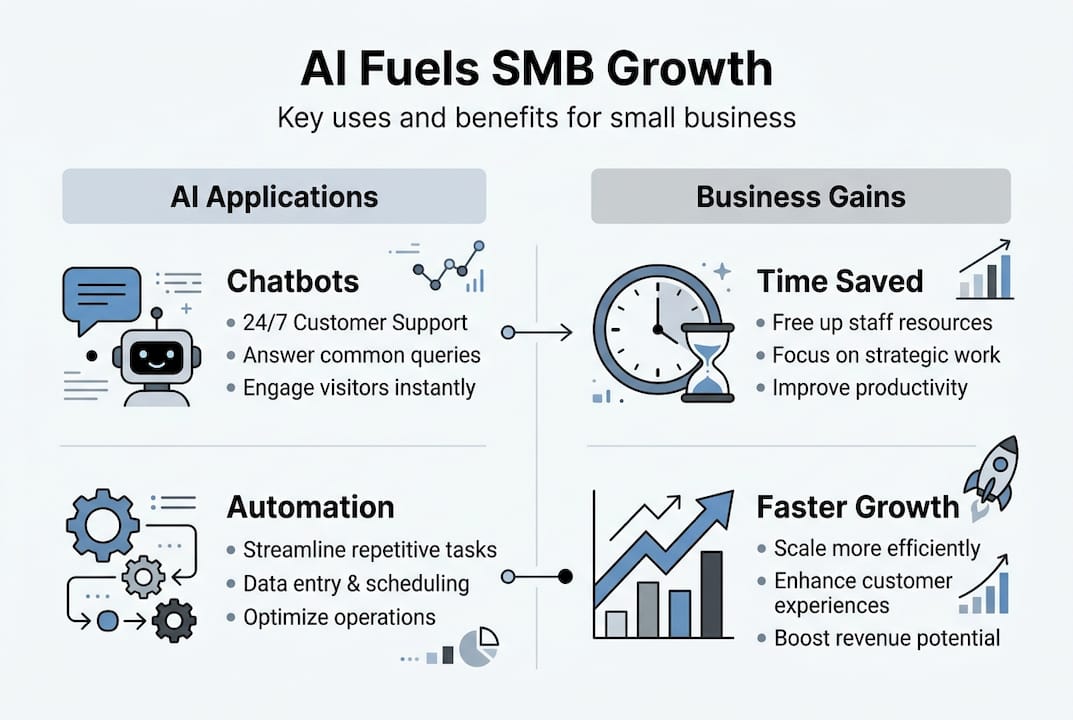
Key AI applications for SMBs span customer service, financial management, workflow automation, HR, marketing, and cybersecurity. Here's how each one plays out in practice:
| AI application | What it does | Business impact |
|---|---|---|
| Customer service chatbots | 24/7 support, FAQ handling, ticket routing | Lower support costs, faster resolution |
| Financial forecasting tools | Cash flow prediction, fraud detection | Fewer surprises, tighter margins |
| Workflow automation | Document processing, approvals, scheduling | Hours saved weekly per employee |
| HR and recruitment AI | Resume screening, onboarding automation | Faster hiring, reduced admin burden |
| Marketing and content AI | Email campaigns, SEO content, ad targeting | Higher engagement, lower cost per lead |
| Cybersecurity AI | Threat detection, anomaly monitoring | Reduced breach risk for lean IT teams |
Among these, customer service and financial tools tend to deliver the fastest return. An AI chatbot can handle 60 to 80 percent of routine inquiries without human involvement, which translates directly into staff hours recovered. Pair that with top AI productivity tools and you're looking at 15 to 25 hours saved per week across a small team.

Marketing AI is another area where SMBs punch above their weight. Automated email sequences, AI-generated content drafts, and predictive ad targeting let a two-person marketing function compete with a full agency. The key is using tools that integrate with your existing systems rather than creating yet another disconnected platform to manage.
Pro Tip: If you're not sure where to start, pick one process that's costing you more than five hours a week and find an AI tool built specifically for it. Customer support and invoicing are the two fastest wins for most SMBs looking to build early momentum with operational efficiency with AI.
Barriers and edge cases: What slows SMB AI adoption?
AI adoption doesn't stall because the technology isn't good enough. It stalls because the conditions inside the business aren't ready. Understanding these barriers isn't pessimistic. It's practical.
The three most common hurdles are well-documented. Expertise gaps affect 76% of SMBs, integration complexity blocks 64%, and upfront cost concerns affect 58%. Beyond those, data quality issues and uncertainty about ROI regularly derail projects before they gain traction.
| Barrier | Why it matters | Targeted solution |
|---|---|---|
| Lack of internal expertise | No one knows how to configure or manage AI tools | Use platforms with guided onboarding and no-code setup |
| Integration complexity | New AI doesn't connect with existing software | Choose tools with native integrations or open APIs |
| Budget constraints | Upfront costs feel risky without guaranteed returns | Start with free trials and low-cost pilot projects |
| Poor data quality | AI outputs are only as good as the data fed in | Audit and clean core data sets before deploying AI |
| ROI uncertainty | Hard to justify spend without clear metrics | Define success metrics before launch, not after |
Here are three steps to break through the most common barriers:
- Start with a pilot: Choose one low-risk, high-frequency task and automate it. Measure the time and cost saved over 30 days before expanding.
- Leverage external partners: You don't need to build internal AI expertise from scratch. Platforms like AI onboarding for SMBs are designed to walk you through setup without a technical team.
- Follow a structured adoption path: A step-by-step AI adoption approach reduces the risk of costly missteps and builds organisational confidence over time.
One statistic that should inform your planning: pilot initiatives fail 40 to 50% of the time without careful management. That's not a reason to avoid pilots. It's a reason to run them with discipline, clear goals, and a defined exit criteria. G7 AI adoption insights consistently show that governance and planning are the variables that separate successful deployments from expensive experiments.
Pro Tip: Before signing any AI contract, map out exactly which workflow it will touch, who will own it internally, and how you'll measure success in the first 60 days. Vague intentions produce vague results.
Best practices for sustainable SMB AI integration
Getting AI to work once is a milestone. Getting it to keep working, scale with your business, and deliver compounding returns is the real goal. That requires more than a good tool. It requires a disciplined approach.
Phased adoption, consistent measurement, data governance, and human oversight are the four pillars that separate sustainable AI integration from one-time experiments. Here's what each looks like in practice:
- Phase your rollout: Begin with one or two low-risk, repetitive tasks. Once those are stable and measured, expand to adjacent workflows. Avoid the temptation to automate everything at once.
- Measure continuously: Track productivity metrics, error rates, customer satisfaction scores, and cost per task before and after AI deployment. Numbers tell you what intuition misses.
- Maintain human oversight: AI should augment your team, not replace judgement. Keep humans in the loop for customer-facing decisions, sensitive data handling, and anything with legal or financial implications.
- Clean your data first: AI tools are only as accurate as the information they process. Before deploying any model, audit your core data for duplicates, gaps, and inconsistencies.
- Build for privacy compliance: Ensure any AI tool you adopt meets Canadian privacy regulations, including PIPEDA requirements for data handling and consent.
Stat to remember: Disciplined pilot management can cut the 40 to 50% pilot failure rate dramatically, but only when success metrics are defined before launch.
The SMBs seeing the strongest returns from AI productivity tips aren't the ones with the most tools. They're the ones with the clearest processes. Every automation they deploy connects to a measurable business outcome, and they review performance monthly. That discipline is what turns a promising pilot into a lasting competitive advantage. Explore how AI for business efficiency compounds over time when built on a structured foundation.
Why most SMBs get stuck: The overlooked role of strategy and measurement
Here's what we see repeatedly: an SMB owner gets excited about AI, signs up for three tools, gets modest results for a few weeks, and then quietly stops using them. The tools weren't the problem. The strategy was.
Most SMBs treat AI as a side experiment rather than a strategic pillar. They don't assign ownership, set clear goals, or review outcomes. Without that structure, even the best technology becomes shelf-ware. Strategic integration consistently outperforms experimentation alone in avoiding AI plateaus.
Leadership buy-in changes everything. When the owner or senior team treats AI adoption as a business priority with defined milestones, the whole organisation aligns around it. When it's delegated without direction, it drifts. The businesses that boost SMB operational efficiency at scale all share one trait: they measure relentlessly and course-correct fast.
Treat AI not as a gadget, but as a business essential. That's where real growth happens.
Powering your next leap: AI solutions for forward-thinking SMBs
You've seen where AI delivers, what slows adoption, and how to build a strategy that lasts. The next step is having the right infrastructure to make it real.
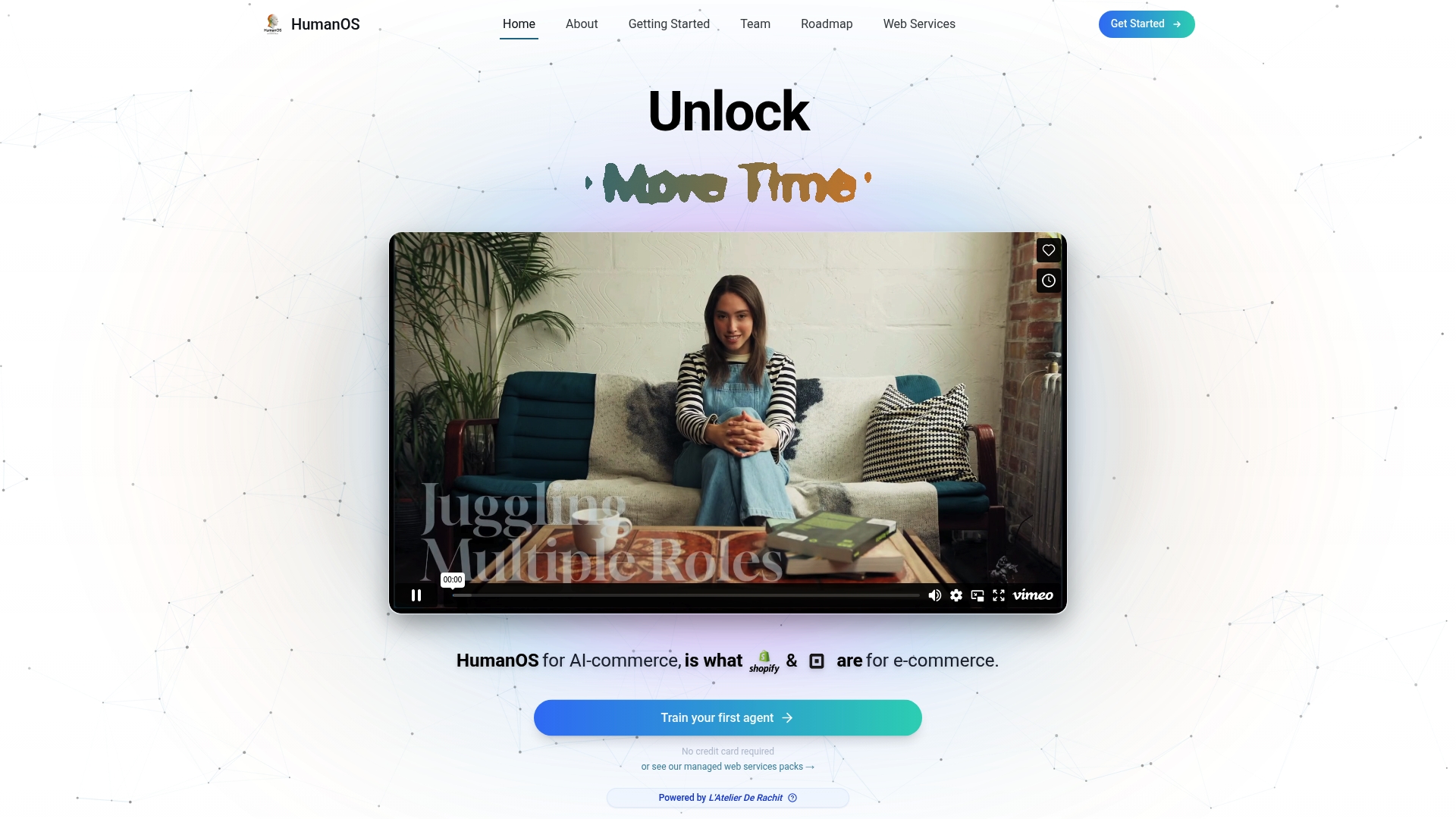
HumanOS is built specifically for SMBs ready to move beyond duct-taped workflows. The HumanOS AI platform combines a full suite of AI agents for email, scheduling, customer support, document processing, and more, with a self-guided onboarding system that requires no coding and no credit card to start. On average, clients see an 80% boost in productivity and a 30 to 50% improvement in profitability. You can also automate with AI agents purpose-built for your operational workflows. Start your free trial today and stop firefighting.
Frequently asked questions
What are the most effective ways SMBs use AI?
Key AI applications for SMBs include customer service automation, workflow streamlining, and financial management tools that improve forecasting and reduce manual effort. SMBs see the greatest results when they focus on high-frequency, repetitive tasks first.
What stops SMBs from adopting AI fully?
Expertise gaps, complexity, and costs are the top barriers, alongside concerns about data quality and uncertain ROI. Most of these obstacles are manageable with the right platform and a structured adoption plan.
How can businesses avoid failed AI projects?
Start with clear goals, small pilot projects, and defined success metrics before launch. Pilot initiatives fail 40 to 50% of the time without proper discipline, so involving staff in training and tracking outcomes closely is essential.
Is AI adoption causing major job losses for SMBs?
AI use in SMBs has produced limited aggregate labour disruption so far, with productivity gains and GDP growth potential significantly outweighing job displacement impacts. Most SMBs are using AI to augment their teams, not replace them.