

TL;DR:
- AI reduces stockouts by 20 to 50% and cuts overstock costs effectively.
- Successful AI adoption depends on clean, connected data and gradual workflow implementation.
- Proper change management and continuous iteration are essential for sustainable AI-driven productivity.
Running an e-commerce business often feels like sprinting on a treadmill. Orders pile up, inventory goes sideways, and customer queries flood in faster than your team can handle them. The result is wasted hours, missed sales, and a shrinking margin. AI inventory forecasting reduces stockouts by 20 to 50% and cuts overstock costs by a similar margin, which is the kind of measurable relief that every operator needs right now. This guide walks through exactly how to prepare your business, choose the right tools, roll them out step by step, and keep improving over time, so AI actually works for your bottom line.
Table of Contents
- Setting up for AI-driven productivity gains
- Choosing the right AI tools and automation platforms
- Step-by-step: Implementing AI productivity boosters
- Troubleshooting, measurement, and continuous improvement
- What most e-commerce businesses miss with AI productivity
- How HumanOS accelerates e-commerce productivity
- Frequently asked questions
Key Takeaways
| Point | Details |
|---|---|
| Build strong data foundations | Your data quality and systems prep determine the impact of AI-driven productivity gains. |
| Start with high-impact processes | Begin your AI journey with the most time-consuming or error-prone workflow for easy early wins. |
| Track and iterate | Regularly measure results and refine your approach for sustained e-commerce growth. |
| Incremental beats all-at-once | Adopt AI in steps, not all at once, to avoid disruption and maximise learnings. |
Setting up for AI-driven productivity gains
Once you see the potential impact of AI, the next step is ensuring you're fully prepared to harness these tools for real operational wins. Most businesses skip this part and pay for it later. Jumping straight into automation without the right groundwork is how you end up with a flashy tool that produces unreliable outputs and frustrated staff.
The foundation of any successful AI rollout is clean, consistent, and connected data. As research confirms, poor data leads to classic "garbage in, garbage out" failures that no amount of sophisticated software can fix. Before you evaluate a single AI tool, audit what data you actually have and whether it is usable.
Here is what you need to assess before moving forward:
- Data sources: Do your inventory, customer, sales, and marketing data all live in accessible systems?
- Integration options: Can your existing platforms connect via API or native integration to AI tools?
- Staff readiness: Does your team understand enough about your workflows to guide and validate AI outputs?
- Data quality: Are your product catalogues, customer records, and order histories complete and up to date?
These are not optional checkboxes. They are the difference between a productive AI rollout and an expensive distraction. Reviewing AI productivity tips tailored for small and mid-sized businesses can help you identify where your infrastructure gaps are before you commit to any platform.
| Infrastructure area | Minimum requirement | Common gap |
|---|---|---|
| Customer data | Unified CRM or database | Scattered across tools |
| Inventory records | Real-time stock counts | Manual spreadsheets |
| Sales data | 12+ months of history | Incomplete or siloed |
| Team workflows | Documented processes | Tribal knowledge only |
References like AI tools for small business also highlight how many operators underestimate the time needed to clean and connect data before automation can kick in. Budget for it. It pays off.
Pro Tip: Build a weekly data hygiene routine before you launch any AI tool. Assign one team member to flag duplicates, outdated records, or missing fields every Monday morning. This single habit dramatically improves the quality of AI outputs over time.
If your data is in reasonably good shape, reviewing AI strategies for SMBs will help you prioritise which operational areas to target first for the greatest impact.
Choosing the right AI tools and automation platforms
With your foundations in place, selecting the right tools is the critical next step for boosting productivity. The e-commerce AI landscape has expanded rapidly, and not every platform is built for your scale, your stack, or your actual workflow.
The most productive e-commerce businesses in 2026 are using AI across four core categories:
- Inventory and demand forecasting: Predicts stock needs based on historical data and seasonal trends
- Marketing automation: Personalises email campaigns, ad targeting, and product recommendations
- Customer service AI: Handles routine enquiries, returns, and order updates without human involvement
- Analytics and reporting: Surfaces actionable insights from sales, traffic, and behaviour data
Small and mid-sized e-commerce businesses that adopt AI across these areas see 35 to 45% sales increases, a 42% reduction in operational costs, and a 27% drop in stockouts. Those numbers reflect disciplined adoption, not just tool installation.
When comparing platforms, evaluate them across these factors:
| Feature | What to look for | Red flag |
|---|---|---|
| Integration | Connects to your existing stack | Requires full migration |
| Support | Onboarding and live help available | Documentation only |
| Scalability | Grows with your transaction volume | Fixed tier limitations |
| Transparency | Explainable outputs and audit trails | Black-box decisions |
| Pricing | Clear, predictable cost structure | Usage-based surprise billing |
Browsing a reliable AI tools directory can help you cut through the noise and compare platforms side by side before committing. Also check out top AI productivity tools that are already helping SMBs save 15 to 25 hours per week.
Platforms like the HumanOS AI operating system are purpose-built for this exact challenge, combining multiple automation functions into a single governed environment.
Pro Tip: Start with one automation workflow before adding more. Pick your most repetitive, high-volume process, automate it well, and learn from it. Expanding incrementally is far more effective than launching five workflows simultaneously and managing five sets of problems at once.
Step-by-step: Implementing AI productivity boosters
Once you've chosen your tools, here's how to roll them out for real productivity gains. A structured rollout protects your operations while giving AI a fair chance to prove its value.
Step 1: Identify your highest-impact process Look for tasks that are repetitive, high-volume, and time-sensitive. Inventory reordering, customer support triaging, and order confirmation emails are classic starting points.

Step 2: Map the current workflow Document exactly how the process works today. Every step, every person involved, every decision point. You cannot automate what you have not mapped.
Step 3: Select and configure your AI tool Choose the platform that fits this specific workflow. Connect your data sources, configure the logic, and set thresholds for when a human needs to review an AI decision.
Step 4: Run a small-scale test Apply the automation to a limited subset of transactions or customers. A sample size of 100 to 200 interactions gives you enough signal to evaluate performance without exposing your full operation to risk.
Step 5: Review outputs and iterate Compare AI outputs against what your team would have done manually. Identify errors, gaps, or missed nuances. Adjust the configuration and run another test cycle.
Step 6: Scale with confidence Once accuracy and efficiency targets are met, expand the automation to your full operation. Set KPIs before you scale so you have clear benchmarks to measure against.
Reviewing a detailed workflow automation guide can help you tailor this process to your specific tech stack. You can also explore AI productivity improvement steps developed specifically for small and mid-sized businesses.
Proper AI implementation can reduce stockouts by 20 to 50% and cut overstock costs by an equivalent margin, directly improving cash flow and customer satisfaction at the same time.
For team leaders, exploring how to improve team productivity through structured AI adoption provides the change management layer that most rollouts overlook.
Troubleshooting, measurement, and continuous improvement
With systems in place, maintaining and improving your AI-driven productivity is an ongoing process. The rollout is not the finish line. It is the starting line.
Your primary job after launch is measurement. Set clear KPIs before anything goes live, and review them consistently. Here are the metrics that matter most for e-commerce AI performance:
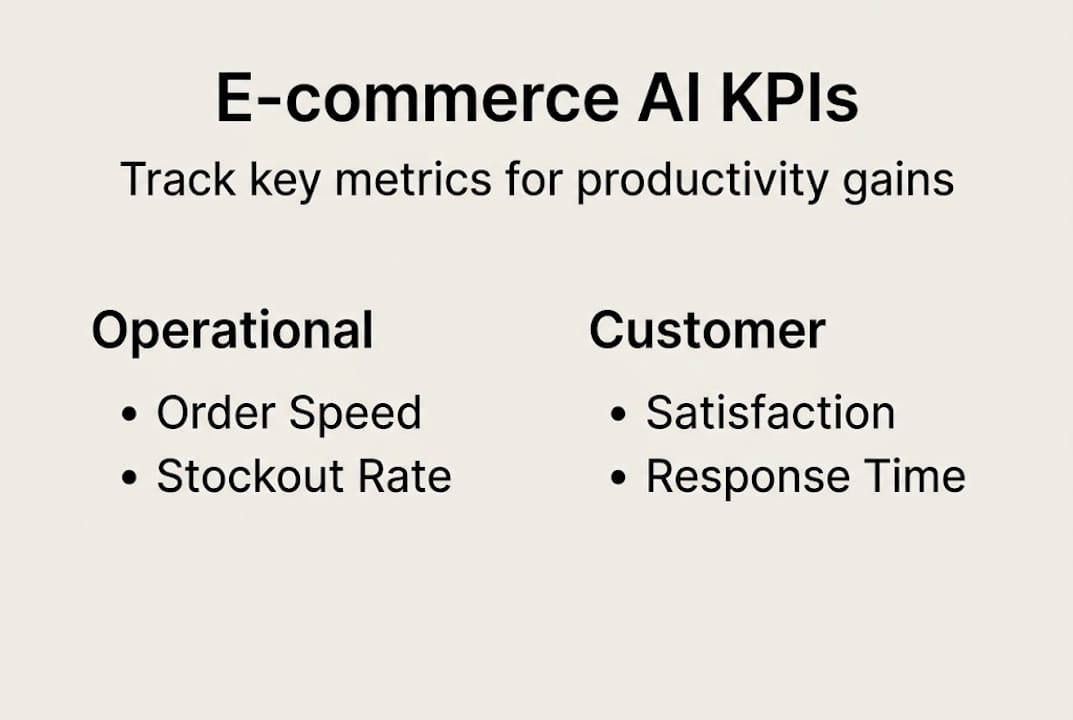
| KPI | Baseline target | Healthy AI-driven result |
|---|---|---|
| Stockout rate | Current rate | 20 to 27% reduction |
| Conversion rate | Current rate | 35 to 45% improvement |
| Operational cost | Current cost | Up to 42% reduction |
| Customer response time | Current average | 50 to 70% faster |
These benchmarks are consistent with what SMEs achieve when they adopt AI with discipline and clear success criteria.
Common issues to watch for after launch:
- Output drift: AI recommendations gradually become less accurate as market conditions change. Retrain models regularly.
- Integration breaks: Platform updates from your e-commerce stack can disconnect data feeds. Monitor integrations weekly.
- Staff workarounds: If your team is bypassing the AI tool, find out why. It usually signals a configuration problem, not a people problem.
- Alert fatigue: Too many AI-generated notifications trains your team to ignore them. Tune alert thresholds carefully.
For a deeper look at how to structure ongoing performance reviews, the Pecan AI workflow guide offers practical frameworks that translate well to e-commerce environments. You can also explore strategies to boost profitability through sustained AI automation.
Pro Tip: Run a short weekly review meeting of no more than 20 minutes to assess AI performance. Bring your KPI dashboard, flag any anomalies, and assign one action item per session. This rhythm catches problems early and keeps your team aligned with the system.
What most e-commerce businesses miss with AI productivity
Here is the uncomfortable truth most AI guides will not tell you. The businesses that fail with AI are not failing because they chose the wrong tool. They are failing because they never got their data right in the first place, and poor data infrastructure is still the single biggest predictor of an unsuccessful AI rollout.
The second mistake is expecting transformation from a single launch. Real gains come from iteration. A business that automates one workflow, learns from it, and improves it over three months will outperform one that launches ten workflows simultaneously and manages the chaos that follows.
What separates the businesses that compound their AI gains from those that plateau? Change management. Getting your team to trust AI outputs, flagging errors without abandoning the system, and closing the feedback loop between AI decisions and real-world outcomes. These are human skills, not technical ones.
The role of AI in business efficiency is real and growing. But the edge goes to operators who treat AI as a discipline, not a shortcut. Incremental, consistent improvement beats a grand launch every time.
How HumanOS accelerates e-commerce productivity
If you're ready to put these strategies to work, here's how HumanOS can help your e-commerce business achieve AI-driven productivity at scale.

The HumanOS AI operating system brings together AI agents for email, scheduling, customer support, data analysis, and content creation into a single governed platform. No coding required. No credit card to start. On average, businesses see an 80% boost in productivity and a 30 to 50% improvement in profitability. For operators who also need a high-performance web presence, our AI automation web services deliver professionally built, continuously optimised WordPress sites starting at $825. Stop duct-taping your digital operations together and start running on infrastructure that actually scales.
Frequently asked questions
What are common mistakes when adopting AI in e-commerce?
Overlooking data quality and trying to automate too many processes at once are the most common pitfalls. Poor data infrastructure consistently leads to unreliable AI outputs regardless of how capable the tool is.
How quickly can AI tools improve e-commerce productivity?
Many businesses report measurable improvements within a few months of a disciplined implementation. Research shows 35 to 45% sales increases and a 42% reduction in operational costs are achievable with structured AI adoption.
Which e-commerce processes benefit most from AI automation?
Inventory management, customer service, marketing automation, and analytics deliver the strongest early returns. AI inventory forecasting alone reduces stockouts by 20 to 50% and cuts overstock costs by an equivalent amount.
What KPI improvements can e-commerce firms expect from AI?
Typical improvements include higher conversion rates, lower operational costs, and reduced stockout rates. Businesses following a structured approach see 27% stockout reductions and conversion rate gains of up to 45% within the first year.