

TL;DR:
- Modern time tracking tools automate tasks, surface blind spots, and support smarter decision-making.
- They reduce manual effort, errors, and improve accountability, saving SMBs 15-25 hours weekly.
- Choosing the right solution requires assessing workflows, integration needs, scalability, and support quality.
Time tracking software is not just about clocking in and out. That misconception costs small and mid-sized businesses real money every single week. The truth is, modern time tracking tools are workflow engines. They automate repetitive tasks, surface operational blind spots, and give managers the data they need to make faster, smarter decisions. If you've been treating time tracking as a payroll checkbox, you're leaving serious productivity gains on the table. This article breaks down what these tools actually do, which benefits matter most for your business, how to compare your options, and how to choose the right fit for where you are right now.
Table of Contents
- Understanding time tracking software
- Key benefits for small and mid-sized businesses
- Comparing popular time tracking solutions
- How to choose the right tool for your business
- Why time tracking software is a game-changer for Canadian SMBs
- Explore AI-powered time tracking solutions
- Frequently asked questions
Key Takeaways
| Point | Details |
|---|---|
| Boost productivity automatically | Time tracking software reduces manual work and increases efficiency by automating repetitive tasks. |
| Choose tools that fit your needs | Evaluate features, integrations, and support to ensure the software matches your business workflow and goals. |
| Compare options for best value | Review side-by-side comparisons to select a solution that balances functionality, scalability, and price. |
| Automation saves hours weekly | Implementing workflow automation with time tracking can reclaim up to 15-25 hours per week for your business. |
Understanding time tracking software
At its core, time tracking software records how your team spends working hours. But that's just the surface. Today's platforms go far beyond simple logs. They connect with project management tools, invoicing systems, payroll platforms, and communication apps to create a unified picture of your operations.
Here's what most modern time tracking tools actually include:
- Automated time logs that capture activity without requiring manual entry
- Project and task tracking so you know exactly where hours are going
- Integrations with tools like Slack, QuickBooks, Asana, and Google Workspace
- Real-time dashboards that give managers instant visibility into team output
- Reporting and analytics that turn raw data into actionable insight
One of the biggest misconceptions is that these tools exist only for compliance or payroll. That's outdated thinking. Top AI productivity tools show that time tracking software automates workflow and boosts productivity well beyond the payroll function. When you automate time capture, you eliminate the manual effort of chasing timesheets, reduce human error, and free your team to focus on higher-value work.
Consider a small marketing agency with eight employees. Before implementing time tracking software, project managers spent roughly four hours each week compiling timesheets and reconciling billable hours. After automating that process, those four hours shifted to client strategy. That's a real, measurable gain that compounds over time.
You can also explore effective time tracking strategies to understand how businesses are structuring their approach in 2026 for maximum impact.
"The best time tracking tools don't just record hours. They reveal where your business is leaking energy and where it's firing on all cylinders."
Pro Tip: When evaluating tools, look specifically for automation features that eliminate repetitive data entry. If you're still manually inputting start and end times, you're using a 2010 solution for a 2026 problem.
Key benefits for small and mid-sized businesses
Now that you know what time tracking software is, let's explore how it delivers measurable benefits to small businesses. The advantages go well beyond saving a few minutes here and there.
- Automated time logging reduces manual effort. When software captures time automatically, your team stops wasting energy on administrative tasks. That energy goes back into the work that actually moves the needle.
- Fewer errors in reporting. Manual timesheets are notoriously inaccurate. Automated tracking cuts down on mistakes that affect invoicing, payroll, and project budgeting.
- Improved accountability without micromanagement. Transparent time data creates natural accountability. Team members can see their own output clearly, which encourages ownership without requiring constant oversight.
- Better decisions from real data. When you know exactly how long projects take, you can price more accurately, staff more efficiently, and identify bottlenecks before they become crises.
- Stronger client relationships. Accurate time data supports precise invoicing, which builds trust with clients and reduces billing disputes.
Statistic to know: SMBs save up to 15-25 hours weekly through automation. That's nearly a full-time employee's worth of recovered capacity every single week.
Those recovered hours aren't just a nice number. They represent real budget, real capacity, and real competitive advantage. A business saving 20 hours a week can redirect that time toward sales, product improvement, or customer service without hiring anyone new.
For a deeper look at how AI-driven SMB productivity is reshaping operations, the evidence is consistent: automation is the lever that separates growing businesses from stagnant ones. You can also use an operational efficiency checklist to audit where your business stands before selecting a tool.

Comparing popular time tracking solutions
With benefits in mind, it's essential to evaluate which software fits your business needs best. The market has matured significantly, and cloud-based time tracking options are increasingly adopted in the technology sector, making scalability and remote access standard expectations rather than premium features.
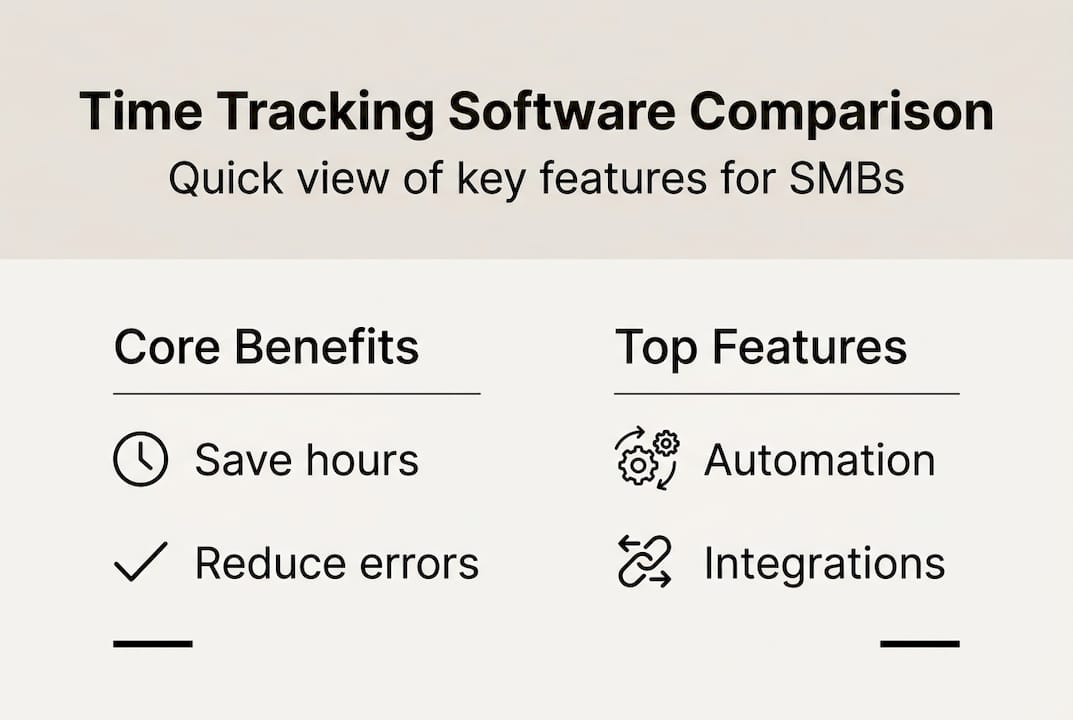
Here's a quick overview of leading platforms:
- Toggl Track: Simple interface, strong reporting, great for freelancers and small teams. Limited automation on lower tiers.
- Clockify: Free entry tier, solid project tracking, integrates with popular tools. Can feel basic for complex operations.
- Harvest: Excellent invoicing integration, clean UI, ideal for service businesses. Pricing scales quickly with team size.
- Hubstaff: Strong remote team features, GPS tracking, robust reporting. Better suited for field teams or distributed workforces.
- Time Doctor: Deep productivity analytics, screenshot monitoring, good for accountability-focused teams. Can feel intrusive if not implemented thoughtfully.
| Platform | Best for | Key integrations | Starting price |
|---|---|---|---|
| Toggl Track | Small teams, freelancers | Asana, Jira, Slack | Free / $9 per user |
| Clockify | Budget-conscious SMBs | Trello, QuickBooks | Free / $3.99 per user |
| Harvest | Service businesses | Xero, Stripe, Basecamp | $12 per user |
| Hubstaff | Remote/field teams | PayPal, Gusto, GitHub | $7 per user |
| Time Doctor | Productivity analytics | Salesforce, Zapier | $7 per user |
When reviewing top AI productivity tools alongside dedicated time trackers, the pattern is clear: integration capability is often more important than any single feature. A tool that connects seamlessly with your existing stack delivers far more value than a feature-rich platform that operates in isolation. You can also review a checklist for SMB efficiency to clarify which integrations matter most for your workflow before committing to a platform.
How to choose the right tool for your business
Once you've seen what's out there, here's how to pinpoint the best fit for your company. Selection isn't about picking the most popular tool. It's about matching the right capabilities to your specific workflow and growth stage.
- Map your current workflow. Before looking at software, document how your team currently tracks time and where the friction points are. Choosing the right software starts with workflow analysis and integration needs, not feature lists.
- Identify your top three pain points. Is it inaccurate invoicing? Poor project visibility? Manual reporting? Your pain points should drive your feature priorities.
- Assess your integration requirements. List every tool your team uses daily. Your time tracking software needs to connect with at least the most critical ones.
- Evaluate scalability. A tool that works for five people should still work well at twenty. Check pricing tiers and feature availability as your team grows.
- Test before you commit. Most platforms offer free trials. Use them. Have two or three team members test the tool in real work conditions, not just demo scenarios.
Pro Tip: Prioritise onboarding support and customer service quality when evaluating platforms. A tool with slightly fewer features but excellent support will outperform a feature-rich platform with poor documentation every time. Check user reviews specifically for comments about support responsiveness.
For practical guidance, explore workflow automation tips that help you identify where automation will have the highest impact in your specific business context. You can also look at how to maximise productivity with AI scheduling to see how time tracking fits into a broader automation strategy.
Why time tracking software is a game-changer for Canadian SMBs
Most conversations about time tracking focus on oversight. That framing misses the point entirely, and it's the reason so many Canadian business owners resist these tools.
The real value isn't surveillance. It's empowerment. When your team has clear data about where their time goes, they make better decisions independently. Managers stop guessing and start leading with evidence. That shift from gut feel to data-driven management is where the real transformation happens.
Sceptics often raise privacy concerns. Those concerns are valid, and the best tools address them directly through transparent policies and employee-controlled data visibility. Trust is built through clarity, not control.
In 2026, the Canadian SMB landscape is competitive. Labour costs are rising, and margins are tighter than ever. Businesses that integrate time tracking strategies with broader automation systems aren't just saving hours. They're building operational infrastructure that compounds over time. That's not a small advantage. That's the difference between a business that scales and one that plateaus.
Explore AI-powered time tracking solutions
If you're ready to stop guessing where your team's hours are going and start building a business that runs with precision, the next step is straightforward.
HumanOS combines AI-powered time tracking with a full suite of automation agents designed specifically for small and mid-sized businesses. No coding required. No credit card to start. Our platform integrates time tracking directly into your existing workflows, giving you the operational clarity you need to grow with confidence. From automated scheduling to real-time reporting, AI automation for humans is built to deliver measurable results. Explore the full HumanOS AI operating system and see how your business can recover hours, reduce errors, and scale smarter starting today.
Frequently asked questions
How does time tracking software improve productivity?
Time tracking software automates repetitive tasks, reduces errors, and gives managers actionable data to streamline workflow. SMBs save up to 15-25 hours weekly through this kind of automation, freeing capacity for higher-value work.
What features should I look for in time tracking software?
Prioritise real-time tracking, seamless integrations, robust reporting, and scalability. Choosing the right software begins with understanding your workflow gaps and matching features to those specific needs.
Is time tracking software suitable for remote teams?
Absolutely. Cloud-based time tracking enables remote teams to log hours accurately and collaborate efficiently, improving accountability regardless of location.
How much time can automation save my business?
Automation typically saves small businesses 15-25 hours per week, particularly when time tracking is integrated with broader workflow and scheduling tools.