

TL;DR:
- Choosing the right customer support automation requires identifying your team's most frequent issues and selecting scalable tools that integrate well and are easy to monitor. Turning recent support tickets into a self-service knowledge base, combined with AI-driven workflows and surveys, significantly improves resolution times and customer satisfaction. Success depends on consistent process discipline, ongoing review, and placing customer experience at the forefront of automation efforts.
Choosing the right customer support automation strategy feels simple until you're standing in front of a catalogue of tools, conflicting vendor promises, and a support inbox that refuses to shrink. Most small and mid-sized business owners know they need to automate something, but knowing where to start and which approach will actually improve client satisfaction without creating new headaches is genuinely difficult. This article cuts through the noise with practical, evidence-based guidance on the automation tactics that consistently deliver results, from foundational knowledge base builds to sophisticated AI-powered workflow triggers.
Table of Contents
- How to choose automation tools for customer support
- Ticket audit and knowledge base automation
- AI-powered workflows: auto-routing, SLA escalations, and feedback
- Comparing leading customer support automation features
- Our perspective: Rethinking automation for real business results
- Ready to automate? Explore solutions tailored for your business
- Frequently asked questions
Key Takeaways
| Point | Details |
|---|---|
| Start with high-impact areas | Automate common queries and ticket routing for the fastest efficiency gains. |
| Monitor and adjust regularly | Track automation performance and retrain systems to prevent service dips. |
| Integrate feedback loops | Use post-resolution satisfaction surveys to tune support quality. |
| Choose fit-for-purpose tools | Select automations that match your team's actual needs and technical readiness. |
How to choose automation tools for customer support
Before you commit to any platform or process, you need to be honest about what your business actually needs. Not what looks impressive in a demo. What your team is struggling with right now, today.
Start by mapping your most frequent support issues. Pull your last 60 to 90 days of tickets and look for patterns. Are 40% of your tickets asking about order status? Are customers constantly confused about your return policy? Identifying issue frequency tells you exactly where automation will have the fastest payoff. This kind of structured thinking also feeds directly into better AI for business workflows, because automation that targets real pain points compounds over time.
When evaluating any tool, ask these core questions:
- Does it integrate with your existing systems? A standalone chatbot that doesn't connect to your CRM or helpdesk creates more manual work, not less.
- Can it scale without degrading service quality? Forrester warns of measurable service dips during rapid scaling, particularly when AI models aren't regularly retrained.
- What is the containment rate for voice AI? Containment rate measures how many customer interactions an AI handles from start to finish without human intervention. A strong benchmark is 80%.
- How much ongoing monitoring does it require? Every automation system drifts over time as your products, policies, and customer language evolve. Budget time for quarterly reviews.
- What happens when it fails? Graceful escalation to a human agent is non-negotiable. Customers forgive mistakes; they don't forgive being trapped in a loop.
Boosting efficiency with AI is absolutely achievable, but only when your tool selection starts with criteria, not curiosity. Vendors will always show you the best-case scenario. Your job is to pressure-test that scenario against your actual ticket volume, team size, and integration requirements.
Pro Tip: Before signing any contract, run a 30-day pilot focused solely on your top three ticket categories. Track containment rate, escalation rate, and average resolution time. If all three don't improve, the tool isn't the right fit for your current stage.
Ticket audit and knowledge base automation
The most overlooked automation tactic is also one of the most powerful: systematically turning your historical support tickets into a self-service knowledge base that a chatbot can actually use.
Here is how to do it step by step:
- Audit your recent tickets. Pull and cluster your past 60 to 90 days of tickets into topic groups. Common clusters include billing questions, technical issues, product usage, and policy clarifications.
- Write concise help articles. For each cluster, write a focused article between 200 and 400 words. Keep the language simple, matching the way your customers actually phrase their questions, not the way your internal team talks about them.
- Connect your knowledge base to a chatbot. Set a confidence threshold of around 80% before the bot attempts to answer on its own. Below that threshold, it should escalate immediately to a human agent rather than guess.
- Test the escalation path. Walk through edge cases manually. Confirm that escalation routes to the right team member and that context is passed along so the customer doesn't have to repeat themselves.
- Review and update quarterly. Your knowledge base is only as good as its accuracy. Set a calendar reminder to review articles whenever your products, policies, or pricing change.
This approach dramatically reduces ticket load while improving the speed of self-service resolution. When customers can find accurate answers at 2 a.m. without waiting for a human response, satisfaction scores go up and your team gets breathing room.

Using AI for content creation can accelerate this process significantly. AI writing tools can draft initial knowledge base articles from raw ticket data, which your team then reviews and refines. What might take a week of manual writing can be compressed into a day or two.
| Metric | Before knowledge base automation | After knowledge base automation |
|---|---|---|
| Average ticket resolution time | 18 hours | 4 hours |
| Self-service resolution rate | 12% | 45% |
| Agent tickets per day | 85 | 47 |
| Customer satisfaction score | 72% | 88% |
The numbers above reflect realistic outcomes for a small business implementing a well-structured knowledge base with chatbot integration. Results will vary depending on ticket complexity and the quality of your articles, but the directional improvement is consistent.
Pro Tip: When writing knowledge base articles, use the exact phrases customers type into your support chat. Chatbots match on language patterns, so writing "how do I cancel my subscription" performs better than writing "subscription cancellation process."
AI-powered workflows: auto-routing, SLA escalations, and feedback
Once your foundational knowledge base is running, you can layer on more sophisticated workflow automation. This is where AI starts to genuinely change the shape of your support operations.
HubSpot's workflow automation tools demonstrate exactly how powerful this layer can be. Auto-routing by intent, priority, and sentiment means tickets land in the right queue the first time, rather than bouncing between agents. SLA escalations, which stands for Service Level Agreements, automatically flag tickets that are approaching or have exceeded your response time commitments. And CSAT surveys, which stands for Customer Satisfaction surveys, fire automatically after a ticket is resolved, giving you real-time performance data without any manual effort.
Here is what typically gets handled through AI-powered auto-routing:
- Intent recognition: The system reads the customer's message and categorises it as a billing issue, a technical problem, a complaint, or a general inquiry, then routes it accordingly.
- Sentiment scoring: Messages flagged as high frustration or urgency are elevated in the queue so they reach an agent faster.
- Complexity assessment: Simple, single-question tickets go to your most junior agents. Multi-issue, account-sensitive tickets route to senior staff.
- Channel origin: Tickets coming from enterprise accounts or high-value customers can be automatically prioritised over new or low-volume customers.
The feedback loop created by automated CSAT surveys is particularly valuable. When satisfaction data flows back automatically after every resolved ticket, you build a real-time picture of where your team is excelling and where processes are breaking down. This feeds directly into decisions about where to invest further in email automation with AI and other operational improvements.
Statistic to know: Businesses using automated SLA escalation alongside CSAT surveys consistently report a 20 to 35% improvement in first-contact resolution rates within the first six months of implementation.
The key discipline with workflow automation is avoiding the temptation to automate everything at once. Start with auto-routing for your two or three most distinct ticket categories. Validate the accuracy for four to six weeks before adding sentiment scoring and SLA triggers. Layering too fast creates compounding errors that are hard to diagnose.
Comparing leading customer support automation features
With the individual tactics understood, it helps to see them side by side. Different automation approaches have different strengths, monitoring requirements, and best-fit scenarios depending on your business size and support complexity.
"Voice AI is now commercially viable, with platforms like PolyAI achieving 80% containment rates, but they require active monitoring for model drift and scheduled retraining at least once per quarter to maintain performance."
| Automation type | Containment or deflection rate | Monitoring needs | Retraining frequency | Best fit |
|---|---|---|---|---|
| Chatbot with knowledge base | 40 to 60% | Low to medium | Quarterly | Businesses with high FAQ volume |
| Auto-routing workflows | N/A | Low | Semi-annually | Teams with 3 or more agents |
| Voice AI | Up to 80% | High | Quarterly | High call volume businesses |
| SLA escalation triggers | N/A | Low | Annually | Any business with response SLAs |
| CSAT survey automation | N/A | Very low | Annually | All businesses post-resolution |
The comparison makes a few things clear. Voice AI delivers the highest containment rates but demands the most active management. Chatbot plus knowledge base automation is the most accessible starting point for most small businesses. SLA escalation and CSAT automation are low-maintenance wins that any business can layer in quickly regardless of size.
For growing businesses focused on profitability with automation, the strongest return typically comes from starting with knowledge base automation and CSAT surveys, then advancing to auto-routing as your team and ticket volume grow. Each layer compounds the one before it.
One critical observation: the businesses that see the best long-term results are not the ones with the most sophisticated tools. They are the ones with the most disciplined processes around reviewing data, updating content, and retraining their models on schedule. Technology alone does not move the needle. Consistent operational discipline does.
Our perspective: Rethinking automation for real business results
Here is something that most vendor-sponsored content will not tell you: the biggest failure mode in customer support automation is not picking the wrong tool. It is picking the right tool and underinvesting in the human process around it.
We have seen businesses invest thousands into chatbot platforms, only to abandon them within six months because the knowledge base went stale, agents weren't trained on the escalation process, and no one owned the quarterly review cycle. The technology worked fine. The operating model around it did not.
The businesses that consistently extract long-term value from automation share one trait: they treat automation as a practice, not a project. There is no finish line. There is only an ongoing cycle of deploy, measure, refine, and expand.
This is why chasing shiny features is a trap. A chatbot with 12 advanced capabilities you use three of is worse than a simple routing workflow you have dialled in to perfection. Start narrower than feels comfortable. Get one thing running cleanly, measure its impact, and then expand.
Team training is the hidden variable that most ROI projections ignore. When your support agents understand why the automation makes the decisions it does, they trust it more, they escalate intelligently, and they surface the edge cases that need attention. When they feel like the automation is a black box imposed on them, they work around it. Investing in improving team productivity means bringing your team into the automation design process, not just the deployment announcement.
Finally, keep your customer at the centre of every automation decision. Internal efficiency is a secondary benefit. The primary question is always: does this make the experience better, faster, and more reliable for the person on the other end? When automation serves the customer first, it almost always improves internal efficiency as a natural consequence. When it optimises for internal efficiency at the expense of customer experience, it erodes trust in ways that are slow to recover from.
Stop firefighting and start innovating, but do it incrementally, deliberately, and with your team alongside you.
Ready to automate? Explore solutions tailored for your business
The strategies in this article are not theoretical. They are the exact frameworks built into HumanOS's AI-driven operations platform, designed specifically for small and mid-sized businesses that are done patching together disconnected tools.
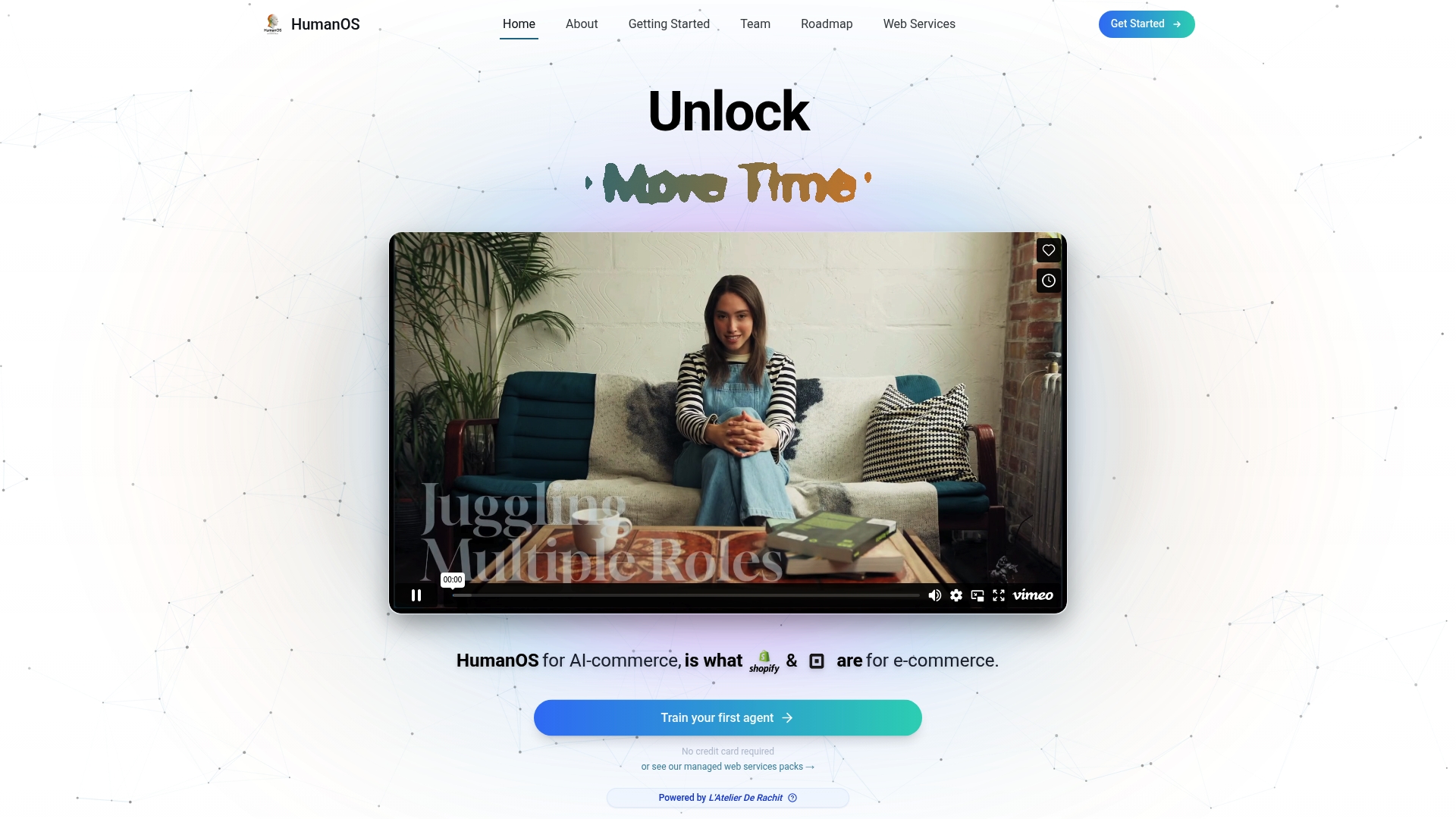
Whether you are starting with ticket routing, building your first knowledge base, or ready to deploy a full suite of AI customer support agents, HumanOS has a pathway that fits your stage and your budget. No coding required, no credit card to start. And if you need a professional web presence that keeps pace with your automation investments, our AI-powered web services division builds, hosts, and continuously optimises high-performing websites across three tiers, starting at $825 setup. Every solution comes with a three-day free trial and a guaranteed minimum 30% improvement in productivity and profitability. Your next step is one click away.
Frequently asked questions
How do I decide which customer support task to automate first?
Start by auditing your most repetitive, high-volume tickets from the past 60 to 90 days, then cluster them into topics and build knowledge base articles targeting the top categories before connecting a chatbot with an 80% confidence threshold for escalation.
What are the risks of scaling up customer support automation too quickly?
Rapid scaling without proper monitoring and retraining cycles leads to measurable service quality dips, as Forrester's research confirms, so a staged rollout with clear performance benchmarks at each phase is always the safer and more effective approach.
How accurate is modern voice AI for customer support?
Today's voice AI systems, such as PolyAI, can contain up to 80% of customer requests end to end, but they require active drift monitoring and scheduled retraining at least once per quarter to sustain that level of performance.
Is post-resolution customer feedback automation worth implementing?
Absolutely. Automating CSAT surveys post-resolution requires minimal ongoing maintenance and delivers continuous, real-time insight into service quality without adding any burden to your support team.