

TL;DR:
- Mobile IQ primarily refers to equipment diagnostics that enhance operational efficiency, not recreational IQ tests. Using validated diagnostic tools integrated with AI automation provides real-time insights, automation, and measurable productivity gains for SMBs. Most businesses fail to leverage mobile IQ strategically, missing out on transformative operational benefits through isolated tool use.
If you've searched "mobile IQ" recently, you've likely landed on a confusing mix of equipment diagnostic apps, smartphone IQ tests, and AI-driven performance platforms. For business owners, that confusion has real consequences. Choosing the wrong interpretation means wasting time on recreational tools that deliver zero operational value. Choosing the right one means unlocking a layer of mobile intelligence that feeds directly into automation, smarter decisioning, and measurable productivity gains. This guide cuts through the noise, explains exactly what mobile IQ means in a business context, and shows you how to put it to work.
Table of Contents
- What does mobile IQ mean for your business?
- Mobile IQ testing apps: use with caution
- Driving operational excellence with mobile IQ and AI-driven tools
- Implementing mobile IQ: best practices for SMBs
- Most businesses overlook the strategic potential of mobile IQ
- Accelerate your business with AI-powered mobile IQ solutions
- Frequently asked questions
Key Takeaways
| Point | Details |
|---|---|
| Mobile IQ meanings clarified | Mobile IQ refers to both diagnostic business apps and recreational IQ tests, but only the former matter for SMB productivity. |
| AI tools drive efficiency | AI-enhanced mobile platforms automate diagnostics and cut workflow delays to boost overall performance. |
| Testing app limitations | App-based IQ scores are not reliable for HR or hiring decisions due to lack of clinical accuracy. |
| Operational benchmarks | Measure response times and reliability to maximise the value of mobile IQ solutions. |
| Implement for impact | Successful SMBs strategically integrate mobile IQ with automation for sustainable growth. |
What does mobile IQ mean for your business?
The term "mobile IQ" creates genuine confusion, and it's worth addressing that head-on before anything else. There are two completely different worlds using this same phrase, and only one of them matters if you're running a business.
The first world involves equipment and field device diagnostics. A good example is the Siemens SITRANS mobile IQ, a professional-grade app for commissioning, parameterising, and monitoring industrial instruments via Bluetooth. This is a purpose-built, technical tool designed to give operators real-time device intelligence in the field. The second world involves smartphone apps marketed as IQ tests, the kind you download for free, answer twenty questions, and get a score that tells you you're a genius. These are primarily recreational.
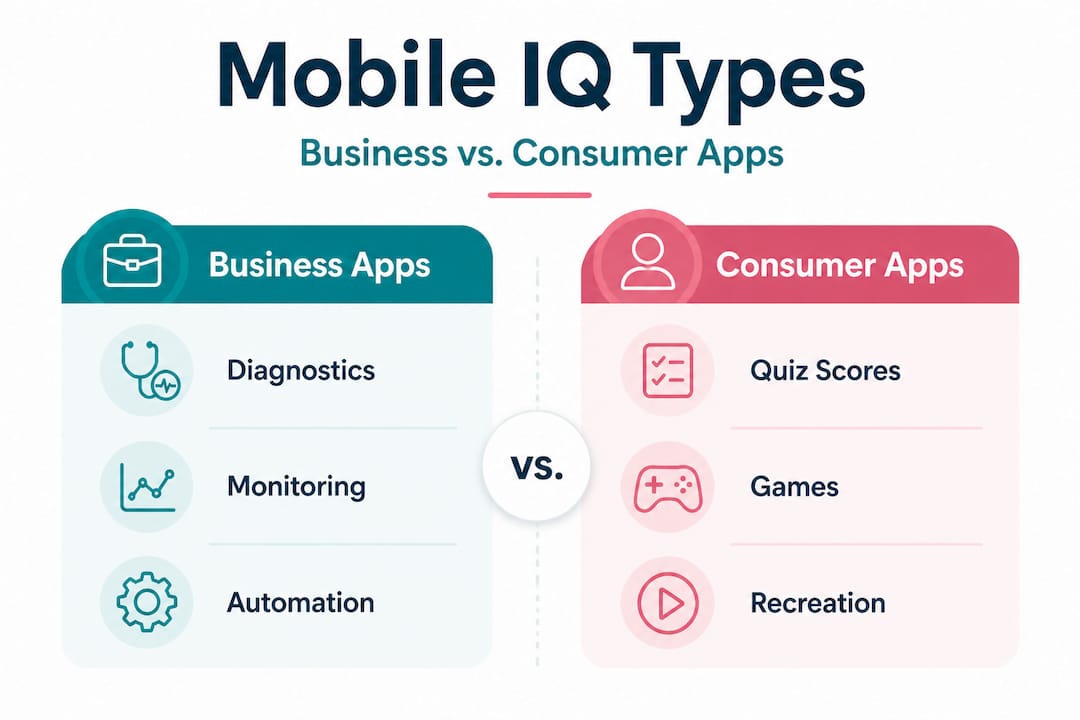
For small and mid-sized businesses, only the first category has legitimate strategic value. AI-powered mobile apps in the diagnostic and operational category can connect your team to live data, trigger automated responses, and feed intelligence directly into your workflows. That's the definition worth building a strategy around.
| Feature | Diagnostic mobile IQ apps | Recreational IQ test apps |
|---|---|---|
| Primary purpose | Equipment monitoring, workflow intelligence | Entertainment, curiosity |
| Business relevance | High | None |
| Data reliability | Validated, measurable | Approximate, non-clinical |
| Integration potential | Connects to systems and workflows | Standalone, siloed |
| ROI potential | Measurable efficiency gains | None |
Key business outcomes from adopting the right mobile IQ tools:
- Real-time visibility into equipment, operations, and system performance
- Faster response to issues before they become costly outages
- Automated alerts that reduce manual monitoring workloads
- Richer data feeding into AI-driven decisioning and reporting
- Reduced dependence on on-site staff for routine diagnostics
The difference between these two categories is not subtle. One is a business asset. The other is a distraction. Knowing which is which saves you time, money, and a great deal of frustration.
Mobile IQ testing apps: use with caution
Understanding what mobile IQ apps can and cannot do is critical, especially when it comes to measuring human intelligence. This becomes a serious issue when business owners or managers consider using consumer IQ apps as part of hiring, team assessment, or performance reviews.
Mobile IQ tests are primarily recreational and include significant limitations: approximate scoring, potential practice effects, and coverage of only narrow subsets of cognitive abilities. They are not clinically validated. They are not standardised in the way that professional cognitive assessments are. And they were not designed for business use.
There are several specific pitfalls to be aware of:
- Approximate scoring: App-based IQ scores are estimates, not diagnostically accurate measurements. A score of 120 from a mobile app tells you very little about a candidate's actual cognitive abilities.
- Narrow ability coverage: Most apps test pattern recognition or basic logic. They skip the verbal, spatial, and processing speed dimensions that full cognitive assessments include.
- Practice effects: If someone takes the same app test twice, their score improves simply because they've seen the questions before. That's not intelligence growth; it's familiarity.
- No psychometric standards: Legitimate cognitive tests follow strict psychometric protocols. Consumer apps rarely do.
- Legal and ethical risks: Using unvalidated tests in hiring can expose your business to discrimination claims if those tools disproportionately filter out protected groups.
"Treat reported IQ numbers from mobile apps as non-clinical and approximate. Evaluate them with deep scepticism for any decisions about hiring or assessment, because they can be based on limited subsets of abilities and exhibit practice effects that invalidate repeat comparisons."
Pro Tip: If you need cognitive or aptitude assessment for hiring, engage a certified organisational psychologist or use professionally validated assessment platforms. The cost is modest compared to a bad hire, and the legal protection alone is worth it.
The broader lesson here is consistency with the mobile IQ theme overall. Use the right tool for the right job. Recreational apps have a place in personal curiosity, but not in business-critical decisions. The same discipline that protects you from bad hiring tools will also guide you toward mobile IQ solutions that actually drive results.
Driving operational excellence with mobile IQ and AI-driven tools
Beyond the misconceptions, let's explore how businesses can harness mobile IQ as a practical, results-driven tool. When mobile intelligence is properly integrated into your operations, the performance gains are concrete and measurable.
The starting point is understanding that mobile app performance is directly tied to business outcomes. Performance and reliability benchmarks are material to conversion and revenue risk, which means your mobile IQ deployments need to include measurable responsiveness targets from day one. A 1-second delay in mobile app response can drop conversions by up to 20%. That single statistic should reframe how seriously you take mobile performance as a business metric.
| Benchmark metric | Impact on business | Target threshold |
|---|---|---|
| App response time | Directly tied to conversion rates | Under 2 seconds |
| System uptime | Affects customer trust and revenue | 99.9% or higher |
| Diagnostic resolution time | Determines operational downtime | 50% faster with AI tools |
| Engineering time reclaimed | Frees capacity for strategic work | Up to 20 hours per week |
Integrating AI automation for operations into your mobile strategy isn't just about faster apps. It's about creating a responsive intelligence layer that catches problems before your customers do, routes information to the right people automatically, and generates actionable insights without someone having to manually pull a report.
Here's how to deploy mobile IQ solutions for measurable results:
- Audit your current mobile touchpoints. Identify every customer-facing or internal mobile interaction, from field diagnostics to scheduling tools. Know what you have before you optimise it.
- Set performance benchmarks. Define acceptable response times, uptime thresholds, and error rates. These numbers anchor your evaluation of any mobile IQ platform.
- Choose AI-enabled diagnostic tools. Prioritise platforms that offer real-time monitoring, automated alerts, and direct integration with your existing workflow tools.
- Connect mobile data to your automation layer. A diagnostic tool that sends data into a silo is only half useful. Feed mobile intelligence directly into your AI workflows so it can trigger actions automatically.
- Track and report on outcomes. Measure resolution times, conversion rates, and staff time saved monthly. Adjust thresholds as your operations grow.
- Iterate based on data, not assumptions. Mobile IQ tools generate rich data. Use it. Teams that review performance dashboards weekly outperform those that check in quarterly.
Pro Tip: Set your mobile response time target before you deploy, not after. Businesses that establish clear SLAs (service level agreements) for mobile performance from the start see 30% faster issue resolution because their teams know exactly what "good" looks like.
Focusing on improving team productivity through mobile intelligence is not a nice-to-have. For SMBs competing against larger players with bigger teams, it's one of the most practical ways to close the capability gap without hiring a small army.

Implementing mobile IQ: best practices for SMBs
Having seen the impact, here's how you can make mobile IQ a reality in your own business. Knowing the theory is one thing. Getting it deployed in a way that sticks is another challenge entirely.
The most important first move is targeting easy automation wins. Monitoring, diagnostics, and automated reporting are the lowest-friction entry points. They deliver visible results quickly, which builds internal confidence and executive support for broader AI adoption.
Tips for choosing and rolling out mobile IQ and AI tools:
- Start with one workflow, not five. Pick the single most painful operational bottleneck your team faces on mobile. Fix that first and prove the model before scaling.
- Demand integration, not just features. A mobile IQ tool that doesn't connect to your existing CRM, scheduling system, or communications platform creates more work, not less.
- Prioritise tools with real-time alerting. Passive dashboards get ignored. Active alerts that push to your team's existing channels, like email, Slack, or SMS, get acted on.
- Involve your team early. The people using the tools daily will spot integration gaps that management misses. Early input prevents costly rework.
- Build in a review cycle. Luciq's mobile performance benchmarks show gains like cutting resolution times by 50 to 60% and reclaiming 20 hours of engineering time per week. Those numbers only materialise if you're actively measuring and optimising.
- Connect outcomes to profitability. Translate time saved into dollar value. If your team reclaims 15 hours a week at a fully loaded cost of $50 per hour, that's $39,000 a year back in your business.
These best practices link directly to broader AI productivity strategies that deliver lasting growth rather than short-term wins. The businesses seeing the biggest return from mobile IQ aren't treating it as a technology project. They're treating it as an operational strategy with clear owners, defined outcomes, and regular accountability reviews.
The path from manual operations to AI-augmented workflows doesn't have to be overwhelming. AI and automation for SMBs has matured to the point where even teams without a dedicated IT department can deploy meaningful mobile intelligence in weeks, not months. The barrier to entry is lower than most operators assume.
Most businesses overlook the strategic potential of mobile IQ
With concrete steps to execution in hand, let's step back and consider a strategy few businesses fully leverage. Most SMBs that adopt mobile IQ tools do so at a surface level. They download a diagnostic app, use it for one specific task, and call it done. That's not a strategy. That's a gadget.
The uncomfortable truth is that the majority of productivity gains from mobile IQ never materialise because businesses treat mobile tools as isolated utilities rather than as nodes in an intelligent operational network. A diagnostic app that monitors your field equipment is useful on its own. The same app feeding real-time data into an AI automation layer that updates your CRM, notifies your service team, and generates a client report automatically is transformational.
The businesses winning with mobile intelligence right now are the ones that have made a deliberate choice to integrate. They've connected their mobile data streams to their broader AI workflows. They've set performance benchmarks and built accountability around them. And they've stopped thinking of mobile tools as separate from their core operations.
We've seen this pattern clearly across different industries. An operator who treats their mobile diagnostics as a standalone tool saves maybe two hours a week. An operator who feeds that same data into automated scheduling, billing, and client communications saves fifteen. The tool is the same. The strategy is completely different.
The shift requires a willingness to think about mobile IQ not as a feature but as a capability layer. What does this tool know? Where can that knowledge go? What can happen automatically as a result? Those three questions, asked consistently, are what separate the businesses that see incremental gains from the ones that see genuine operational transformation.
You can explore AI productivity tips that reinforce this integrated approach and help you build a mobile intelligence strategy that compounds over time rather than fading after the initial launch excitement wears off.
Accelerate your business with AI-powered mobile IQ solutions
If you're ready to turn insight into practice, explore purpose-built solutions that can take your mobile IQ strategy to the next level. Understanding mobile IQ is the first step. Building the infrastructure that makes it work inside your business is where the real gains happen.
HumanOS is built precisely for this. Our AI-driven operations platform enables SMBs to automate key workflows, connect mobile intelligence to real-time decisioning, and eliminate the manual overhead that keeps operators stuck in reactive mode. Whether you need AI agents handling diagnostics, reporting, and customer communications, or a professionally managed web presence that converts mobile visitors into leads, we've designed every layer to work together. Explore the full AI operating system for business automation, or visit the AI OS for business productivity to start your free trial today. No credit card required.
Frequently asked questions
Are mobile IQ testing apps accurate for hiring or employee evaluation?
No. Mobile IQ apps provide only approximate scores and lack clinical validation, making them entirely unsuitable for HR or hiring decisions. Always rely on professionally validated cognitive assessments for any consequential evaluation.
Which mobile IQ tools should my business use for process automation?
Focus on business-grade diagnostic and monitoring apps, like Siemens SITRANS mobile IQ, which are built for commissioning, parameterising, and monitoring field devices via Bluetooth, rather than recreational IQ tests. Look for tools with real-time alerting and workflow integration capabilities.
How do mobile IQ platforms help with business productivity?
They automate diagnostics, streamline monitoring, and surface performance issues before they escalate, reducing costly downtime and freeing up your team's time. Luciq benchmarks show gains including 50 to 60% faster resolution times and reclaiming 20 engineering hours per week.
What benchmarks matter when evaluating mobile IQ solutions?
Prioritise response time, system uptime, and measurable productivity improvements tied directly to your operations. Performance and reliability benchmarks are directly material to conversion and revenue risk, so anchor your evaluation in hard numbers from the start.