

TL;DR:
- Strategic automation reduces SMB operating costs by 20 to 30 percent and delivers quick ROI.
- It involves deliberate process improvements, layered gradually across existing tools for better scalability.
- Proper governance, process redesign, and staff buy-in are essential to avoid pitfalls and sustain automation benefits.
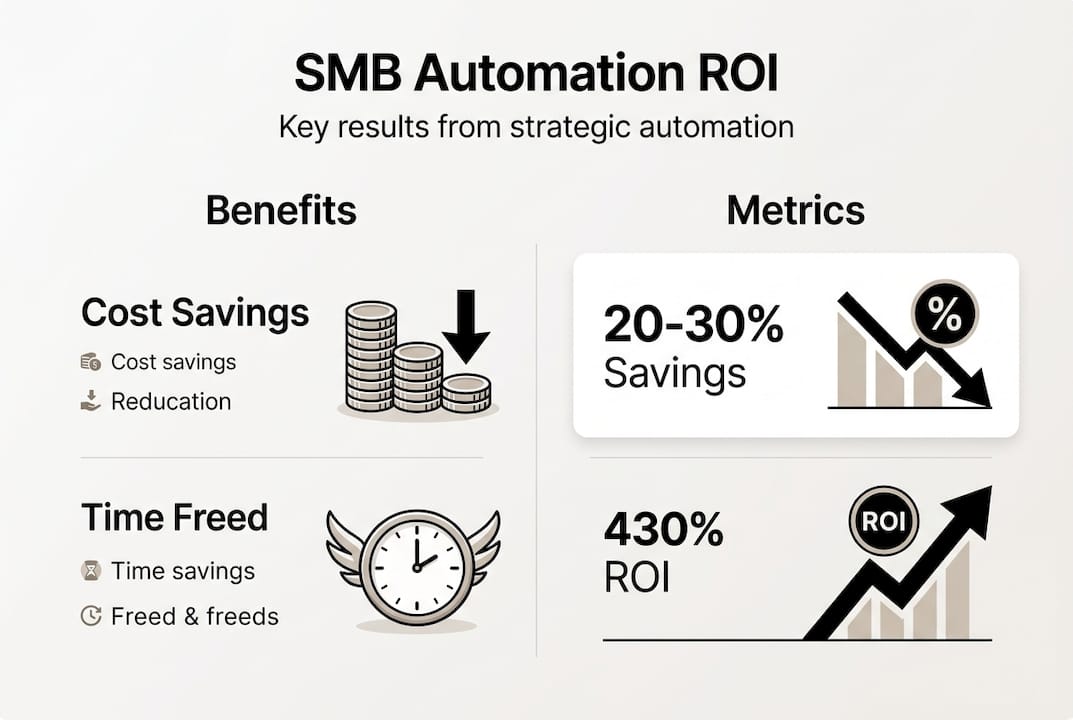
Most small and mid-sized business owners assume automation is a luxury reserved for corporations with deep pockets and dedicated IT teams. That assumption is costing you time, money, and competitive ground. Empirical benchmarks show that businesses implementing strategic automation achieve 20 to 30% operating cost reductions, with ROI ranging from 100 to 430% and payback periods as short as one month. These are not projections from software vendors. They are measured outcomes from real businesses. This guide breaks down what strategic automation actually means for SMBs, where it delivers the fastest wins, what it costs, and how to avoid the pitfalls that derail even well-intentioned efforts.
Table of Contents
- What is strategic automation and why it matters
- Core areas transformed by automation
- The real costs and ROI of automation
- Risks, pitfalls, and how to automate safely
- A fresh take: Automation is a tool, not a substitute for good process
- Take the next step with strategic automation
- Frequently asked questions
Key Takeaways
| Point | Details |
|---|---|
| Automation boosts ROI fast | Most SMBs achieve payback on automation in 1-8 months with significant time and cost savings. |
| Start where it matters | Focus early automation on repetitive tasks in operations and customer service for rapid impact. |
| Governance prevents risks | A clear framework for oversight and escalation is essential to avoid common automation pitfalls. |
| Technology complements process | Automation delivers best results when paired with strong, refined business processes. |
What is strategic automation and why it matters
Strategic automation is not about buying a tool and hoping it saves time. It is a coordinated, intentional approach to improving specific business processes through technology, applied where the impact is measurable and the risk is understood. That distinction matters enormously for smaller businesses.
Many SMB owners have tried ad hoc automation: a Zapier workflow here, an email sequence there, a scheduling tool bolted onto the side of operations. The result is a patchwork of disconnected systems that create new problems while solving old ones. Strategic automation is the opposite. It starts with understanding your workflows first, then applying the right technology to improve them in a deliberate sequence.
A common misconception is that automation requires replacing staff or overhauling your entire tech stack overnight. Neither is true. Workflow automation, AI integration, and orchestration across existing tools like CRM and ERP platforms are the core mechanics, and they can be layered in gradually without disrupting day-to-day operations.
For SMBs specifically, the case for strategic automation comes down to three compounding benefits:
- Cost and time savings: Fewer manual hours spent on repetitive tasks means your team focuses on higher-value work.
- Better productivity: Automated workflows reduce errors, speed up approvals, and keep processes moving without constant human intervention.
- Scalability: Systems that run automatically scale with your business without requiring proportional headcount increases.
You can learn more about the foundations in this business process automation guide built specifically for SMB operators.
"Strategic automation is not about doing things faster. It is about building a business that runs better, even when you are not watching."
The shift from reactive to strategic is where the real gains live. Businesses that treat automation as a continuous improvement discipline, rather than a one-time project, consistently outperform those that treat it as a shortcut.
Core areas transformed by automation
With a clear definition in place, the next question is: where does automation actually move the needle? The answer is broader than most owners expect.
Automation benefits operations, sales, marketing, HR, and customer service in ways that are measurable within weeks, not quarters. The most commonly automated workflows in SMBs include notifications, approvals, report generation, lead follow-up, invoice processing, and onboarding sequences.

Here is a before-and-after look at what strategic automation changes across key business functions:
| Business area | Before automation | After automation |
|---|---|---|
| Operations | Manual status updates, missed deadlines | Automated alerts, real-time dashboards |
| Sales | Leads falling through the cracks | Automated follow-ups, CRM updates |
| Marketing | Inconsistent campaign execution | Scheduled, triggered campaigns |
| HR | Paper-heavy onboarding, manual tracking | Digital workflows, auto-reminders |
| Customer service | Slow response times, repeated queries | Instant replies, routed escalations |
The numbers behind these improvements are compelling. Research shows businesses save 15 hours per week on average through automation, with UK small and medium enterprises reporting a median payback period of just 5 to 8 weeks. That is less than two months to recover your investment and start operating at a net gain.
Pro Tip: Do not start by automating everything at once. Identify your single biggest bottleneck, the task that eats the most time or causes the most errors, and automate that first. A fast, visible win builds team confidence and gives you a template for what comes next.
For a deeper look at where automation delivers the fastest operational returns, this guide on operational efficiency with automation walks through practical SMB examples with measurable outcomes.
The businesses seeing the strongest results are not automating everything. They are automating the right things, in the right order, with clear metrics attached to each change.
The real costs and ROI of automation
Understanding what automation costs, and what it returns, is where many SMB owners get stuck. The numbers are more accessible than most expect.
Research benchmarks show 20 to 30% operating cost savings, ROI between 100 and 430%, and payback periods ranging from one to eight months depending on the scope of implementation. Here is how those numbers break down in practice:
| Metric | Typical SMB range |
|---|---|
| Operating cost reduction | 20 to 30% |
| ROI | 100 to 430% |
| Payback period | 1 to 8 months |
| Weekly hours saved | 10 to 20 hours |
| Staff time redirected | 25 to 40% of manual tasks |
The upfront investment varies widely. Entry-level automation tools cost as little as $50 to $200 per month. More sophisticated AI-driven platforms with orchestration across multiple systems run higher, but the operating savings typically offset those costs within the first quarter.
To estimate your ROI before committing, follow these three steps:
- Map your manual hours. Calculate how many hours per week your team spends on repetitive, rule-based tasks. Multiply by your average hourly labour cost to get your baseline waste number.
- Identify your highest-impact process. Choose the workflow where errors or delays cost you the most, whether in lost revenue, rework time, or customer dissatisfaction.
- Estimate time savings conservatively. Assume automation captures 50 to 70% of manual effort in that process, then calculate monthly savings against the tool's monthly cost.
Even modest automations pay off quickly. A single automated invoice approval workflow, for example, can save a four-person team three to five hours per week. At $35 per hour, that is $420 to $700 in recovered labour monthly, often exceeding the cost of the tool itself.
For a broader look at how AI-driven approaches improve SMB profitability, and practical AI productivity tips you can apply immediately, both resources offer concrete frameworks worth exploring.
Risks, pitfalls, and how to automate safely
The financial case for automation is strong. But automation without guardrails creates new categories of risk that can quietly erode the gains you worked to build.
The most dangerous pitfall is scaling too fast. Businesses that automate five or ten processes simultaneously before validating any of them often find themselves managing invisible errors at scale. A misconfigured approval workflow, for instance, can silently skip steps for weeks before anyone notices. By then, the downstream damage is significant.
Without governance, automation risks outweigh benefits: implement observability, build escalation paths, and start small to avoid over-automation that compounds errors rather than eliminating them.
Here is a practical safety checklist before you automate any process:
- Document the process first. If you cannot describe the workflow step by step, you are not ready to automate it.
- Define your success metrics. Know exactly what improvement you expect and how you will measure it.
- Build in escalation paths. Every automated workflow needs a human override mechanism for exceptions.
- Set up monitoring from day one. Use dashboards or alerts to catch failures before they compound.
- Run a pilot before full deployment. Test on a small volume of transactions or a single team before rolling out broadly.
Pro Tip: Treat your first automation as a learning project, not a permanent solution. Review it after 30 days, gather feedback from the people using it, and refine before expanding. The businesses that automate sustainably are the ones that iterate, not the ones that set and forget.
The governance gap is the most overlooked risk in SMB automation. Staff need to understand what is automated, why, and what to do when something goes wrong. Without that clarity, errors go unreported and trust in the system erodes. For a structured approach, this SMB automation guide and this resource on how to improve team productivity with automation both address the human side of implementation.
A fresh take: Automation is a tool, not a substitute for good process
Here is something most automation guides will not tell you: automation does not fix broken processes. It accelerates them. If your customer onboarding is chaotic, automating it produces chaos faster. If your approval chain has unnecessary steps, automation locks those inefficiencies in permanently.
The businesses that get the most from AI automation for SMB productivity are the ones that treat automation as a mirror first. Before deploying any tool, they ask: does this process actually make sense? Could we redesign it entirely and then automate the better version?
Staff buy-in is equally critical and consistently underestimated. When your team does not understand why a process was automated, they work around it. They create manual workarounds that reintroduce the exact inefficiencies you were trying to eliminate. Continuous feedback loops, not just at launch but monthly, are what separate sustainable automation programmes from expensive experiments that quietly get abandoned.
The technology is the easy part. The discipline to refine your processes before automating them, and the culture to keep improving after, is where the real competitive advantage lives.
Take the next step with strategic automation
You now have the framework: what strategic automation is, where it delivers results, what it costs, and how to implement it without the risks that derail most SMB efforts. The next step is putting it into practice with tools built specifically for businesses your size.

HumanOS gives SMBs access to AI agents that automate email management, scheduling, document processing, customer support, and more, all through a self-guided onboarding system that requires no coding and no credit card to start. Paired with fully managed AI automation web services, HumanOS delivers a unified operational backbone that grows with your business. With a guaranteed 30% productivity improvement and a BBB A-rating backing every deployment, this is automation you can trust from day one.
Frequently asked questions
How quickly can SMBs see ROI from strategic automation?
Most small and mid-sized businesses see payback within 1 to 8 months, with many recovering costs in as little as 5 to 8 weeks depending on the scope and complexity of the processes automated.
What are the first processes SMBs should automate?
Start with repetitive, rule-based tasks in operations, customer communications, and reporting. Notifications, approvals, and reporting are the highest-impact starting points for immediate efficiency gains.
Can strategic automation be implemented without major IT investment?
Yes. Modern automation platforms orchestrate across existing stacks without requiring lock-in or full system replacements, making entry costs modest and accessible for most SMBs.
What is the biggest risk of automating SMB processes?
The most significant risk is over-automation without governance. Without proper monitoring, hidden errors compound silently, often causing more disruption than the manual process they replaced.