

TL;DR:
- Small and mid-sized businesses can achieve 30-40% IT cost reductions through structured digital infrastructure optimization.
- Implementing phased strategies like cloud migration, automation, and AI pilots can deliver rapid ROI within six months.
- Successful optimization requires thorough audits, proper governance, skill development, and balancing speed with resilience.
Most small and mid-sized business owners assume digital infrastructure optimisation is something reserved for enterprises with large IT budgets and dedicated tech teams. That assumption is costing you money. 30–40% IT cost reductions are achievable for SMBs that commit to a structured optimisation approach, often with payback in under six months. This guide cuts through the noise, defines what optimisation actually means for your business, shows you the numbers, walks you through proven strategies, and flags the risks you need to avoid. By the end, you will have a clear, actionable picture of how to move forward without wasting time or budget.
Table of Contents
- What does digital infrastructure optimisation mean?
- The business case: Quantifiable benefits of optimisation
- How optimisation works: Core strategies and AI-driven approaches
- Avoiding pitfalls: Common risks and how to build resilience
- The uncommon truth: Sustainable optimisation balances speed with resilience
- Ready to unlock your SMB's potential with AI-driven optimisation?
- Frequently asked questions
Key Takeaways
| Point | Details |
|---|---|
| Proven ROI, rapid gains | Most SMBs reduce IT costs by 30–40% and boost productivity by over 40% through optimisation. |
| Prioritise phased approach | Start with readiness audits and foundational changes before AI and automation rollouts. |
| Beware hidden risks | Transformation fails without readiness, proper governance, and skills assessment—avoid shortcuts. |
| Sustainability over speed | Balancing efficiency with resilience ensures long-term success and avoids system fragility. |
What does digital infrastructure optimisation mean?
Let's start with a plain definition. Your digital infrastructure is every technology system your business depends on to operate: cloud storage, communication tools, customer databases, accounting software, automation workflows, and any AI tools you have layered on top. Optimisation means making those systems work harder, faster, and cheaper, while eliminating the manual effort and redundant processes that drain your team.
For most SMBs, the pain points are familiar. You are paying for software no one fully uses. Your team is copying data between systems by hand. Legacy tools that were set up years ago are slowing everything down. Reporting takes hours because nothing talks to anything else. These are not minor inconveniences. They are compounding inefficiencies that quietly erode your margins every single week.
Modern digital infrastructure for an SMB typically includes these critical components:
- Cloud platforms for storage, computing, and collaboration
- Automation tools that eliminate repetitive manual tasks
- Data pipelines that connect your systems so information flows without human intervention
- AI agents that handle scheduling, customer support, document processing, and more
- Analytics dashboards that surface insights without requiring a data analyst
Crucially, optimisation is not just an IT project. It touches every business function. Sales, operations, finance, and customer service all benefit when your infrastructure is properly structured. Methodologies like phased cloud migration, process automation, and agentic AI pilots are now accessible to businesses of any size. Before you start, reviewing an operational efficiency checklist can help you identify exactly where your current setup is leaking value.
The business case: Quantifiable benefits of optimisation
Now that we know what digital optimisation is, let's explore the numbers that prove its value.

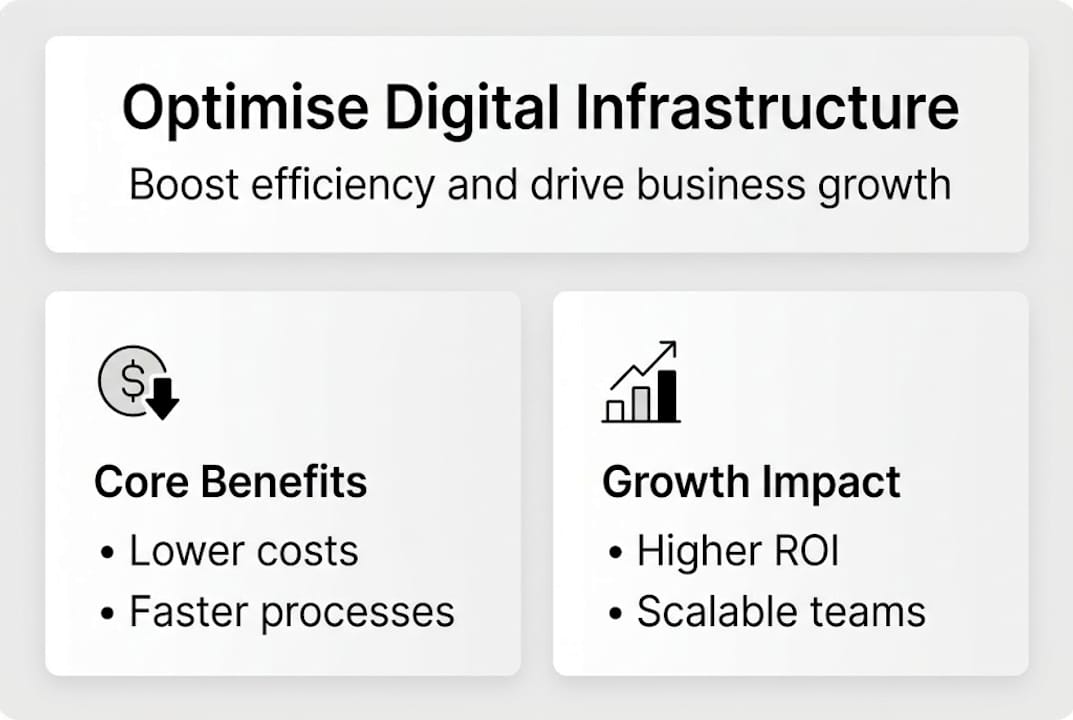
The ROI data for SMB digital optimisation is genuinely striking. AI-driven optimisation delivers 3 to 5 times productivity gains, with a documented 42% productivity lift and returns ranging from 200% to 1,893% depending on the process. Those are not projections. They are outcomes reported by SMBs that committed to structured implementation.
| Benefit area | Typical SMB gain |
|---|---|
| IT cost reduction | 30–40% |
| Productivity improvement | 42–80% |
| Revenue growth | Up to 27% |
| ROI range | 200–1,893% |
| Average payback period | Under 6 months |
SMBs that invest in AI-driven productivity strategies are not just cutting costs. They are building a competitive advantage that compounds over time. When your team spends less time on manual data entry and more time on client relationships and strategy, the downstream effect on revenue is significant. SMBs can achieve 27% revenue growth alongside those cost reductions, which means optimisation pays for itself and then keeps paying.
The scalability benefit is equally important. A business running on optimised infrastructure can grow without proportionally growing its headcount. That is the core efficiency lever most owners miss.
Stat to know: SMBs implementing structured AI optimisation report productivity lifts of 42% on average, with some processes delivering ROI exceeding 1,800%.
Pro Tip: Before you optimise anything, document your current costs and baseline metrics. Time spent per task, software spend, error rates, and support tickets. Without a baseline, you cannot measure your gains, and you cannot make the case internally for continued investment. A step-by-step AI productivity guide can help you structure that baseline assessment.
How optimisation works: Core strategies and AI-driven approaches
Seeing the ROI is motivating. Here is how SMBs can actually achieve it with proven strategies.
The most effective approach follows a phased roadmap rather than trying to transform everything at once. A realistic 18-month structure looks like this:
- Audit (months 1–2): Map every system, process, and data flow. Identify redundancies, manual steps, and cost centres.
- Prioritise (month 3): Rank processes by ROI potential and implementation complexity. Back-office functions almost always win.
- Cloud migration (months 4–6): Move legacy systems to cloud platforms to reduce infrastructure costs and improve reliability.
- Automation layer (months 7–12): Deploy no-code and low-code tools to eliminate repetitive tasks across operations, finance, and customer service.
- AI pilots (months 13–18): Introduce AI agents for scheduling, document processing, customer support, and data analysis. Measure and iterate.
Phased roadmaps, cloud-first strategies, no-code tools, and FinOps practices are the methodologies consistently recommended for SMB-scale implementation. Tools like Zapier for workflow automation and AWS SageMaker for AI model deployment make it possible to move fast without a large IT team.
| Approach | Best for | Speed to value |
|---|---|---|
| Plug-and-play tools (Zapier, etc.) | Quick wins, simple workflows | Days to weeks |
| Custom AI automation | Complex, high-volume processes | Weeks to months |
| Managed AI platforms | Full-stack optimisation | Immediate with expert support |
Explore AI workflow automation tips to identify which tools fit your current stack. You can also review AI tools for SMBs that are already saving operators 15 to 25 hours weekly.
Pro Tip: Start with back-office processes like accounts payable, scheduling, and data entry. These are high-volume, low-complexity tasks where automation delivers the fastest and most measurable ROI, and where errors from manual handling are most costly.
Avoiding pitfalls: Common risks and how to build resilience
Optimisation delivers major value, but it is critical to understand the risks and avoid common missteps.
The failure rate for digital transformations is sobering. 62% of digital transformations fail when organisations skip readiness assessments and governance planning. For SMBs, this often looks like adopting several new tools simultaneously, skipping staff training, and then watching adoption collapse within 90 days.
The most common risk factors include:
- Lack of readiness: Jumping into automation before auditing existing processes creates new chaos on top of old chaos.
- Poor governance: AI systems without clear rules and human oversight can produce errors that scale faster than manual mistakes ever could.
- Over-optimisation: Removing all redundancy from a system makes it fragile. When one component fails, everything stops.
- Skills gaps: Most SMB teams are not trained to manage AI tools, interpret outputs critically, or identify when an AI agent is producing unreliable results.
- Vendor lock-in: Building everything on a single platform without a backup plan creates dependency risk.
"AI errors can amplify without human oversight — skills gaps remain one of the highest-risk factors in SMB AI adoption." Hidden risks of AI automation are often invisible until they cause real damage.
Building resilience means running phased projects with clear checkpoints, retaining backup capacity for critical processes, and scheduling regular audits. Reviewing AI automation for SMBs best practices and staying current with AI productivity tips will help you stay ahead of emerging risks as your infrastructure evolves.
The uncommon truth: Sustainable optimisation balances speed with resilience
Most articles on digital optimisation push speed. Move fast, automate everything, adopt the latest AI tool. That advice works well in a case study and poorly in practice.
Here is what a decade of building business infrastructure has taught us: the businesses that sustain their gains are the ones that started with a thorough audit, not a tool purchase. They understood their own processes before they automated them. They layered on AI incrementally, kept humans in the loop at every critical juncture, and treated governance as a feature rather than a bureaucratic obstacle.
True optimisation is not about eliminating human judgement. It is about freeing your team from the tasks that do not require it, so their judgement can be applied where it actually matters. Speed without resilience creates fragility. Balancing growth and efficiency is the real competitive advantage, not just the fastest adoption curve.
Admit what you do not know. Skills gaps are real, and the businesses that acknowledge them early invest in training and expert support. Those that ignore them spend twice as much fixing problems that proper governance would have prevented.
Ready to unlock your SMB's potential with AI-driven optimisation?
If the strategies in this article resonate, the next step is straightforward. You do not need a six-figure IT budget or a team of developers to start seeing results.
HumanOS is built specifically for SMBs ready to stop patching together disconnected tools and start running on infrastructure that actually works. From AI agents that automate your daily operations to fully managed web services that continuously optimise your online presence, every offering is designed to deliver measurable gains fast. Explore the full range of AI automation services and see how quickly your business can move from firefighting to growing. No credit card required to start.
Frequently asked questions
What is the average time to ROI for SMBs optimising digital infrastructure?
Many SMBs realise full ROI within about six months of implementation, particularly when optimisation begins with high-volume back-office processes that have clear, measurable baselines.
How can I choose which processes to automate first?
Start with repetitive back-office functions like accounts payable, scheduling, or customer support. High-ROI back-office automation consistently delivers faster, more measurable returns before you expand into more complex workflows.
What are the most common reasons SMB digital transformations fail?
The main reasons are skipping a readiness assessment, underestimating skills gaps, and lacking clear governance. 62% of transformations fail without these foundations, and AI errors amplify quickly when proper oversight is absent.
Are no-code and low-code AI tools effective for SMBs?
Yes. No-code tools like Zapier and AWS SageMaker allow SMBs to deploy automation and AI agents without large IT teams, making them ideal entry points for businesses beginning their optimisation journey.
Recommended
- How AI drives SMB growth: efficiency, strategy, and real gains
- How to boost operational efficiency with AI automation
- Profitability optimisation: AI-driven strategies for SMBs
- The ultimate operational efficiency checklist for SMBs
- Digital Solutions in UK Construction: 5 Key Gains | BRCKS
- Mise à niveau hardware : fiabilité et efficacité en entreprise