

TL;DR:
- AI makes data analysis faster, more accurate, and accessible for small and mid-sized businesses.
- Proper implementation requires identifying key challenges, ensuring data quality, and human oversight.
- Successful AI use depends on cultivating good habits and combining automation with human judgment.
AI-powered data analysis is no longer a privilege reserved for large corporations with dedicated data science teams. Small and mid-sized businesses are now accessing the same calibre of insights that once required expensive infrastructure and specialist staff. Manual spreadsheets, slow reporting cycles, and gut-feel decisions are costing SMBs real money and competitive ground. This guide cuts through the noise to show you exactly when and how AI-driven analysis delivers a measurable edge, what the practical pitfalls look like, and how your team can get started without a data engineering background or a six-figure software budget.
Table of Contents
- The limitations of manual data analysis for SMBs
- How AI transforms data analysis for business impact
- When and where does AI for data analysis shine?
- How to implement AI-driven data analysis in your business
- Our perspective: The real key to using AI for data analysis in SMBs
- Unlock your business potential with AI automation
- Frequently asked questions
Key Takeaways
| Point | Details |
|---|---|
| Time-saving power | AI transforms analytics from a days-long task to insights delivered in seconds. |
| Actionable insights | AI uncovers patterns and trends manual review often misses, helping SMBs make better decisions. |
| Human + AI wins | Combining AI analytics with human judgement leads to the most reliable business outcomes. |
| Simple adoption path | SMBs can start small with AI for immediate wins and scale up with confidence. |
The limitations of manual data analysis for SMBs
For most small business owners, data analysis means exporting a spreadsheet, spending hours formatting rows, and hoping the pivot table tells you something useful. It rarely does, at least not fast enough to act on. Manual data analysis requires significant time and expertise, resulting in slower, less consistent decisions. That is not just an inconvenience. It is a structural disadvantage.
The core problem is that manual analysis creates a bottleneck at every step. Someone has to pull the data, clean it, interpret it, and then present it in a format that decision-makers can actually use. On small teams, that someone is usually you or a generalist employee who has three other priorities that day.
Here are the most common challenges SMBs face with traditional data analysis:
- Cost: Hiring a dedicated analyst is expensive and often impractical for businesses under $5M in revenue.
- Speed: Manual reporting cycles can take days or weeks, making insights stale before they reach a decision-maker.
- Accuracy: Human error in data entry, formula logic, or interpretation introduces risk at every stage.
- Scalability: As your data volume grows, manual methods buckle under the weight without proportional staff increases.
- Competitive lag: By the time insights are ready, market conditions may have shifted and the opportunity has passed.
Switching from manual methods to AI-driven analysis does not just speed things up. It fundamentally changes who can do the work and how quickly action follows insight.
Think about what this means in practice. A retail business tracking inventory trends manually might spend two full days preparing a monthly report. An AI tool can surface the same patterns in seconds, flagging anomalies and forecasting demand shifts before stock issues become customer complaints. The gap between those two realities is where AI in business efficiency starts to pay off.
How AI transforms data analysis for business impact
With the traditional pitfalls clear, let's see exactly how AI changes the game for your business. At its core, AI-driven data analysis relies on three capabilities that manual methods simply cannot replicate at scale: pattern recognition, predictive analytics, and natural language querying.
Pattern recognition means AI can scan thousands of data points and identify correlations that a human analyst would likely miss or take days to find. Predictive analytics uses historical data to forecast future outcomes, giving you a forward-looking view rather than a rear-view mirror. Natural language querying lets you ask your data questions in plain English (or French), without writing a single line of SQL code.

AI accelerates analytics at scales manual approaches cannot match, and natural language interfaces democratise insights across your entire team, not just the person who knows how to build a formula.
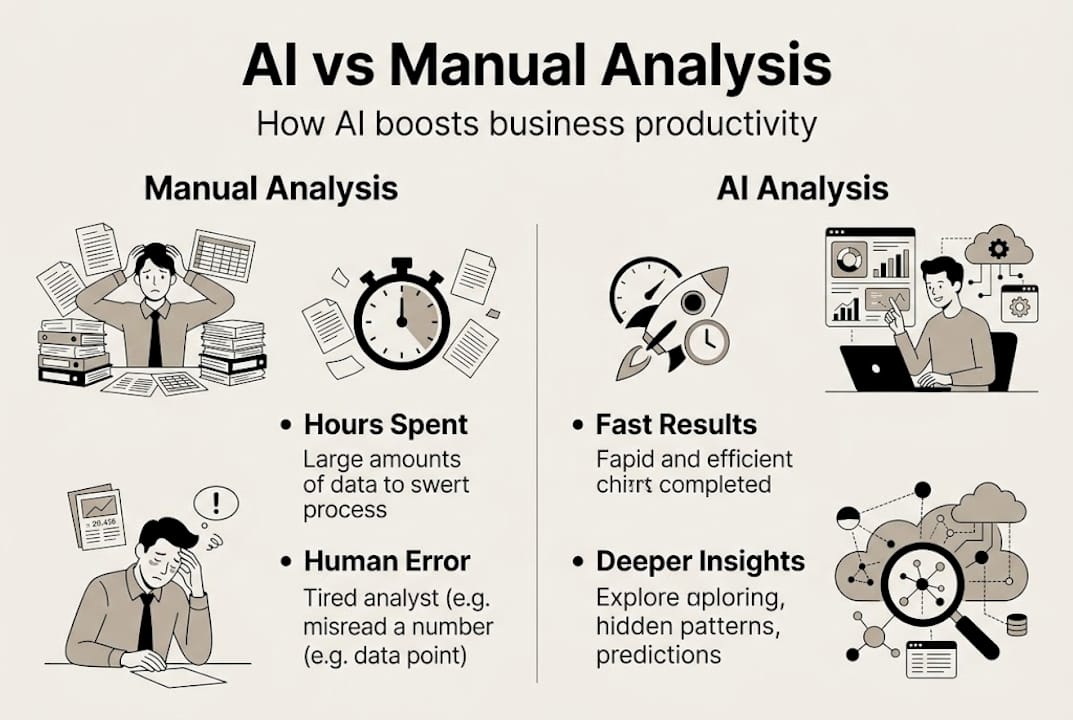
| Factor | Manual analysis | AI-driven analysis |
|---|---|---|
| Time to insight | Days to weeks | Seconds to minutes |
| Staff required | Specialist analyst | Any team member |
| Error rate | High (human input) | Low (automated validation) |
| Data volume handled | Limited | Virtually unlimited |
| Cost at scale | Increases linearly | Relatively fixed |
The business impacts are direct and measurable. Faster decisions mean fewer missed opportunities. Higher accuracy means fewer costly mistakes. Insights that surface automatically mean your team spends time acting, not digging.
Key benefits SMBs report after adopting AI-driven analysis:
- Reduced reporting time by 70% or more
- Identification of revenue leaks that were invisible in manual reports
- More confident pricing and inventory decisions
- Customer behaviour patterns surfaced without dedicated research budgets
For AI automation productivity, the return is clearest when teams stop treating analysis as a periodic project and start treating it as a continuous, automated process. That shift is what separates businesses that react to problems from businesses that anticipate them.
Pro Tip: You do not need an enterprise analytics suite to start. Many affordable, SMB-focused AI tools integrate directly with your existing CRM, POS, or accounting software. Start where your data already lives, and let AI for SMB growth layer on top of workflows you already trust.
When and where does AI for data analysis shine?
Knowing what AI can do, let's pinpoint where it delivers standout results for SMBs, and when caution matters. AI is not equally powerful in every situation. Understanding its sweet spots helps you direct effort and investment where results are most reliable.
AI performs best with unstructured data, pattern discovery, and rapid real-time forecasting. It excels in unstructured data and pattern recognition, but requires context and human oversight to deliver decisions that actually fit your business reality.
| Business problem | Manual method | AI-powered solution |
|---|---|---|
| Customer feedback analysis | Read and tag responses manually | Sentiment analysis in seconds |
| Inventory forecasting | Spreadsheet trend lines | Predictive demand modelling |
| Sales performance review | Monthly report, static | Real-time dashboard with alerts |
| Churn risk identification | Reactive, after cancellation | Predictive scoring before churn |
Scenarios where AI delivers the clearest wins for SMBs:
- Analysing customer reviews and support tickets for recurring themes
- Spotting inventory trends before stockouts or overstock situations occur
- Generating weekly sales forecasts without analyst involvement
- Identifying which marketing channels drive the highest quality leads
- Flagging unusual expense patterns that indicate billing errors or fraud
These are tasks that previously required either a specialist or a substantial time investment. AI tools saving time make them accessible to any operator who is willing to set up the pipeline once and let it run.
Pro Tip: The biggest risk with AI analysis is treating outputs as final answers. Every AI-generated insight should pass through a human checkpoint. Ask whether the recommendation makes sense given what you know about your customers, your market, and your operations. This is what separates smart AI use from the "black box" trap. Boosting operational efficiency with AI only works sustainably when humans remain in the loop.
How to implement AI-driven data analysis in your business
Now that you know when and where AI shines, let's get practical. Here is a straightforward implementation framework designed for SMBs without dedicated IT departments.
Data-centric preparation and human oversight are essential for businesses implementing AI. Skipping the groundwork is the number one reason early AI projects disappoint.
- Identify one core data challenge. Do not try to automate everything at once. Pick the single analysis task that consumes the most time or causes the most errors. Sales forecasting and customer feedback analysis are strong starting points.
- Audit your existing data. AI is only as reliable as the data it processes. Before selecting any tool, assess the quality, completeness, and consistency of your current data sources.
- Map your process flow. Document how data currently moves through your business. Where does it enter? Who touches it? Where do decisions get made? This map reveals where automation will create the most value.
- Select an AI tool suited to your scale. Look for tools that integrate with software you already use, offer SMB-friendly pricing, and do not require coding to configure. Many platforms offer trial periods.
- Run a pilot project. Apply the tool to your chosen use case for four to six weeks. Set clear success metrics before you start, such as time saved, accuracy improvement, or decisions made faster.
- Validate outputs with human review. Throughout the pilot, have a team member cross-check AI insights against known data or common sense. Adjust the tool's settings based on what you learn.
- Scale with confidence. Once the pilot demonstrates reliable results, expand the tool to additional use cases or data sources. Document what worked so onboarding future team members is straightforward.
For practical AI productivity tips, the pattern is consistent: businesses that pilot small, measure clearly, and validate thoroughly outperform those who buy big and implement broadly from day one.
Pro Tip: Data quality is not a one-time clean-up project. Build a simple monthly process to check for duplicate entries, missing fields, and format inconsistencies. Clean data going in means trustworthy insights coming out. It is the unsexy work that makes AI reliable. Pairing this discipline with tools that help improve workflows with AI creates a compounding advantage over time.
Our perspective: The real key to using AI for data analysis in SMBs
Here is our candid take after working with hundreds of small and mid-sized business operators: the businesses that get the most out of AI data analysis are not the ones with the best tools. They are the ones with the best habits.
AI is not a set-and-forget solution. The operators who win are those who pair automation with sharp human judgement. They review AI outputs with scepticism, ask whether the numbers align with what they know on the ground, and use those insights to spark better conversations, not to replace them.
The most common mistake we see? Expecting results before the data is ready. Teams rush to plug in an AI tool and are disappointed when outputs feel unreliable. Almost always, the culprit is messy, inconsistent source data, not a flawed tool.
Speed without context is just noise. The real power of AI analysis comes when human business knowledge wraps around the output and turns a trend line into a decision.
Small teams that validate AI outputs, ask sharp follow-up questions, and treat the tool as a starting point rather than a final answer consistently outperform those chasing fully automated pipelines. For profitability optimisation with AI, that human-in-the-loop discipline is not optional. It is the whole strategy.
Unlock your business potential with AI automation
If this article has made one thing clear, it is that AI-driven data analysis is no longer out of reach for your business. The tools exist. The frameworks are proven. The only variable is whether you take the first step.
At HumanOS, we have built an AI-powered operations platform specifically for small and mid-sized businesses that want real results without the complexity. Our AI agents handle data analysis, reporting, and operational workflows so your team can focus on decisions, not data wrangling. Whether you are starting from scratch or ready to scale, explore our AI automation for web services and see how seamlessly intelligent operations can fit into what you already do. No credit card required to start.
Frequently asked questions
What types of data analysis does AI handle best for SMBs?
AI excels at pattern recognition, forecasting trends, and analysing unstructured data like customer feedback, where manual methods are too slow and error-prone to keep pace.
Is AI data analysis affordable for smaller businesses?
Many modern AI tools offer scalable pricing for SMBs, with entry-level options that integrate into existing software without requiring dedicated technical staff or large upfront investments.
Does AI replace the need for human analysis?
No. Human oversight is essential to provide business context, validate AI-generated insights, and ensure that automated recommendations align with your actual goals and conditions.
How do I start using AI for data analysis in my business?
Identify one specific data challenge, choose an SMB-friendly AI tool, and run a focused pilot. AI reduces manual effort dramatically once a clean, validated workflow is in place.