

TL;DR:
- Content automation helps SMBs produce content faster and save up to $1.3 million annually.
- No-code AI tools enable small teams to automate content tasks like drafting, SEO, and distribution easily.
- Human oversight is crucial to avoid risks like brand voice drift, factual errors, and SEO penalties.
Content automation is not a luxury reserved for enterprise marketing teams with six-figure budgets. For small and mid-sized business owners, it is one of the most practical ways to produce more, spend less, and stop losing weekends to repetitive publishing tasks. Many SMB operators assume automation requires a developer, a data team, or months of setup. It does not. Modern AI-driven tools let you focus on strategy and creativity while the system handles the mechanical work, and the results are measurable from week one.
Table of Contents
- What is content automation?
- Why content automation matters for SMBs
- How to implement content automation without technical complexity
- Pitfalls, risks, and best practices in content automation
- A fresh perspective: Where most SMBs get content automation wrong
- Connect your SMB with smart content automation solutions
- Frequently asked questions
Key Takeaways
| Point | Details |
|---|---|
| Clear automation definition | Content automation uses AI and rules to streamline content planning, creation, and publishing so humans can focus on strategy and creativity. |
| Evidence-backed SMB benefits | Small and mid-sized businesses gain measurable speed, productivity, and ROI through content automation, often with minimal technical barriers. |
| No-code tool accessibility | SMB owners do not need coding expertise to get started; automation platforms are simple to integrate with current business workflows. |
| Hybrid model prevents pitfalls | Combining AI with human oversight avoids risks of factual errors, generic content, and loss of brand voice. |
| Measure beyond time savings | The best SMBs track automation success via revenue, creative quality, and engagement, not just hours saved. |
What is content automation?
Content automation is the use of AI and rule-based systems to handle the full lifecycle of content production, from idea generation through to performance reporting. It is not just scheduling social posts or using a grammar checker. It covers the entire pipeline.
According to HubSpot, full content automation spans planning, research, drafting, editing, publishing, distribution, and analytics. That means every stage where a human used to spend time clicking, copying, or reformatting can now be handled by a configured workflow.
The core methodologies involved include:
- AI-assisted ideation and drafting: Tools analyse your existing content, audience data, and search trends to suggest topics and generate first drafts.
- Automated SEO checks: Keyword density, meta descriptions, and internal linking are reviewed and flagged without manual audits.
- Workflow triggers: When a draft is approved, the system automatically formats it, schedules it, and distributes it across channels.
- NLP for semantic analysis: Natural language processing (NLP) reads your content to ensure it matches the intent of your target audience.
- Integration with existing tools: Your CMS, email platform, and analytics dashboard connect through APIs or no-code connectors.
Forrester's research on content engine maturity reinforces that core automation methodologies now include NLP-driven semantic analysis and deep integration with business tools, not just basic scheduling.
"The goal of content automation is not to replace your voice. It is to remove the friction between your ideas and your audience."
For SMBs, this matters because your team is small. Every hour spent reformatting a blog post for email or manually uploading to three platforms is an hour not spent on improving business workflows or closing sales. Automation hands that time back to you.
The practical takeaway is straightforward. Content automation does not mean you stop thinking. It means you stop doing the tasks that do not require thinking.
Why content automation matters for SMBs
The numbers behind content automation are striking, especially for smaller operations that assume the gains only apply at scale.
| Metric | Benchmark result |
|---|---|
| Content production speed | 40 to 60% faster |
| ROI from automation | 353% |
| Time savings per team | Up to 50% |
| Annual cost savings | Up to $1.3M |
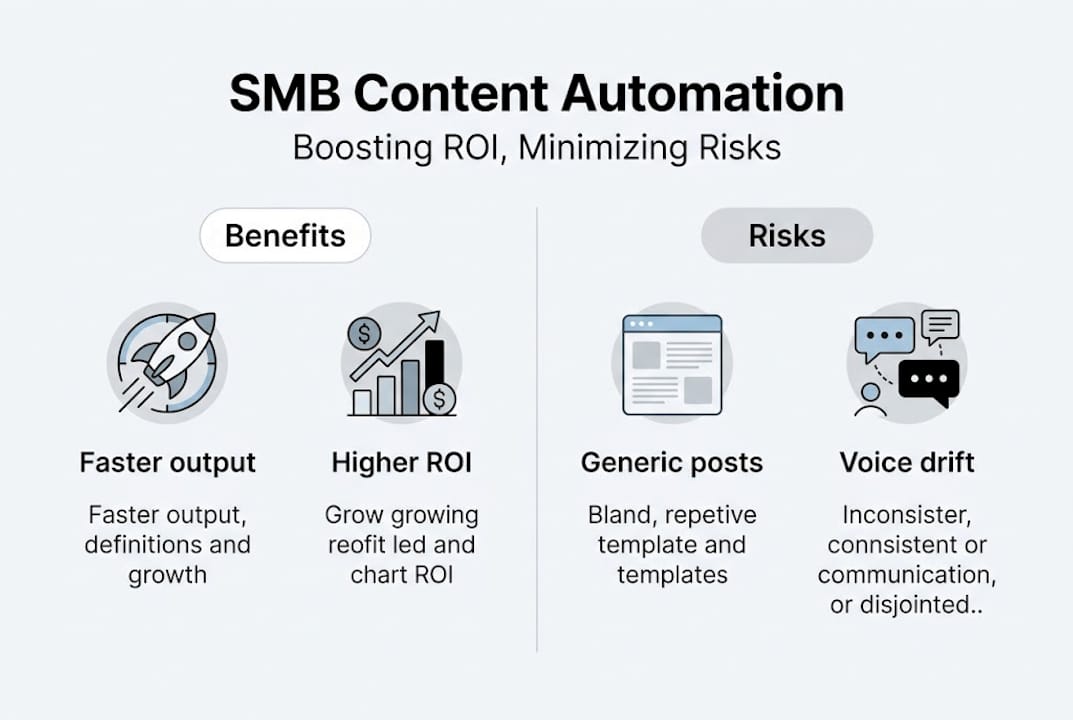
These are not projections. SMBs using AI content tools have documented 40 to 60% faster production, a 353% ROI, and up to $1.3M in annual savings. For a business running lean, even a fraction of those gains changes the operational picture entirely.

The OECD's research on SMB AI adoption found that empirical benchmarks show 450 hours saved per month, one person producing 130 posts over 26 weeks, and workflow time cut in half. That is not a team of 20. That is one operator with the right tools.
What this looks like in practice for SMBs:
- A single marketing coordinator can manage content output that previously required three people.
- Blog posts that took four hours to research, write, and publish now take under 90 minutes.
- Automated distribution means content reaches your email list, social channels, and website simultaneously, without manual effort.
- Analytics reports are generated automatically, so you always know what is performing without building spreadsheets.
The bottleneck for most SMBs is not ideas. It is execution. You know what you want to say, but the process of getting it out consistently is exhausting. Automation removes that bottleneck.
Explore AI productivity tools for SMBs that are already delivering these results, and see how SMB productivity with AI is reshaping what small teams can accomplish.
How to implement content automation without technical complexity
The biggest barrier most SMB owners cite is not cost. It is the assumption that automation requires technical expertise. That assumption is outdated.
Here is a practical implementation path that requires no coding:
- Audit your current content tasks. List every recurring content activity: blog writing, social posting, email newsletters, SEO updates. Identify which ones are repetitive and rule-based. Those are your first automation targets.
- Choose a no-code starting point. Platforms like HubSpot Content Hub, Jasper, or Make.com let you build automated workflows through drag-and-drop interfaces. No developer required.
- Start with drafting and SEO checks. These are the highest-time tasks and the easiest to automate first. Use AI to generate a first draft, then apply automated SEO scoring before human review.
- Build a human-in-the-loop review step. Every automated draft should pass through a human before publishing. This is not optional. It protects your brand voice and catches factual errors.
- Connect your CMS and scheduler. Once a draft is approved, your workflow should automatically format it for your website, schedule it, and trigger distribution across channels.
- Measure and refine weekly. Use your analytics integration to track what is working. Adjust your automation rules based on real performance data.
HubSpot's guidance on no-code implementation confirms that SMBs can start with drafting and SEO automation and layer in complexity over time, without needing a technical team.
Pro Tip: Do not try to automate everything at once. Pick one content type, get the workflow running smoothly, then expand. Quick wins build confidence and reveal where automation adds the most value for your specific operation.
For deeper guidance on building efficient systems, review these workflow automation tips and strategies for team productivity improvement that apply directly to content operations.
Pitfalls, risks, and best practices in content automation
Content automation delivers real results, but it also introduces risks that many SMBs do not anticipate until something goes wrong.
| Risk | Impact | Mitigation |
|---|---|---|
| AI hallucinations | Factual errors published | Human review before publishing |
| Brand voice drift | Content sounds generic | Style guide fed into AI prompts |
| Thin content | SEO penalties | Minimum quality standards enforced |
| Over-automation | Loss of uniqueness and trust | Regular content audits |
The most documented risks include AI hallucinations, voice drift, and SEO penalties for thin or repetitive content. When you automate without oversight, your content starts to sound like everyone else's. That sameness erodes trust over time.
Forrester's 2026 digital content analysis makes the contrast clear: pure automation risks deindexing and mediocrity, while hybrid AI drafts with human edits sustain rankings and amplify what humans do best.
The risks you need to actively manage:
- Factual inaccuracy: AI models can confidently state incorrect information. Always verify statistics and claims before publishing.
- Voice drift: Without a detailed style guide embedded in your prompts, AI-generated content gradually loses your brand's personality.
- SEO penalties: Search engines penalise low-quality, repetitive, or spun content. Automation that prioritises volume over quality will hurt your rankings.
- Over-automation: Removing all human judgement from the process leads to content that is technically correct but creatively flat.
Also consider the hidden costs of over-automation in marketing teams, including reduced team creativity and slower response to audience feedback.
Pro Tip: Schedule a monthly content audit. Read five to ten recent automated pieces out loud. If they do not sound like you, your prompts and review process need adjustment.
For a broader view of how to protect business efficiency with AI and understand the role of AI in business without introducing unnecessary risk, these resources offer practical frameworks.
A fresh perspective: Where most SMBs get content automation wrong
Most SMBs approach content automation as a volume problem. They want more posts, more emails, more output. So they automate everything and measure success by how many pieces they published this week. That is the wrong metric.
The SMBs that actually win with automation are measuring engagement rates, lead quality, and revenue attributed to content. They are not celebrating 130 posts. They are asking whether those posts converted.
We have seen this pattern repeatedly: businesses that audit for over-automation and prioritise human-in-the-loop review consistently outperform those running fully automated pipelines. The hybrid model is not a compromise. It is the strategy.
AI should handle the mechanical work. Humans should handle the judgement calls, the creative pivots, and the moments where your brand voice needs to say something that no prompt template can anticipate. That balance is what separates content that builds trust from content that fills a calendar.
Measure your automation by boosting profitability with AI, not just hours saved. Revenue and engagement are the real indicators of a healthy content operation.
Connect your SMB with smart content automation solutions
You now have the strategy, the benchmarks, and the risk framework. The next step is putting it into practice with tools built for businesses like yours, not enterprise teams with dedicated IT departments.

HumanOS is designed exactly for this moment. Our AI agents handle content creation, distribution, and analytics inside your existing workflows, with no coding required and no credit card needed to start. The platform's AI automation capabilities are built to deliver measurable results, with an average 80% boost in productivity and a guaranteed 30% improvement in profitability. Visit the HumanOS platform to explore how content automation can work for your operation, starting today.
Frequently asked questions
What are the easiest content automation tools for SMBs?
No-code platforms like HubSpot Content Hub and Make.com are ideal for quick wins in drafting and distribution, requiring minimal tech skills. They integrate with most existing business apps and can be configured without a developer.
How much money and time can content automation save?
SMBs typically see 40 to 60% faster production and up to 50% reduction in manual workflow time, with some businesses reporting over $1M in annual savings. Results scale with how consistently the automation is maintained and refined.
What's the biggest risk in automating content with AI?
Over-automation can lead to generic content, brand voice drift, and SEO penalties for thin content, so maintaining human oversight at the review stage is essential. A monthly audit of automated output helps catch quality issues before they compound.
Do you need technical or coding expertise to use content automation?
Most modern automation tools are designed for non-technical users and integrate with existing apps without requiring any coding knowledge. The setup process for leading platforms typically takes hours, not weeks.
Recommended
- Strategic automation for SMB productivity: 430% ROI
- Boost your SMB productivity with AI automation in 2026
- Top workflow automation tips to boost SMB productivity
- How AI drives SMB growth: efficiency, strategy, and real gains
- Why invest in digital marketing: boost growth & leads for SMBs
- How content hubs boost engagement: 60% conversion lift