

TL;DR:
- Successful AI onboarding for SMBs requires a structured, phased approach focusing on adoption metrics.
- Change management and executive sponsorship are critical to ensure effective AI implementation.
- Typical process improvements range from 10 to 40 percent in efficiency after structured onboarding.
Every small business owner we speak with says the same thing: "I know AI can help us, I just don't know where to start without breaking something." That feeling is valid. The pressure to modernise operations is real, the vendor noise is loud, and the fear of wasting time or budget on the wrong tool is enough to keep you stuck. This guide cuts through the uncertainty with a practical, structured onboarding framework built specifically for small and mid-sized businesses. You'll walk away knowing exactly what to prepare, how to execute each phase, what pitfalls to sidestep, and how to measure whether it's actually working.
Table of Contents
- What you need before you start
- Step-by-step AI onboarding process
- Common pitfalls and how to overcome them
- Measuring success: Key metrics and next steps
- Our perspective: Why SMBs win with pragmatic AI pilots
- Take the next step with streamlined AI onboarding
- Frequently asked questions
Key Takeaways
| Point | Details |
|---|---|
| Start with pilots | Begin with a low-risk pilot and measure adoption before assessing ROI for success. |
| 90-day onboarding plan | A well-structured onboarding process delivers measurable results for SMBs within three months. |
| Avoid common pitfalls | Overcome challenges like poor change management, rushing to scale, or ignoring governance issues. |
| Measure what matters | Track workflow adoption and weekly usage as your first success indicators before ROI. |
| Pragmatic pilots win | SMBs succeed by piloting focused, impactful automations rather than copying big enterprise strategies. |
What you need before you start
With the problem of where to begin now clearly defined, it's time to clarify what's required for a confident start. Most failed AI implementations don't fail because of bad technology. They fail because the business wasn't ready for it.
The first shift you need to make is a mindset one. AI onboarding is not an IT project. It's a process improvement initiative that happens to use technology. If you frame it as a systems upgrade, your team will treat it like a nuisance. If you frame it as a way to get back hours every week, they'll engage with it very differently. That framing matters enormously from day one.
Before you touch a single tool, you need executive sponsorship. Someone at the leadership level must own this initiative and communicate its importance clearly. Without that visible commitment, middle managers will quietly deprioritise it, and adoption will stall. Key methodologies emphasise starting with low-risk pilots, securing executive buy-in, aligning middle managers, and measuring adoption metrics before ROI.
Here's what your pre-onboarding checklist should include:
- Workflow inventory: List every repeated task your team does weekly. Email sorting, report generation, appointment scheduling, invoice follow-up. These are your candidates.
- Pilot candidate selection: Choose one or two low-risk, high-repetition workflows. Low risk means the consequences of an error are minor and correctable.
- Baseline data: Document how long the chosen workflows currently take, how often errors occur, and who is responsible. You need this for comparison later.
- Onboarding team: Include at least one person with business context (the process owner) and one with basic tech comfort. You don't need a developer.
- Governance basics: Decide who can approve AI-generated outputs before they're actioned. Even a simple two-person review process prevents early mistakes.
Understanding the AI onboarding basics before diving in helps you avoid the most expensive mistake of all: assuming your team will adapt on their own. Onboarding automation works best when the human side is structured first.
| Preparation element | Why it matters | Common mistake |
|---|---|---|
| Executive sponsorship | Drives accountability and removes blockers | Delegating entirely to a junior employee |
| Workflow inventory | Surfaces the best pilot candidates | Skipping this and starting with a complex process |
| Baseline data collection | Enables before-and-after measurement | Starting without benchmarks |
| Governance plan | Prevents errors from compounding | Assuming AI output needs no review |
| Cross-functional team | Balances tech and business judgement | Assigning to IT alone |
Pro Tip: Don't pick your most important process as your first pilot. Pick your most repetitive one. The goal of the first 30 days isn't transformation. It's evidence.
Step-by-step AI onboarding process
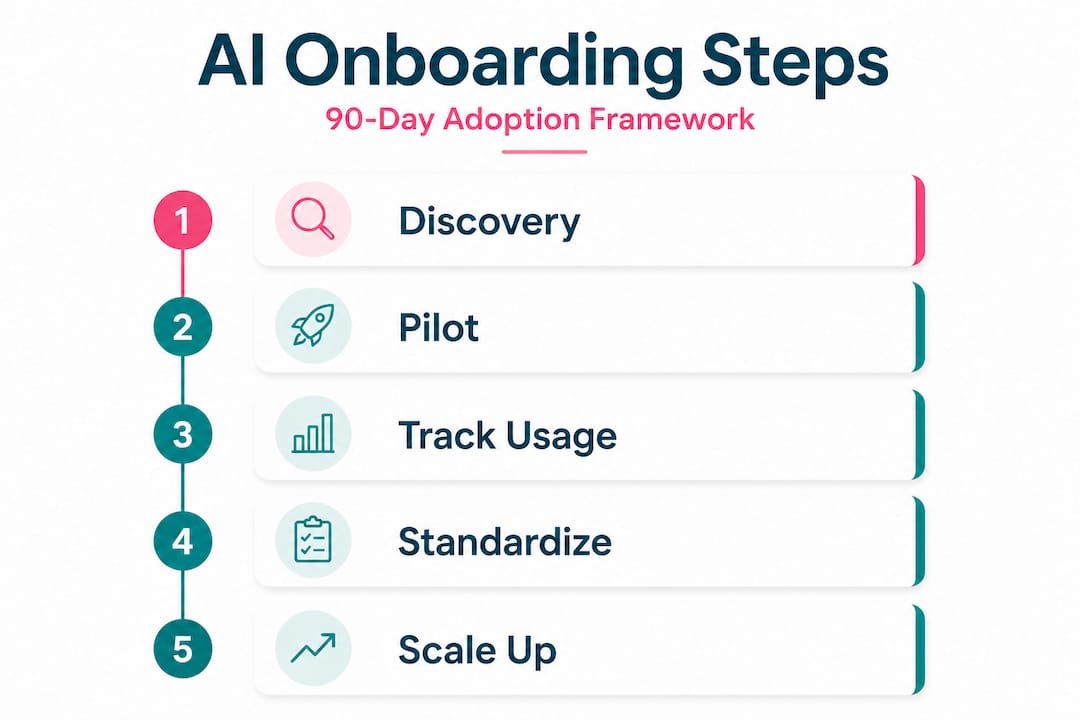
With the requirements and team in place, here's how to move through the actual onboarding process step by step. A 90-day framework structured across three distinct phases gives SMBs the right pace to build confidence without rushing.
1. Days 0 to 30: Discovery and baseline setup
Start by documenting your selected workflows in detail. Walk through each step as if explaining it to someone new. Where do inputs come from? What decisions get made? Where do handoffs happen? This process, called "as-is documentation," is often eye-opening. You'll discover inefficiencies before AI even enters the picture.
Set measurable goals for the pilot. Not vague goals like "save time," but specific ones: reduce invoice follow-up time by 50%, or cut email triage from 45 minutes to 15 minutes per day. These specifics give your team something real to aim for and make success undeniable when you hit them.
2. Days 30 to 60: Pilot phase
This is where you deploy AI in a contained, monitored workflow. Run the AI process alongside your existing one for the first two weeks. Don't replace the old way yet. Compare outputs side by side. Collect feedback from the people doing the work daily, not just managers. Ask specifically: where does this feel helpful, and where does it create more work?
Track usage carefully. Who is using the tool consistently? Who isn't? Low usage is your earliest warning sign of an adoption problem, and catching it at week five is far easier than catching it at month four. Use this phase to iterate quickly. Small adjustments to prompts, triggers, or review steps can dramatically improve how well the AI fits your actual workflow.

3. Days 60 to 90: Scaling up and establishing SOPs
Once the pilot produces consistent, reliable results, it's time to formalise. Codify what's working into a standard operating procedure (SOP). Document the setup, the review steps, and how errors are handled. Then train the rest of the relevant team on the SOP, not on the tool itself. People adopt processes better than they adopt software.
Expand cautiously. Move to the next workflow only after the first one is running without active supervision. This discipline is what separates SMBs that sustain AI gains from those who backslide after the initial excitement wears off. To improve team productivity sustainably, the secret is always about repeatable systems, not one-off wins.
| Phase | Timeline | Primary goal | Key output |
|---|---|---|---|
| Discovery and baseline | Days 0 to 30 | Document and measure | As-is maps, baseline metrics |
| Pilot | Days 30 to 60 | Test and refine | Usage data, feedback, early results |
| Scale and SOPs | Days 60 to 90 | Formalise and expand | SOPs, trained team, next pilot plan |
Reviewing productivity strategies for SMBs at each phase will help you benchmark your progress against what other businesses in your space are achieving.
Pro Tip: At the end of Day 90, hold a brief retrospective. Ask three questions: What worked? What didn't? What do we do next? This simple habit compounds your learning across every future AI initiative.
Common pitfalls and how to overcome them
Having outlined the steps, let's anticipate challenges and learn how to sidestep common roadblocks. Even well-planned implementations run into trouble. The good news is that the most damaging mistakes are also the most predictable.
Underestimating change management
Technology adoption is a human problem first. If your team doesn't understand why the change is happening, they'll find workarounds. Communicate early, often, and honestly. Explain what's changing, what's staying the same, and what's in it for them. When people see that AI removes tedious tasks rather than replacing their roles, resistance drops significantly.
Skipping or rushing the pilot phase
This is the single most common mistake we see. A business sees a compelling demo, gets excited, and tries to roll AI across multiple departments at once. Scope creep during onboarding is brutal. The pilot phase exists precisely to surface the unexpected. A constraint that only shows up in your specific workflow context won't appear in any vendor demo.
Measuring ROI before adoption is stable
Checking for financial return in the first 30 days is like stepping on the scale after one workout. Measure adoption first. What percentage of your targeted workflows now have AI involved? How many times per week is each team member interacting with the system? These metrics tell you whether the foundation is solid before you evaluate profit impact.
Neglecting governance and data privacy
This one has teeth. Governance gaps cause 41% of workflow incidents for SMBs adopting AI, even as optimists report 10 to 40% process gains. That's a wide spread, and it's almost entirely explained by whether businesses built governance into their rollout or bolted it on as an afterthought.
"The biggest differentiator between SMBs that succeed with AI and those that struggle isn't the tool they chose. It's whether they treated governance as a feature, not a footnote."
When improving workflows with AI, establish clear rules for what data the AI can access, who reviews its outputs, and how errors are logged and corrected. A simple one-page governance document reviewed at onboarding is enough to prevent most incidents. You should also consider how AI-generated outputs interact with client data, especially if you're subject to privacy regulations. Tools that help you streamline time tracking and document processing need to handle data with the same care as any employee would.
Measuring success: Key metrics and next steps
Once implementation is underway, keeping tabs on the right progress metrics ensures your efforts are paying off. The temptation is to look for a big revenue number immediately. Resist it.
The metrics that actually predict long-term AI success at the SMB level are simpler than most people expect:
- Percentage of targeted workflows with AI active: This is your adoption rate. Aim for 100% of your pilot workflows within 60 days.
- Weekly team usage frequency: Are people using the system consistently, or only when reminded? Consistent usage signals genuine utility.
- Time saved per task: Compare your baseline to current actuals. Even a 20% reduction in time for a task done 50 times a week is meaningful.
- Error rate change: Are AI-assisted outputs more or less accurate than the previous manual process? This is especially important for document processing and data entry.
- Employee feedback score: A simple weekly pulse (one to five rating, one open comment) gives you early warning of friction before it becomes resistance.
Measuring adoption metrics before ROI is the discipline that separates businesses that sustain gains from those that revert. Once your adoption metrics are stable, you can confidently layer in financial measurement.
What gains are realistic? Typical SMBs see 10 to 40% improvement in targeted process efficiency after structured AI adoption. At HumanOS, we see an average 80% productivity boost across our clients, because our onboarding is structured specifically to avoid the pitfalls that reduce results elsewhere.
Your next steps after Day 90 should include selecting the next pilot workflow, reviewing your SOPs for the first process, and identifying whether any governance updates are needed based on what you observed. Think of AI onboarding as an ongoing operating rhythm, not a one-time project. Businesses that treat it that way consistently see gains compound over time. Tracking efficiency and growth with AI over rolling 90-day periods gives you a clear picture of trajectory.
Our perspective: Why SMBs win with pragmatic AI pilots
With measurable success in focus, it's time for a fresh look at what really drives results for business owners like you.
Most AI adoption guides are written with enterprise budgets in mind. They assume you have a dedicated IT department, a change management officer, and months to run parallel systems before committing. If you're running a 15-person company, that model doesn't apply. And frankly, it doesn't need to.
SMBs have a structural advantage that enterprises rarely talk about: speed of decision-making. When an owner sees a process working, they can scale it in days, not quarters. When something isn't working, they cut it fast. That agility is an asset in AI onboarding. The key is directing that speed toward pragmatic, focused pilots rather than sprawling transformations.
Enterprises succeed via scale, but SMBs succeed via pragmatic pilots and a financial operations focus. This isn't just a philosophical distinction. It changes how you should prioritise your first AI use cases. Financial operations, meaning invoice processing, expense tracking, payment follow-up, and reporting, deliver immediate, measurable, and highly visible wins. They're also low-risk in terms of brand exposure if something goes slightly wrong.
One or two well-executed pilots do more for your organisation's AI culture than a broad rollout ever could. Why? Because your team sees it working. They stop viewing AI as a threat or a gimmick and start asking, "Can we do this for my process too?" That curiosity is the foundation of a business ready to automate its way to real competitive advantage.
We've watched businesses try to boost SMB productivity by automating everything at once and end up demoralised when adoption struggles. The businesses that win are the ones who celebrate small, visible, repeatable wins first. That culture of evidence-based optimism is what makes the next pilot easier, the one after that even easier, and eventually makes AI feel like a natural part of how your business operates.
Take the next step with streamlined AI onboarding
To make your onboarding journey easier, explore practical solutions built for businesses like yours.
You now have a concrete framework. But knowing the steps and executing them without friction are two different things. At HumanOS, we've built our platform specifically to remove the friction from every phase of this process for SMBs.
Our AI agents handle the workflows you documented in your inventory: email management, scheduling, document processing, customer support, data analysis, content creation, and time tracking. They deploy through a self-guided onboarding system that requires no coding and no credit card to start. Our web services complement that automation layer with a professionally managed digital presence that converts visitors into clients while you focus on operations. Whether you're at the discovery phase or ready to scale, HumanOS provides the structure, governance, and expertise your business needs to onboard AI with confidence and measurable results.
Frequently asked questions
How long does AI onboarding take for a small business?
Most SMBs can complete initial AI onboarding and pilot with measurable results in about 90 days using a structured framework, with the 90-day model covering discovery, pilot, and scaling phases sequentially.
What is the biggest barrier to successful AI onboarding?
The main challenge is often change management and getting staff to genuinely adopt new AI-driven workflows. Measuring adoption metrics before chasing ROI is the discipline that most businesses miss.
What kind of process gains can SMBs expect from AI onboarding?
Typical small businesses see 10 to 40% improvement in targeted process efficiency after structured AI adoption, with well-governed implementations consistently achieving the higher end of that range.
Do I need technical expertise to onboard AI successfully?
You don't need deep technical skills, but you do need a clear process, business context, and visible executive sponsorship to ensure the initiative stays prioritised and resourced across the full 90-day framework.