

TL;DR:
- Human-in-the-loop systems significantly reduce AI critical errors by 78 percent.
- The human layer acts as a quality gate for high-stakes automation tasks.
- Implementing HITL enhances reliability, compliance, and trust in small and mid-sized businesses.
AI automation promises efficiency, but removing human oversight from the equation introduces a risk most business owners don't see coming until something goes wrong. A misrouted customer email, an auto-approved contract with the wrong terms, a support bot that confidently gives the wrong answer — these aren't edge cases. They're predictable outcomes of pure automation running without guardrails. Research across 4.2 million tasks shows that human-in-the-loop (HITL) systems reduce critical errors by 78% compared to fully automated pipelines. This article breaks down exactly what the human layer is, how it works, and how you can apply it to make your AI automation far more reliable, without needing a software engineering degree to do it.
Table of Contents
- What is the human layer in AI automation?
- How does the human layer work? Core mechanics and tools
- Proven benefits: Why HITL delivers better reliability and outcomes
- Limitations and best practices: Where the human layer makes the biggest difference
- Getting started: How SMBs can adopt the human layer without coding expertise
- Why the human layer is your operational unfair advantage
- Upgrade your operations with human-layered AI solutions
- Frequently asked questions
Key Takeaways
| Point | Details |
|---|---|
| HITL enhances reliability | Adding the human layer can cut critical AI errors by over two-thirds without blocking productivity. |
| Not just for coders | Small businesses can adopt human-in-the-loop tools easily, even with minimal technical resources. |
| Best for complex tasks | Workflows with ambiguity—like support and compliance—benefit most from human oversight. |
| Focus on augmentation | Human and AI collaboration outperforms full automation for SMBs tackling high-stakes processes. |
| Start small, scale up | Begin with free plans and proven workflows, expanding HITL as your operations grow. |
What is the human layer in AI automation?
Now that you've seen why AI needs human guidance, let's get clear on what the human layer actually is, and isn't.
The human layer is not a manual workaround for broken automation. It's a deliberate design choice. It refers to the structured points in an automated workflow where a human reviews, approves, or corrects an AI's output before the process continues. Think of it as a quality gate woven directly into your digital operations.
Human-in-the-loop (HITL) is the underlying concept. It describes a system where human judgement is embedded at strategic moments in an otherwise automated process. That could mean approving an AI-drafted proposal before it gets sent, flagging an anomalous data entry, or confirming a high-value refund before it's processed.
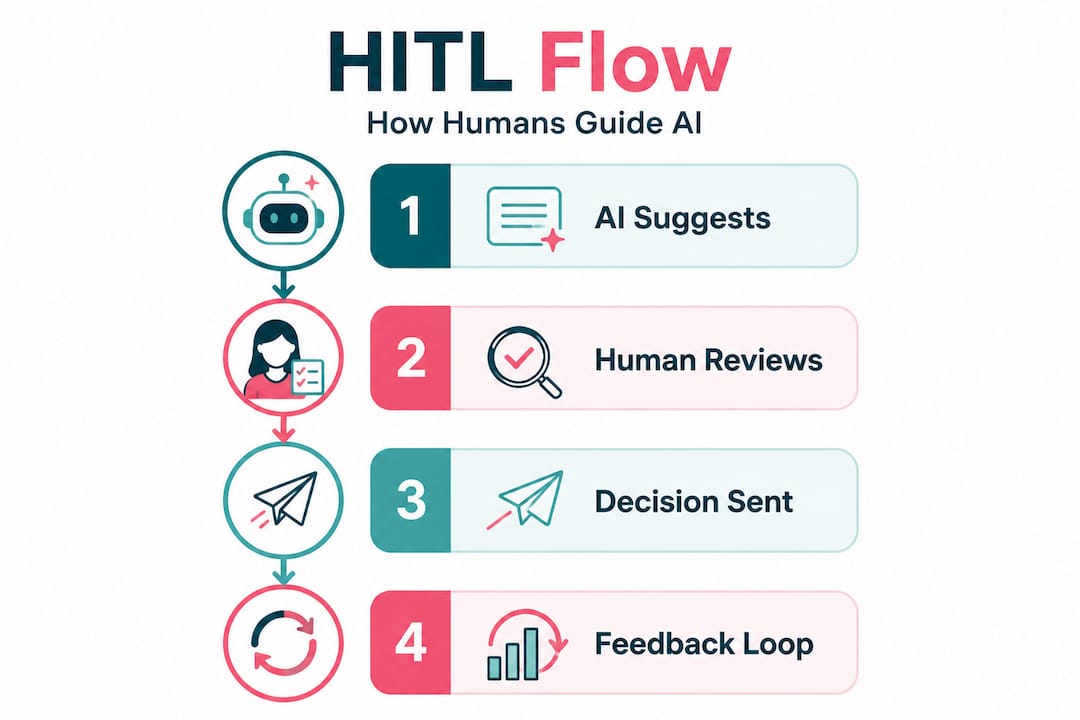
Why does this matter specifically for SMBs? Because the stakes of a single bad automated decision are proportionally higher when your team is small. A missed approval in a large enterprise might be absorbed quietly. In a 10-person operation, it can cost a client relationship or thousands of dollars.
Here's where the human layer typically plugs in for small and mid-sized businesses:
- Web services: Reviewing AI-generated content before it goes live on your site
- Customer support: Escalating ambiguous or sensitive tickets to a human agent
- Sales workflows: Approving AI-drafted proposals or discount offers before delivery
- Operations: Confirming automated data processing results before they're actioned
- Compliance: Flagging any automated outputs that touch regulated domains
Tools like HumanLayer are purpose-built for this. It's an open-source API and SDK that enables AI agents to integrate HITL approvals, feedback, and oversight directly into automation workflows, without the agent needing to be rebuilt from scratch. You can explore how this fits into broader multi-agent systems to understand where individual HITL checkpoints sit within larger automation architectures.
"Human oversight is not the opposite of automation efficiency. It's what makes automation trustworthy enough to scale."
The human layer turns AI from a liability into a reliable co-worker.
How does the human layer work? Core mechanics and tools
With the basics defined, here's how the human layer operates in real-world SMB contexts using popular tools.
At its core, HITL works by pausing an AI agent's action at a defined point and routing a request for human review through a communication channel your team already uses. No exotic dashboards required. No complex infrastructure.
HumanLayer's core mechanics include a "@hl.require_approvaldecorator that pauses high-stakes function calls until a human approves via Slack, Email, or Discord. There's also anhl.human_as_tool` option that allows the AI to request open-ended feedback from a human mid-task. It integrates with frameworks like LangChain and CrewAI, meaning it fits inside automation stacks that SMBs commonly use.
Here's a breakdown of the main HITL components you'll encounter:
| Component | What it does | Best use case |
|---|---|---|
| Approval decorator | Pauses AI action until a human approves | High-value transactions, contract sends |
| Human-as-tool | Allows AI to ask a human for input | Ambiguous queries, complex decisions |
| Escalation routing | Sends unresolved items to a human queue | Customer complaints, edge cases |
| Auto-approval rules | Skips review for pre-vetted low-risk tasks | Routine data entry, status updates |
| Omnichannel feedback | Routes requests via Slack, Email, Discord | Wherever your team is working |
Here's a straightforward path for an SMB to set up semi-automated approvals:
- Map your highest-risk automated tasks, the ones where a wrong output would be costly or embarrassing.
- Identify which of those tasks involve ambiguity or judgement calls that AI consistently mishandles.
- Choose your communication channel for approvals. Slack works well for teams that move fast.
- Integrate a HITL tool like HumanLayer via a freelance developer or managed platform.
- Set approval thresholds. For example, any automated email above $500 in value gets reviewed before sending.
- Monitor your approval queue weekly and identify patterns. Use those patterns to update your auto-approval rules over time.
Pro Tip: Use omnichannel feedback to meet your team where they already are. If your team lives in Slack, route approvals there. Forcing staff to log into a separate dashboard adds friction and delays, which defeats the point of keeping teams productive. The human touch in automation is most effective when it's frictionless.
The minimum technical barrier is lower than most SMB owners expect. A freelance developer familiar with Python or a managed provider can implement HumanLayer in hours, not weeks. And you don't need to understand the code to benefit from it. You just need to define where the gates go and who reviews what. That's a business decision, not a technical one. Pairing this with good workflow automation fundamentals will set you up for a clean, scalable implementation.
Proven benefits: Why HITL delivers better reliability and outcomes
Moving from how the human layer works, let's look at real data showing why it matters so much for your business.

The numbers are hard to argue with. Across 4.2 million automated tasks, organisations using HITL saw critical error rates drop from 23% to 5.1%. That's a 78% reduction in errors. The same data shows a 3x performance multiplier for human-augmented AI compared to pure automation across 1,500 organisations. One well-documented case involved a $280,000 contract that was saved because a human reviewer caught an AI-generated clause error before it was signed.
Here's how human-augmented AI stacks up against pure automation:
| Metric | Pure automation | Human-augmented AI |
|---|---|---|
| Critical error rate | 23% | 5.1% |
| Performance multiplier | 1x (baseline) | 3x |
| Compliance risk | High in regulated domains | Significantly reduced |
| Client trust factor | Variable | Consistently higher |
| Cost of failure | Often catastrophic | Contained by review |
The direct benefits for SMBs break down like this:
- Error reduction: Fewer costly mistakes in customer-facing communications and financial processes
- Prevented failures: Catching AI hallucinations before they reach clients or trigger real-world consequences
- Improved compliance: Human oversight becomes a structural safeguard in regulated industries like finance, healthcare, and legal services
- Better outcomes over time: Human feedback loops train AI systems to improve, creating a compounding effect on performance
One of the most underappreciated risks is what researchers call high-confidence hallucinations. AI models can score an average confidence of 0.87 on actions that are completely wrong. That's a system that's very sure of itself and very mistaken at the same time. In brownfield codebases (existing systems that weren't originally built for AI), this problem compounds because the AI lacks context about legacy logic. In regulated domains, human oversight is not optional; it's load-bearing.
"In domains with high ambiguity or compliance requirements, removing human oversight isn't efficiency. It's exposure."
Real SMB examples include: a customer support bot that confidently resolves the wrong issue and closes the ticket, a sales AI that sends a proposal with a pricing error, or a content agent that publishes copy with factually incorrect product claims. Each of these is preventable with a well-placed human checkpoint. This is directly connected to boosting profitability through risk-aware automation and achieving genuine operational efficiency rather than the illusion of it. The concept of cross-functional AI oversight reinforces this principle across team boundaries.
Limitations and best practices: Where the human layer makes the biggest difference
Seeing the benefits, it's just as important to understand where HITL excels and where to use it for the best results.
HITL is not a replacement for automation. It's an augmentation layer. The goal is never to route every single AI output through a human reviewer. That would eliminate the efficiency gains you're trying to capture. Pure automation without safeguards accumulates risk and technical debt, but over-indexing on approvals creates bottlenecks that slow your team down.
The workflows that benefit most from a human layer include:
- Customer support: Ambiguous complaints, escalation requests, and emotionally sensitive interactions
- Sales: Proposals, pricing adjustments, and high-value client communications
- Regulated domains: Anything touching finance, legal, healthcare, or personal data
- Ambiguous tasks: Situations where the AI lacks sufficient context to make a confident, safe decision
- Brand-sensitive content: Marketing copy, public-facing communications, and partnership materials
Key limitations to keep in mind before you build your HITL architecture:
- Cost per review: Every human touchpoint has a time cost. Be deliberate about what gets reviewed.
- Context engineering: AI agents need well-structured prompts and context to make good decisions in the first place. Garbage in, garbage out, regardless of the human layer.
- Legacy system compatibility: Older systems may need middleware to connect to HITL tools.
Best practices to maximise your HITL impact:
- Start with your highest-risk workflows, not your most frequent ones. A low-volume, high-stakes process benefits more from oversight than a high-volume, low-risk one.
- Audit your HITL presence every 90 days. Ask which decision points have shifted from high-risk to routine, and update your auto-approval rules accordingly.
- Choose feedback channels based on team behaviour, not preference. Where does your team actually respond fastest?
- Document every human override. These become the training data that improves AI performance over time.
- Review AI performance at review points. If approval rates are consistently at 98%, that task may be ready to automate fully.
Pro Tip: Don't treat every human approval as a permanent fixture. The goal is to learn from each override and progressively automate low-risk decisions. This is how you build a smarter system over time, not just a supervised one. Applying this to AI in customer support contexts is particularly powerful because support interactions accumulate rich feedback quickly.
Getting started: How SMBs can adopt the human layer without coding expertise
You now know the what and the why. Here's how any SMB can practically add a human layer to their automation.
The good news is that you don't need an in-house engineering team. There are several accessible paths to adoption:
- Plug-and-play HITL APIs: Tools like HumanLayer on GitHub offer open-source infrastructure with clear documentation. A freelance developer can implement this in a few hours.
- Managed platforms: Providers like HumanOS embed HITL principles directly into their agent architecture, so you get the governance without building it yourself.
- Freelance developer support: Platforms like Upwork and Toptal make it easy to find developers familiar with LangChain, CrewAI, and HITL integrations for one-off implementation projects.
Before engaging any vendor or developer, ask these questions:
- Which communication channels does your HITL tool support for approval routing?
- Can auto-approval thresholds be configured without code changes?
- How does the system handle approval timeouts? Does the AI pause, escalate, or proceed by default?
- What logging and audit trail does the tool provide for compliance purposes?
- Is there a free tier available to test before committing to a paid plan?
When onboarding, prioritise process mapping first. List every automated workflow in your operation, assign a risk rating to each, and identify the two or three that would benefit most from a human checkpoint immediately. Start there. Don't try to instrument everything at once.
Most SMBs can start with a free or low-cost plan. HumanLayer, for instance, offers a free tier suitable for small teams handling up to 100 operations per month. This is more than enough to test HITL on your most critical workflow before scaling. Pair this with disciplined time tracking automation so you can measure exactly how much time the human layer adds versus the errors it prevents.
Why the human layer is your operational unfair advantage
With practical steps in hand, let's step back and look at why this approach fundamentally shifts your competitive position.
Most SMBs chasing automation are chasing the wrong goal. They want to remove humans from the loop entirely, believing that's where efficiency lives. The data says otherwise. Designing HITL as structural infrastructure rather than an afterthought is what separates businesses that scale confidently from those that accumulate silent, compounding errors.
Here's what most automation guides miss: human oversight is not a bottleneck. It's a feedback engine. Every approval, every correction, every override teaches your AI what "good" looks like in your specific business context. That context cannot be pre-loaded from a generic model. It has to be earned through interaction. The businesses that build this systematically will have AI systems in two years that are dramatically more accurate and aligned than those running on pure autopilot today.
The contrarian truth is that full autonomy is a liability, not an achievement. A confident AI making wrong decisions at scale is worse than a slower system with human checks. Speed without accuracy is just expensive noise. Incorporating business workflow best practices alongside your HITL design creates a system that genuinely compounds in performance, not just in volume.
The SMBs winning with AI in 2026 are not the ones who automated the most. They're the ones who automated the right things, kept humans in the loop on the right decisions, and built feedback systems that make their AI smarter every week.
Upgrade your operations with human-layered AI solutions
If this sounds like the operating model you've been looking for, you're closer than you think to getting there.
HumanOS is built specifically for SMBs that want the performance of AI automation with the reliability of human oversight baked in. Our MCP-powered agent architecture keeps AI explainable and governed, so you're never flying blind. From email management and customer support to document processing and web services, every workflow is designed with the human layer in mind. Explore our AI automation for web services or visit HumanOS to start your free trial today. No credit card required, no coding needed, and results guaranteed within 30 days.
Frequently asked questions
What types of SMB tasks benefit most from the human layer?
Customer support, sales, and compliance processes benefit most because they involve ambiguous or high-stakes decisions where AI errors carry disproportionate consequences.
Do I need a software developer to add the human layer to my SMB automation?
Not necessarily. HumanLayer's developer-friendly tools make it accessible with minimal technical help, and managed platforms like HumanOS eliminate the need for in-house development entirely.
How much does it cost to get started with HITL AI tools?
Many tools offer a free starter plan suitable for small teams, with paid options scaling as your usage grows. HumanLayer's free tier covers up to 100 operations per month, making it a low-risk starting point.
Is the human layer necessary if my AI is already accurate?
Yes, because even high-accuracy AI systems produce high-confidence hallucinations, averaging a 0.87 confidence score on incorrect actions. The rare but costly error is exactly what the human layer is designed to catch.
Recommended
- Boost your SMB productivity with AI automation in 2026
- How to boost operational efficiency with AI automation
- How AI drives SMB growth: efficiency, strategy, and real gains
- Top AI productivity tools saving SMBs 15-25 hours weekly
- How We’re Using AI to Make Localization Faster – Without Losing the Human Touch - Gleef